Carag and James Bridger’s transformation-mentoring relationship
WoodwalkersCarag and James Bridger’s transformation-mentoring relationship turns school discipline into personal care: the teacher who first checks Carag’s impulse to break the rules later helps him master transformations that may determine whether he survives. Their bond remains discreet and constrained by the school’s authority structure, but its practical lessons carry Carag from classroom regulation to a life-threatening encounter in the wild.
From discipline to personal attention
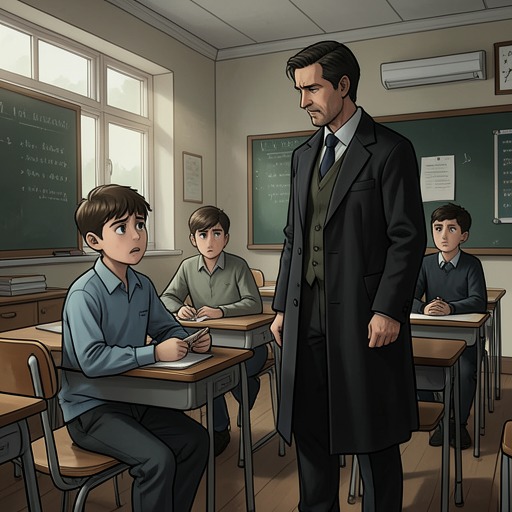
When Carag first clashes with Jeffrey and the other wolves, James Bridger intervenes before the confrontation becomes a student fight. He reminds Carag that transformations during school hours require a teacher’s permission and that student fights are allowed only in the designated class. Carag, who has arrived that day, admits he has not yet read the rules Lissa Clearwater gave him. Bridger’s response establishes him initially as an adult responsible for enforcing Clearwater High’s boundaries, not as a private confidant.
That authority becomes more personal later. After a difficult weekend, Carag follows Bridger toward the river, unsure whether the coyote wants company or solitude. Bridger asks whether Carag would like to hear a story. The movement from the school setting to a quiet walk beside the river makes room for an exchange that is less disciplinary: Bridger speaks about his own history, and then addresses Carag’s particular difficulty with becoming a rule-abiding woodwalker.
A discreet transformation mentor
Bridger tells Carag that he must learn to master his transformations, warning that a predator like him may not get another chance if he cannot. Carag responds that he has been trying for years and brings up Isidore Ellwood, whose instruction has not resolved the problem. Bridger acknowledges that working with Isidore is difficult and offers to help instead. Carag’s relief makes clear how much the offer matters to him.
The arrangement is deliberately private. Bridger does not want to offend Isidore, so he asks Carag to keep their additional lessons secret. He schedules their first practice for half an hour before breakfast the next day. This is more than informal encouragement: Bridger takes on a concrete teaching role while trying not to undermine another instructor. The secrecy also shows the limits around their relationship. He can help Carag, but not openly replace or challenge the existing teacher.
Their exercises address the connection between fear and transformation rather than treating shifting as a purely technical task. On one lesson by the river, Bridger fills a bucket with icy water and raises it over Carag, who instinctively jumps back. Bridger tells him to stay put, keep breathing, and concentrate on slow breaths. Carag understands the exercise as practice in relaxing deliberately while facing a threat. Bridger then pours the water onto a willow instead of Carag. The lesson’s test is therefore not the cold itself but Carag’s attempt to remain composed under its anticipated threat.
Advice when the lessons must stop
The private training cannot continue indefinitely. Bridger leaves Carag a note under his door explaining that they must stop because he does not want Isidore to resign. Rather than leave Carag with no further guidance, he gives him a technique to try: pair the human transformation with one distinct smell and the puma transformation with another. Because woodwalkers have a stronger sense of smell than humans and odors affect them strongly, the associations may help Carag shift even when his mind is clouded. Bridger attributes the method to a fox woodwalker friend who swears by it, presenting it as a practical tip rather than a guaranteed cure.
The note makes the interruption of the lessons explicit, but it also extends the mentorship beyond face-to-face practice. Carag worries that this is Bridger’s last useful trick and wonders whether the method will work without his help. With the midyear exams approaching, the advice arrives under pressure: Carag has little time to learn to control a difficulty he has struggled with for years. Bridger cannot remove that uncertainty, but he gives Carag something specific to test on his own.
From school practice to survival
Bridger’s teaching is not confined to transformation exercises. Before the exam in Fighting and Transformation, he praises Carag’s stealth, and Theo admits he neither saw nor smelled the young puma. The exchange connects Carag’s developing control to an observable skill: he can move unnoticed even by an experienced observer. The exam itself gathers new students in the assembly hall to demonstrate what they can do, placing such abilities within the school’s formal evaluation of its pupils.
The stakes become more immediate when Carag is pursued by hunting dogs far from the school’s safe territory. During hunting season, a license is enough to kill a puma, and Carag recognizes the danger as the dogs close in. He uses a tracking trick he has heard about at school, doubling back along his own tracks before jumping from them onto a tree and then a rock. He reaches a river and enters the water to disrupt his scent trail. The episode does not establish that Bridger personally taught him each tactic; it does show Carag drawing on school learning under genuine threat, in circumstances where composure and practical knowledge matter more than an exam result.
After a hunter shoots him, Shadow guides the limping Carag toward the nearest road. James Bridger rushes from the school van to meet him, while Sherri Rivergirl helps wrap him in a blanket and get him into the vehicle. Later, Carag tells Bridger that he believes the teacher’s advice saved his life. Bridger answers with a wry reference to the breakfasts he had missed for their early lessons. The exchange gives the relationship a clear consequence: the effort Bridger spent teaching Carag has, in Carag’s understanding, become directly bound to his survival.
The relationship’s significance
Their relationship moves through distinct forms of care: public correction, private instruction, advice left behind when instruction must end, and urgent assistance after Carag is hurt. Bridger does not simply free Carag from the rules; his first response is to enforce them. His later help also respects institutional constraints, stopping when continuing might drive Isidore to resign. Within those limits, however, he recognizes that Carag needs more than a warning to behave: he needs control of transformations, a way to manage fear, and methods he can use without a teacher beside him.
Carag’s final acknowledgment completes the relationship’s practical arc. The lessons began with a threat that a predator who could not master transformation might not get another chance; after the pursuit, Carag returns to that concern in concrete form, crediting Bridger’s counsel with helping him stay alive. Their connection is therefore defined less by formal authority than by the transfer of usable knowledge—and by Bridger’s willingness to keep helping, even when the help has to be secret, limited, or delivered at the roadside.