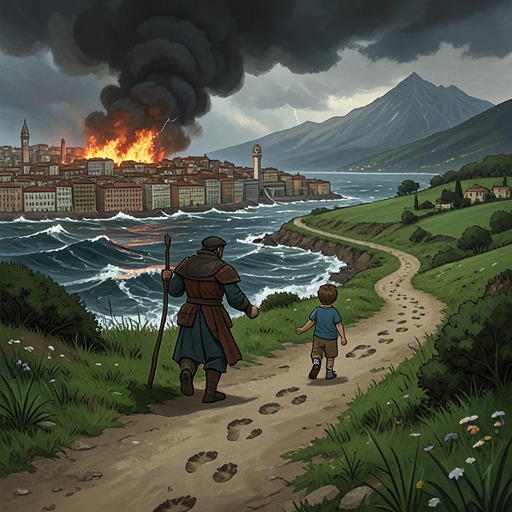
Aeneas's Escape from Troy
AeneidAeneas's Escape from Troy is the crisis in which Aeneas learns that courage cannot mean remaining blindly amid a city’s destruction. As Troy collapses under hostile gods, divine fire, and the violence of battle, Venus intervenes, redirects him toward his trembling spouse and his father Anchises, and makes escape—not victory—the form that duty must take. The action therefore preserves both life and lineage: Aeneas leaves a ruined homeland carrying Anchises, protecting Ascanius, and bearing the surviving promise of the Trojan people.
Divine Intervention and the End of Resistance
Aeneas begins from the position of a fighter still trying to defend Troy, but Venus stops the destined blow before it can be struck. She takes his hand and addresses him as her son, presenting his continued struggle as madness and neglect rather than honorable persistence. Her intervention changes the meaning of the surrounding battle. The city is not merely losing a human war; Jupiter has supplied the enemy with fresh courage, and the partial deities are arming themselves against Troy. Since divine power has already determined the town’s ruin, Aeneas’s labor has become fruitless.
Venus’s command is urgent and practical. She tells Aeneas to hasten to the place where his spouse and sire await him, promising that a mother’s care will befriend his passage. The appeal joins supernatural knowledge to family obligation. Aeneas is not released from responsibility; he is shown where responsibility now lies. The warrior’s first task is no longer to hold the walls but to carry forward the people and relationships that catastrophe would otherwise erase.
Escape Through Fire and Ruin
In Aeneas’s own retrospective account, the passage away from Troy is marked by the unusual withdrawal of danger before Venus. He escapes through enemies and fire, while foes and flames retire before the goddess. The scene presents escape as neither effortless nor merely physical: the threatened survivor can pass only because divine protection opens a narrow route through destruction. Aeneas’s movement is thus a reversal of the battle stance imposed on him. He does not conquer the burning city; he is permitted to survive its fall.
The ruined city supplies the escape with its most visible emblem. Aeneas describes the structure collapsing as its roots can no longer sustain the weight above, after which it falls and spreads ruin across the plain. This collapse converts Troy from a defended civic space into a landscape of disintegration. The passage through it is a passage between historical states: Aeneas leaves the world in which Trojan identity was anchored in a city and enters the uncertain condition of exile, where identity must be carried in bodies, memory, and inherited duty.
Anchises, Ascanius, and the Ethics of Carrying
The escape is defined by the arrangement of generations. Aeneas’s concern is explicitly not for himself but for the charge he bears, and the danger that seizes him is fear for those entrusted to him. Anchises, aged and dependent, must be carried; Ascanius must be protected; and the household must be brought through a city where every shadow may conceal pursuit. Aeneas’s physical burden becomes the visible expression of his pietas: filial duty, paternal protection, and public responsibility converge in one act of carrying.
The action’s importance lies in its refusal to treat survival as private self-preservation. Aeneas does not simply flee alone from a losing battle. He organizes what prudence can provide, clothes his shoulders with a lion’s hide and yellow spoils, and prepares himself to bear the weight of the family. The disguise and covering also bind his escape to the remnants of heroic violence: the warrior’s spoils are repurposed as equipment for protection and endurance. What once signified combat now helps sustain a household in flight.
From Ruined Gate to Uncertain Future
Even after Venus has opened the way, the escape does not become secure. Aeneas reaches the ruined gate at last and believes the danger past, only for a frightening noise of trampling feet to break that expectation. The episode therefore preserves the instability of flight. Safety is provisional, and every apparent threshold may conceal another threat. The ruined gate is both a physical exit and a narrative threshold: beyond it lies not restoration of Troy but the long ordeal of Trojan exile.
The repeated language of haste gives the action its rhythm. Venus urges Aeneas away from fruitless labor; Aeneas orders his preparations; the family must move before the collapsing city and advancing enemies close the route. Escape is consequently an active discipline rather than passive surrender. Aeneas must recognize the change in circumstances, accept assistance from Venus, gather the vulnerable, and continue despite fear. The value at stake shifts from martial honor to the preservation of life and succession.
Narrative and Thematic Significance
Aeneas’s Escape from Troy establishes the pattern by which Aeneas will fulfill his larger destiny. The scene joins a rescue plot to a quest plot: the immediate objective is to save Anchises, Ascanius, and the household, while the wider consequence is to carry Trojan continuity beyond the city’s destruction. The hero’s apparent retreat becomes the first movement toward the future associated with Italy and Rome. In that sense, the fall of Troy does not end Aeneas’s story; it forces its true form to begin.
The episode also defines the conflict between furor and pietas. Battle invites Aeneas to answer ruin with more violence, but Venus teaches him that persistence without purpose is madness. His greatness is measured not by the number of enemies he can confront in the final hours of Troy, but by his ability to abandon a doomed objective when the survival of others demands it. The escape gives epic dignity to endurance, caretaking, and obedience to a destiny that cannot yet be seen.
Finally, the scene makes loss inseparable from continuity. Aeneas passes through enemies, flames, collapse, and renewed alarm, yet he does not preserve Troy as a place. He preserves its persons, obligations, and future claims. The city falls behind him, while Anchises and Ascanius make the past and the future physically present in his flight. Aeneas’s escape is therefore both an ending and a foundation: the last act of Troy’s defender becomes the first act of the founder-in-exile.