Fragmentation and collapse of Russian state authority
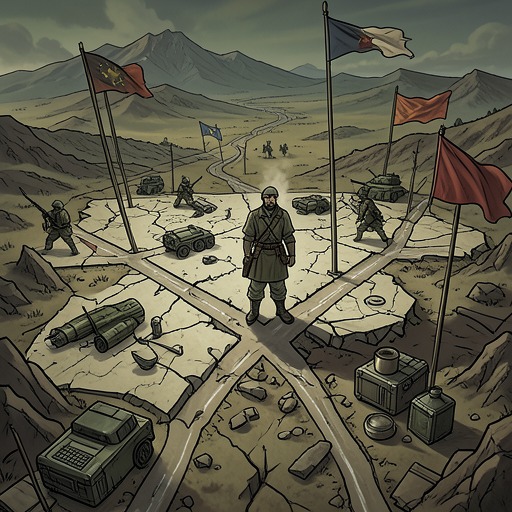
AfterburnFragmentation and collapse of Russian state authority describes the disintegration of the revived Soviet Union into civil conflict, separatist revolts, and a widening international crisis. The breakdown is not a single transfer of power but a succession of failed settlements: economic and political reforms lose control of events, a compromise regime fails to restore stability, and rival armed factions fight as former Soviet states assert independence. The resulting vacuum draws in outside powers, while making the distinction between peacekeeping and intervention increasingly difficult to sustain.
From failed reform to renewed war
The crisis begins with the collapse of the old Soviet Union after Gorbachev withdrew from Europe and lost control of reforms intended to limit the damage of a failing economy. The account then describes an attempt to restore order: Yeltsin is ousted, and a figurehead ruler in the Gorbachev mold is installed to head a revived Soviet Union. That settlement proves unable to stabilize the country. The real leaders of the new Union turn to war as a means of changing the balance of power, replacing political repair with an attempt to impose change by force.
The choice brings no durable unity. A later reflection presents the gamble in Norway as the final blow to the Motherland, following a naval reversal described as the most devastating upset of naval power since the destruction of the Japanese carrier fleet at Midway. The strategic failure coincides with a new domestic rupture: Leonov seizes control from the discredited hard-liners, but his rise does not reunify the state. Instead, Leonov’s Popular Democratic Front, the Blues, are locked in all-out civil war with Marshal Krasilnikov’s Reds. The language of a revived Union thus persists even as its governing authority and military power divide between hostile claimants.
Civil war and the centrifugal breakup
The conflict spreads beyond a contest between rival leaders. The Reds and Blues battle in the streets of Moscow and in a hundred other Russian cities, while the nation slides toward what the narrative calls total anarchy. The geographical scale matters: the crisis is not confined to a capital or a front line but reaches across the country, turning the struggle over central power into a broad collapse of order.
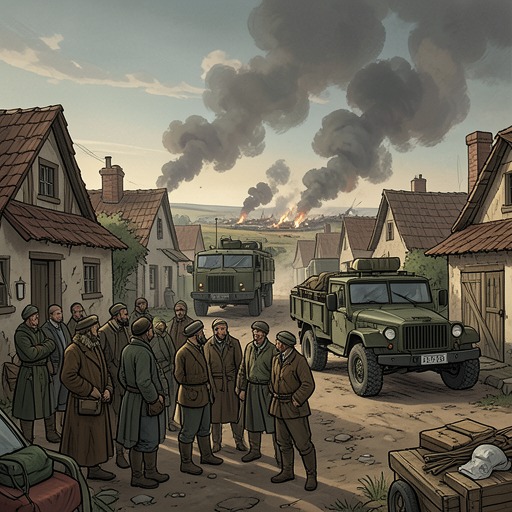
At the same time, former Soviet states move away from the neo-Soviet framework. Ukraine, Belarus, the Baltic states, and Georgia reassert their independence. Popular uprisings drive out garrisons too weak or too discouraged to hold their positions. Independence is therefore presented not as a frictionless declaration but as a change made possible by the erosion of central force—and shadowed by the continued presence of neo-Soviet units scattered across the former empire. The center loses its command, but the military remnants of the old order do not simply disappear with it.
Foreign intervention and the widening emergency
The collapse turns internal disintegration into an international security problem. As the revived Union begins to come apart, the Americans intervene in the far north, seizing key military facilities on the Kola Peninsula. The intervention places foreign forces directly inside a conflict whose political authority is already divided, making the region’s crisis more than a domestic struggle between the Reds and the Blues.
The United Nations also looks to a substantial military presence as a way to defuse other regional dangers. Among them is Turkey’s repeated threat to invade former Soviet Armenia to suppress unrest there. In the Black Sea region, the danger grows more immediate: if the northern half of the sea, from Odessa to Gagra, becomes a war zone, the consequences for a United Nations–United States response may be difficult or impossible to manage. Admiral Scott voices the contradiction bluntly, rejecting the description of the situation as peace when the whole area is tearing itself apart. The exchange makes clear that a mandate framed around preserving peace is operating amid conflicts that peacekeeping language cannot contain.
Competing claims to order
As authority fragments, political language becomes a way to claim legitimacy and resist outside pressure. In a later official statement, a government describes attacks as accidents caused by mistaken identity and invokes the so-called fog of water, while also insisting on its resolve and warning foreign powers not to obstruct its purpose. The pairing is revealing: the speaker’s government disavows responsibility for particular attacks but presents external restraint as a threat to its own security and national project. The statement does not settle who can enforce order; it shows how contested authority is defended through competing accounts of danger and responsibility.
That contest also constrains the response of outside powers. When Scott calls Dmitriev’s demands extortion, Reed challenges him to say what the United States should do instead. The exchange frames intervention as a choice with no clean outcome: refusing demands risks leaving the crisis unresolved, while entering it more forcefully risks deepening a conflict already spreading across governments, armies, and borders. The collapse is consequential not only because central rule fails, but because each attempted answer—military seizure, international presence, or insistence on national resolve—becomes part of the struggle over who has the right and capacity to impose order.