Russian Federation’s political disintegration
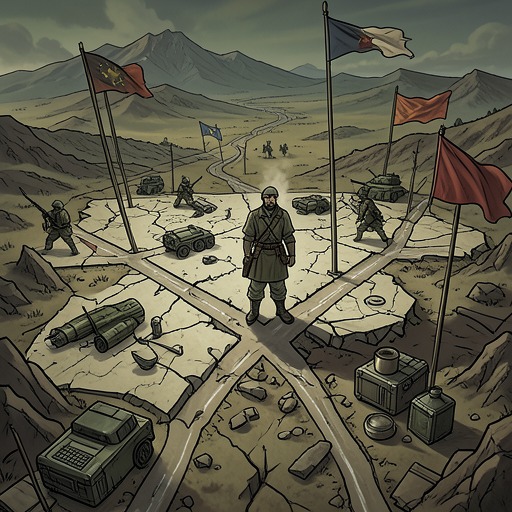
AfterburnThe Russian Federation’s political disintegration is presented not as a single collapse announced from the capital, but as authority breaking apart in public: flights stop, accusations replace explanation, and rival commanders claim the right to govern Crimea. The crisis makes the region’s military fragmentation inseparable from a wider question of legitimacy—who can speak for the state, and whose orders its forces will obey.
Political Order Under Strain
The conflict over authority has a political dimension before the open split in Crimea. In a debate about expanding United Nations power, Admiral Scott calls the transfer of authority a surrender of American sovereignty, while Heideman argues that national sovereignty cannot remain an unquestioned principle. Their disagreement gives the later disorder a larger frame: political leaders are trying to define what intervention and responsibility mean even as events threaten to outrun their decisions. The military tradition of political control remains formally intact—the politicians determine policy, not the armed forces—but the insistence on that rule sits uneasily beside the growing possibility that armed units may choose which authority to recognize.
Regional Instability and the Limits of Intervention
The crisis develops against a regional order already under pressure. The United Nations hopes that a strong military presence can defuse other problems, including Turkey’s repeated threats to invade former Soviet Armenia to suppress unrest there. The proposed intervention therefore belongs to a widening field of instability rather than a single dispute over Crimea: outside military power is being asked to contain dangers whose sources and boundaries are not clear.
As tensions rise, even the description of the situation becomes contested. The northern Black Sea, from Odessa to Gagra, may become a war zone, a prospect that threatens to make it difficult or perhaps impossible for the UN-U.S. force to hinder an attack or deliver the expected one against the peninsula’s defenders. At a policy discussion, Admiral Scott challenges the claim that intervention is needed to maintain peace by arguing that the region is already coming apart; the Secretary counters that Ukraine has not yet attacked. Their disagreement exposes the gap between a threat treated as imminent and violence that has not yet occurred. That uncertainty forms part of the political disintegration: military action is debated as a means of containing collapse even as the meaning of peace, and the authority to act in its name, become less secure.
Competing Claims in Crimea
The rupture becomes visible first as a failure of ordinary information and movement. Commercial flights are shut down for the duration of an unspecified emergency; broadcasts blame Ukrainians and foreign mercenaries without releasing definite details. In the same fragmentary account, General Sergei Boychenko has been branded a traitor, while Nikolai Sergeivich Dmitriev is reported to have taken charge of the Black Sea Fleet and declared himself Crimea’s legitimate military governor. No response from Krasilnikov’s people has been heard. The silence matters: there is no uncontested authority able to explain what is happening, only rival claims filtered through incomplete reports.
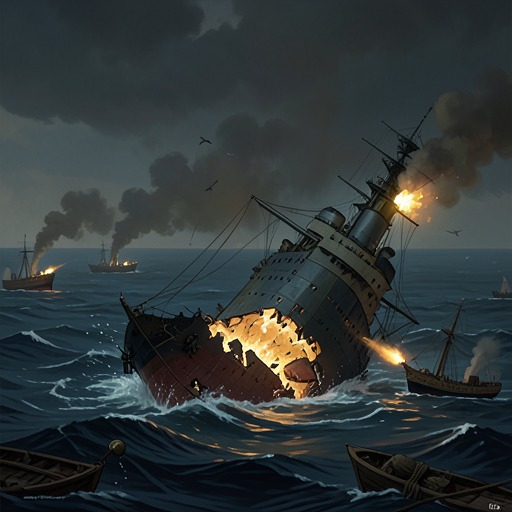
A report from Yalta turns that uncertainty into images of open conflict. It describes Russian naval forces in Crimea refusing to follow General Sergei Boychenko, then shows soldiers in the street, a jet passing overhead, and two men dragging a wounded comrade to shelter. The fighting is between army units loyal to Boychenko and naval infantry and air force units under Dmitriev; reported casualties are heavy. The footage gives the political split a physical form, as military allegiance divides not only on paper but across streets and armed units.
Dmitriev’s counterclaim sharpens the contest over legitimacy: he calls Boychenko a rebel employed by antigovernment forces and assumes full command of all military units in Crimea. The report places this declaration in the wake of the attempted assassination of Boychenko, setting the power struggle amid an already violent crisis without establishing that the assassination caused the mutiny. A separate public statement likewise combines an account of attacks as accidents with a declaration of resolve against foreign interference. Such language does not settle responsibility; it shows how claims of emergency and national purpose become instruments in a conflict where the state’s authority is itself in dispute.
Decisions Without a Stable Center
The competing claims in Crimea also leave outside governments facing an unresolved choice. In a discussion of Dmitriev’s demands, Admiral Scott calls yielding extortion; Samantha Reed presses him on what the government should do instead. The exchange gives the crisis a practical dimension: rejecting a rival commander’s terms does not itself establish who can restore order, or what action remains possible. The discussion also notes that ships can continue for many months on their onboard stores, though not without losing fresh food such as fruit. That measure of endurance sits beside the political impasse, suggesting that the crisis may outlast an immediate decision.
The uncertainty reaches military planning as well. At a meeting to consider options, a battle-group officer asks those present to help him avoid jeopardizing the group, describing its situation that morning as deeply unsettled. In Washington, White House Chief of Staff Gordon West calls the affair a colossal failure and says the President will not want to begin a major military operation. Together, these exchanges show the disintegration spreading beyond the question of which faction commands Crimea: even those considering a response must weigh the danger of acting without a stable political or military center.