Thomas Jefferson battle group’s Black Sea entrapment and fuel crisis
AfterburnThe Thomas Jefferson battle group’s Black Sea entrapment and fuel crisis is a logistical siege in which geography and consumption threaten to neutralize a powerful carrier force without defeating it in a single engagement. The battle group depends on a narrow maritime passage and vulnerable replenishment ships; once the Bosporus is blocked and its tanker burns, every aircraft launched and every day without resupply draws the force closer to becoming, in the novel’s stark formulation, useless inside the Black Sea.
Strategic Setting and Dependence on the Straits
The crisis unfolds against a regional conflict in which Crimea’s political status and the Black Sea Fleet are already disputed. Ukraine had never been wholly comfortable with its position as one of the Union’s largest and most productive republics, and the narrative stresses that ethnic Ukrainians were not Russians. Crimea, geographically linked to Ukraine’s mainland to the north, had long been considered part of Ukraine; Russia bordered the peninsula to the east. As Russia became consumed by civil war, Ukraine appeared poised to settle the older dispute with Moscow over both Crimea and the Black Sea Fleet. The carrier group’s predicament therefore develops within a contest where control of the sea passage and the surrounding political order are inseparable.
The Jefferson’s nuclear propulsion does not make the battle group self-sufficient. The ship does not need fuel for its own engines, but its aircraft consume aviation fuel, and the carrier still requires replenishment of expendable supplies. A modern carrier like the Jefferson needs at-sea replenishment every two to three weeks. Its aircraft fuel could not last more than ten days, and that estimate assumed less than the sustained demands of a heavy flight schedule, a major strike, or an extended running battle. The battle group’s only sources of resupply were the UNREP tankers accompanying it across the sea. The carrier’s power plant could keep it moving; it could not keep its air wing flying.
The Passage Closes and Resupply Fails
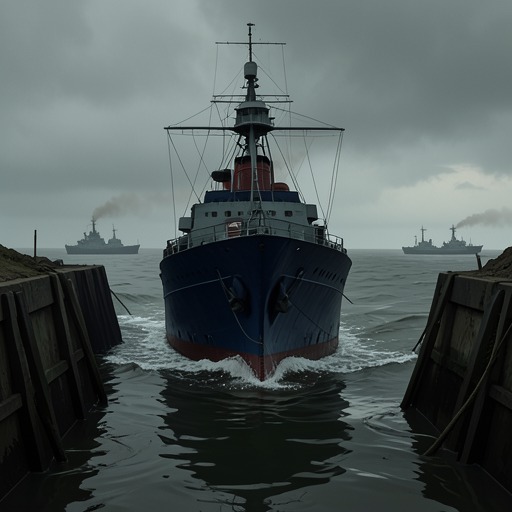
The destruction of the Bosphorus Bridge turns that dependence into isolation. The navigable channel through the center of the Bosporus was only a few hundred yards wide. When the bridge’s main cables snapped, sections of its deck fell into the strait, leaving wreckage beneath the water like a trap for ships. Clearing the obstruction would require a major engineering effort and weeks, possibly months. Until that work was done, vessels could not pass between the Black Sea and the Sea of Marmara, or continue onward to the Aegean Sea. This was not a brief delay that the battle group could confidently wait out: the route on which maritime resupply depended had become physically impassable.
The loss of the Falcon Patriot made the closure more dangerous. At 1008 hours, Zulu plus three, the Air Ops report confirmed that at least a dozen had been involved in the attack. The tanker appeared to be trying to run aground near Sariyer, but its cargo was burning. For Coyote, the report’s significance went beyond the loss of a UNREP ship: the Falcon Patriot had carried almost ten million gallons of fuel. That cargo represented an immense quantity of the resource the carrier group most urgently needed, now lost while the remaining maritime route was already blocked.
The consequences were immediate and strategic. The battle group had been operating with roughly ten days of leeway, but continuous maneuvers and aircraft flying from the flight deck around the clock could reduce that reserve to only two to four days. Once the aviation fuel was spent, the Jefferson and its escorts would remain large warships without the air operations that gave the group much of its combat power. The image of expensive toys locked inside the Black Sea captures the crisis’s central reversal: a force capable of projecting power could be rendered ineffective by the loss of access and fuel, rather than by the destruction of its ships.
Consumption Under Pressure
The battle group’s fuel reserve was threatened not only by the absence of replenishment but also by the effort to maintain readiness. Russian approaches were repeatedly met and turned aside without incident, yet responding required aircraft fuel. During one stretch the force had been putting aircraft off the flight deck nonstop for two hours. Operations staff assessed that the Russians might be deliberately forcing the group to expend its reserves: they had blocked the straits, knew no further fuel was coming, and were now provoking activity that consumed what remained. The assessment is presented as an operational judgment, not as proof of Russian intent, but it explains why even encounters without a battle could worsen the group’s position.
This makes the crisis a contest over endurance as much as a confrontation at sea. The response to pressure is also a form of expenditure: launches and maneuvers can answer immediate threats while shrinking the time available to continue answering them. The group cannot simply conserve fuel without regard to the Russian approaches, but sustained operations hasten the point at which its air wing can no longer function. The strategic trap is therefore double-sided: the blocked passage prevents replenishment, while the need to remain active burns through the supply already aboard.
Alternative Fuel and a Narrow Opening
At a meeting about whether the force could get through to resupply the group, Reed asked whether there was any way to reach it. Scott looked to Magruder, who distributed a sheaf of plastic binders containing their estimates. The exchange makes the crisis a matter of contingency planning as well as battlefield reporting: the question was no longer simply how much fuel remained, but whether an alternative route or source could keep the isolated force operational.
A possible answer emerged at Arsincevo. The aviation gasoline there had been judged suitable for the Jefferson’s demanding standards, and the plan required taking on nearly three million gallons, about nine thousand tons, of highly flammable fuel. The quantity promised a significant replenishment, but the wording leaves the transfer as a task still ahead: the fuel had to be pumped aboard, and flight-deck operations had been suspended. The episode thus offers a possible escape from the immediate arithmetic of depletion, not a return to secure supply at sea.
The crisis’s significance lies in the way it makes operational power depend on infrastructure that can be denied. The Black Sea is not merely the setting for the carrier group’s movements; with the strait obstructed, it becomes a sealed space, and the tanker’s destruction removes the group’s expected lifeline. Arsincevo supplies a precarious alternative, while the hours of nonstop flight operations show how quickly even a capable force can consume its margin. The battle group’s isolation is consequently both a military danger and a logistical condition: its ability to remain effective depends on whether fuel can reach it before the remaining reserve is exhausted.