Yalta shore party stranded in hostile territory
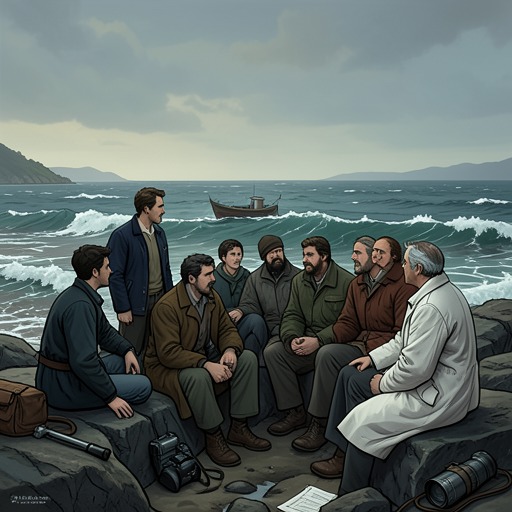
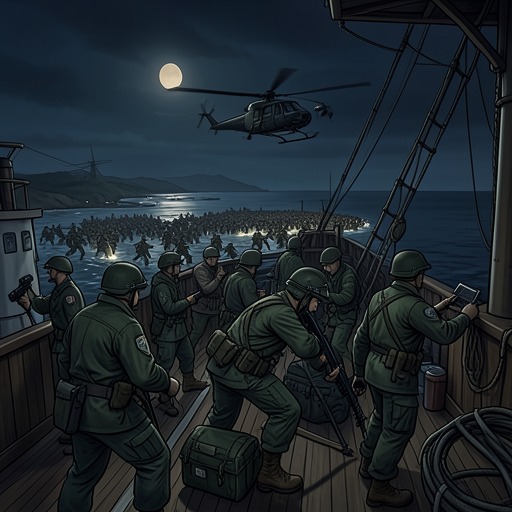
AfterburnThe Yalta shore party stranded in hostile territory is a UN contingent caught in Yalta as the surrounding conflict turns the city into a trap. Roughly one hundred UN personnel, including members of the U.S. Navy’s Jefferson battle group, are reported stranded while the battle group remains offshore. Their predicament joins the practical danger of extracting wounded people to the larger crisis confronting the UN mission: a force sent to help contain regional violence now has personnel exposed to that violence, with no assured route out.
From Contested Mission to Entrapment
Yalta’s danger develops against a widening regional crisis. The UN hopes a strong military presence will defuse problems in the area, including the possibility that Turkey might invade Armenia to suppress unrest. Yet the prospect of fighting spreading across the northern Black Sea—from Odessa to Gagra—makes the movement of UN and U.S. forces increasingly uncertain. The shore party’s confinement is therefore not an isolated accident but a local expression of a conflict threatening to outgrow the mission’s ability to manage it.
The story first places the city in a living urban soundscape. From an open window, Matthew “Tombstone” Magruder hears the muezzins’ calls to afternoon prayer mingling with horns and traffic. That ordinary civic rhythm later stands in sharp contrast to the city’s wartime condition. Yalta is not merely a position on a military map: it is a populated place where everyday life continues amid the strategic contest, even as the shore party’s freedom of movement contracts.
The political argument over intervention sharpens the contradiction. Admiral Scott challenges the claim that intervention is maintaining peace, pointing to the area’s deterioration; Samantha Reed answers that Ukraine has not yet attacked. Their disagreement frames a mission operating between preventive action and a spreading war. For the people trapped in Yalta, that distinction offers little immediate protection: the larger policy debate continues while they face the consequences of hostilities already under way.
The Threat on the Ground
The danger becomes immediate when a strafing run targets a CH-53 Sea Stallion. Matthew “Tombstone” Magruder returns from his hiding place and finds the helicopter resting at a sharp angle, flames and black smoke rising from its port-side fuel-tank sponson. The damaged aircraft is more than wreckage: it is a lost or compromised means of movement at the moment the party most needs to evacuate. A later report shows UN soldiers near the White Palace and the wreckage of a large helicopter on its grounds, making the exposure of UN personnel and aircraft visible to the wider public.
The threat also reaches beyond the attack itself. After an earlier attempt by Tatars to kill General Boychenko fails, Matthew “Tombstone” Magruder warns that hostile forces may already be coming to finish what they began. He urges that the general be told there is little time. The party is thus pressed to protect a high-value person while its own position is insecure; delay risks allowing the attackers another opportunity, while movement toward the relative security of the Jefferson battle group is itself difficult.
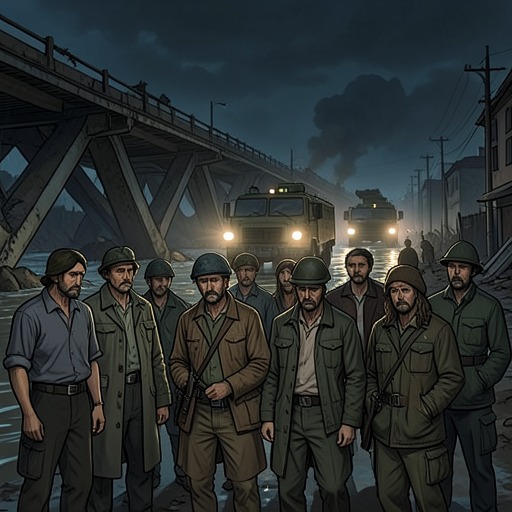
The party’s situation is described as active entrapment, not simply a temporary delay. A report identifies about one hundred UN personnel, including a contingent from the battle group offshore, as trapped in Yalta amid rapidly escalating hostilities. The scale matters: the problem is not confined to a single isolated individual or a damaged aircraft. It is a sizeable group of personnel whose ability to leave depends on conditions they cannot control.
Casualties, Communications, and Extraction
Inside the palace, the wounded receive what treatment the medics can provide in a sitting room converted into a temporary hospital. The improvised arrangement gives the injured shelter and immediate care, but it is plainly not an adequate substitute for medical facilities aboard ship. Matthew “Tombstone” Magruder emphasizes that the admiral needs better medical help and that other wounded personnel also need to be taken off the shore. Evacuation is consequently both a medical necessity and a test of whether the party can re-establish a link to its offshore support.
That link is uncertain. The party needs communications with the carrier battle group restored and hopes to arrange helicopter flights for the wounded, but air superiority is identified as a problem. A response to the request for a way out confirms that those supporting the shore party are working on it, without offering an immediate solution. In the meantime, aircraft continue flying as long as they can, while the possibility that hostile forces are trying to exhaust their JP-5 fuel adds a further limit to sustained air support. Each dependency compounds the others: the wounded need transport, transport depends on aircraft, and aircraft must operate in an unsafe air situation with finite fuel.
The resulting delay makes the makeshift hospital a measure of the party’s vulnerability. It can keep casualties under care while a plan is sought, but cannot resolve the conditions that make evacuation necessary. The party is caught between the palace, where treatment is limited, and the fleet, whose aircraft and medical facilities are not yet reliably accessible. Its immediate objective is concrete—get the wounded and the general to safety—but the means remain constrained by battlefield conditions.
Political Stakes and Public Exposure
At sea, the crisis intersects with a larger dispute over how to respond to Dmitriev. Admiral Scott rejects giving in to his demands as extortion, while Samantha Reed presses the question of what alternative course is available. The exchange does not itself extract the shore party, but it shows how relief and protection are entangled with political decisions about confrontation. The personnel in Yalta are not outside that contest: their peril unfolds while leaders debate the costs of yielding and the risks of acting.
Dmitriev’s public language compounds the uncertainty. He presents attacks as accidents and invokes the phrase “fog of water,” while also insisting that foreign powers must not obstruct his government’s purpose. The juxtaposition of regret and resolve leaves the shore party exposed to a conflict whose violence is disavowed even as the threat continues. Such rhetoric offers no dependable assurance that the attacks will stop or that the trapped personnel will be allowed to leave safely.
The party’s situation therefore marks a reversal in the meaning of the UN presence. A strong military deployment was intended to help defuse regional problems; in Yalta, UN personnel themselves become trapped amid escalating hostilities, and their rescue depends on the very military capacity whose freedom of action is under pressure. The stranded contingent embodies the gap between a mission’s promise of stabilization and the immediate realities of protection, medical care, and extraction. Its position remains unresolved in these scenes: the wounded still need evacuation, the admiral requires better treatment, and the route from the city to the offshore force has yet to become secure.