Crimea’s status under United Nations protection
AfterburnCrimea’s status under United Nations protection is a contested political commitment: the United Nations insisted that the peninsula was under its protection, yet could not make that assertion effective when Ukrainian forces advanced. The gap between the protection claimed and the action it could secure turns the status into a test of both the United Nations’ authority and the limits of its military presence.
Origins of the Dispute
The underlying conflict was not simply a question of where a peninsula lay on a map. Ukraine had never been wholly comfortable with its position as one of the Union’s largest and most productive republics, and the account emphasizes that ethnic Ukrainians were not Russians. As the Russian Civil War weakened Russia, Ukraine used the opportunity to strengthen its position, especially in Crimea.
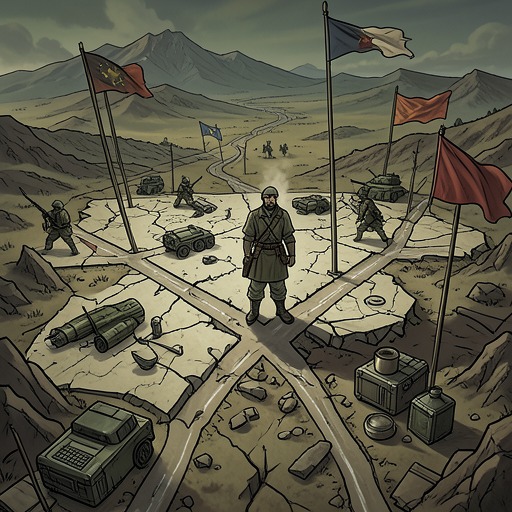
Geography sharpened the competing claims. Crimea had long been considered part of Ukraine, which extended across the mainland to its north; Russia bordered the peninsula to the east. At the same time, the older dispute between Ukraine and Russia over ownership of Crimea and the Black Sea Fleet remained unresolved. With Russia consumed by civil war, Ukraine appeared poised to settle that question. United Nations protection therefore entered a dispute already shaped by territorial claims, war, and a changing balance of power.
Protection as a United Nations Commitment
The United Nations hoped that a strong military presence could defuse problems in the region and help establish the idea of a United Nations with meaningful enforcement power. Crimea’s protection belonged to that larger ambition: the organization was not merely observing instability but sought to use its presence to contain it.
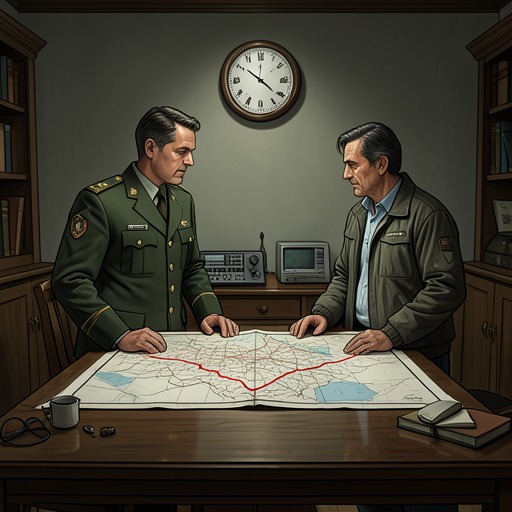
That ambition carried an unresolved command question. Whether American forces should serve under United Nations commanders had been debated for years, even as American forces were being sent to support the United Nations’ position in the region. The debate exposed a practical limit to the protection claim: an international commitment depended on military forces whose command arrangements remained politically contentious.
The surrounding crisis made that limit increasingly urgent. The situation was described as growing more dangerous by the day; if the northern Black Sea, from Odessa to Gagra, became a war zone, the United Nations and the United States could find their wider mission difficult or perhaps impossible to sustain. In a debate over intervention, one official argued that Ukraine had not yet attacked, while Admiral Scott answered that the whole area was already coming apart. Protection was thus invoked amid a deteriorating crisis, but the available account does not establish that it settled the competing claims or prevented escalation.
The Advance and the Limits of the Claim
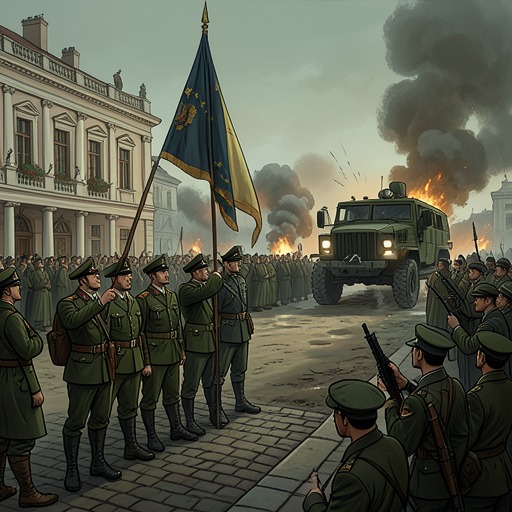
The decisive test came as the military situation shifted. By the late account, the Black Sea Fleet’s air power had been broken. Ukrainian landing craft were coming ashore at Mikolaivka and Kacha, just north of Sevastopol, and were moving toward overrunning the peninsula. The United Nations protested, insisting that Crimea was under its protection; the protest appeared to have no effect on the advance.
This outcome distinguishes an asserted status from an enforced one. The United Nations’ claim remained clear, but Ukrainian forces continued to land and the account records no effective measure that stopped them. Crimea’s protection therefore appears less as a settled arrangement than as a commitment under pressure—one whose credibility depended on the ability to defend it at the moment when the peninsula’s political and military control was being decided.
Political Consequences
The possible loss of Crimea threatened consequences beyond the peninsula. The account suggests that it could deliver a final blow to Marshal Krasilnikov’s hard-line rule over what remained of Russia. That prospect tied the fate of the United Nations’ protection claim to Russia’s internal collapse as well as to the Ukraine-Russia dispute.
The episode also gives concrete meaning to the United Nations’ hope for a forceful international role. A declaration of protection could not, by itself, reconcile rival claims or halt a military advance. With the protests apparently unheeded, Crimea’s status became a measure of the distance between international authority as a political assertion and authority backed by effective action.