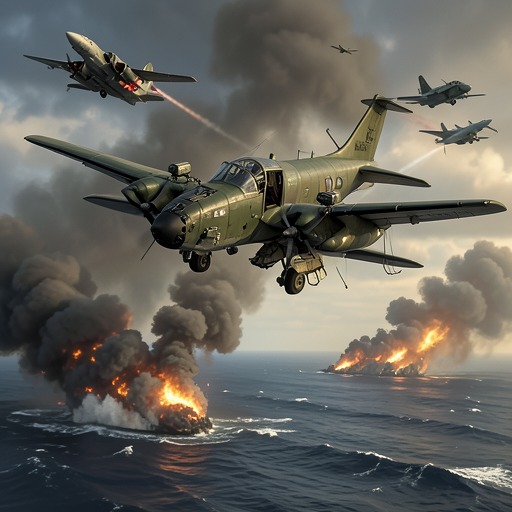
U.S.–Russian truce
AfterburnThe U.S.–Russian truce is less a settled peace than a watchful, uncertain pause: American forces are officially under a truce, but neither the status of the conflict nor the authority of the Russian factions that accepted it is clear. Its purpose is to restrain escalation long enough for the United Nations to pursue a negotiated settlement, while the surrounding crisis repeatedly threatens to make restraint untenable.
Status and Authority
At sea, the uncertainty is explicit. Matthew “Tombstone” Magruder cannot tell whether the United States is still at war with Russia, and the rest of CVBG-14—and perhaps the politicians as well—appear no more certain. Officially, a truce is in force. In practice, its standing is doubtful: the agreement seems unilateral, because it is not clear that the people who accepted it for either the Krasilnikov or Leonov faction had the authority to commit their side.
That uncertainty reflects the fractured political landscape in which the truce operates. The opposing factions are not presented as a single, reliable counterpart, and an agreement made in their names may not bind the forces acting under them. The pause therefore lacks one of the basic assurances of a durable settlement: confidence that the parties can speak for, and control, those expected to observe it.
Restraint Under Naval Threat
The American battle group receives orders from both Washington and United Nations officials directing Operation Sustain Hope. The orders are explicit on at least one point, but the narrative emphasizes the difficulty of carrying them out in modern naval warfare: ship-killer weapons can be deployed in seconds, and a mistake can have grave consequences. A watchful truce is not a safe interval so much as a demand for restraint under immediate threat.
The battle group’s position compounds that danger. The Jefferson is pinned in the straits with its air grounded, leaving its personnel to question the truce without the freedom of action that might make the situation feel secure. The carrier also depends on regular replenishment: a modern carrier requires expendables every two to three weeks, and although the Jefferson is nuclear-powered and does not need fuel for itself, its aircraft consume aviation fuel. These limits make prolonged confinement more than a diplomatic inconvenience; they bear directly on the force’s ability to sustain operations.
American restraint is meant to serve a political purpose as well as an operational one. A unilateral, watchful pause might persuade the Russian factions to back down and allow the United Nations to seek a negotiated settlement. That possibility gives the truce its rationale, but not its guarantee: the Americans can choose to hold their fire, while the willingness and capacity of the fragmented Russian side to do likewise remain uncertain.
Crimea and the Widening Crisis
The truce sits within a larger contest over territory and political identity. Ukraine had never been wholly comfortable with its position as one of the Union’s largest and most productive republics; ethnic Ukrainians were not Russians, despite what outsiders might assume. Crimea, geographically attached to Ukraine by the mainland to its north and bordering Russia only to the east, had long been considered part of Ukraine. The old dispute between Kiev and Moscow over the peninsula and the Black Sea Fleet remained unresolved while Russia was consumed by civil war, and Ukraine appeared poised to settle the issue in its own favor.
That possibility makes the pause especially fragile. As the crisis worsens, the northern Black Sea risks becoming a war zone, a development that could make it difficult or even impossible for United States and United Nations forces to carry out their mission. The truce is thus surrounded by pressures it cannot itself settle: competing claims over Crimea, a weakened and divided Russia, and the prospect that a new conflict could spread across the region.
A Conditional Peace
The United Nations hopes that a strong military presence can help defuse other regional problems as well, including Turkey’s repeated threats to invade Armenia. This broader ambition casts the truce as one part of a larger effort to contain instability, not simply an agreement between two coherent states. Yet the scale of that effort also exposes its vulnerability: maintaining peace depends on military presence, political cooperation, and the ability to keep separate disputes from becoming connected fronts.
The truce’s significance lies in that contradiction. It offers a narrow opening for negotiation, but its signatories’ authority is uncertain, its observance is unilateral in practice, and its military setting leaves little margin for error. Rather than resolving whether peace has arrived, the pause leaves American forces operating inside the question—restrained by orders, exposed to sudden attack, and dependent on a political settlement that the surrounding crisis keeps moving further out of reach.