Russian Civil War
AfterburnThe Russian Civil War is the book’s continuing crisis of political authority: as Moscow’s central government collapses, armed factional conflict worsens and the borders and loyalties of the former Soviet state become newly unstable. Rather than remaining a struggle contained within Russia, it shapes Ukraine’s renewed independence, intensifies the dispute over Crimea, and makes the prospect of international peacekeeping part of the debate over what can follow.
Factional Conflict and Political Breakdown
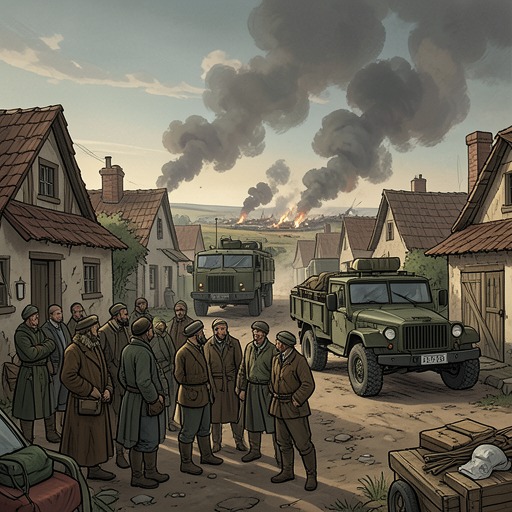
Leonov’s Popular Democratic Front, known as the Blues, is described as locked in conflict. The book situates that factional struggle within a civil war that has grown more severe over time: a retrospective measure notes that conditions inside the former Soviet state had become far worse in the seven months since an earlier point in the crisis. The account establishes deterioration as a continuing condition, not a settled transition from one political order to another.
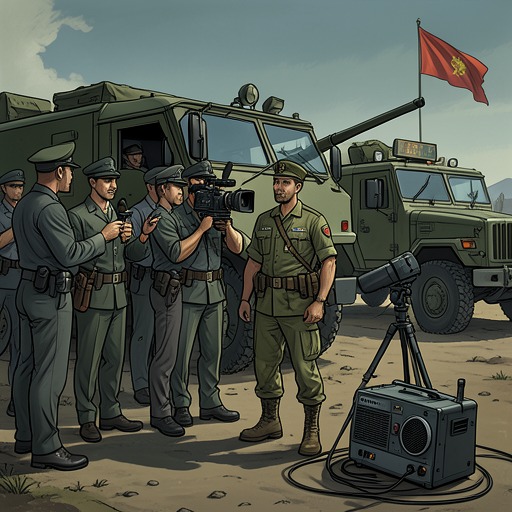
The breakdown also gives the conflict an uncertain scale and outcome. In a later military setting, the morale of the men is good, and Yevtushenko is pleased by it; nevertheless, the narration stresses that in a civil war—or a mutiny—commanders cannot know in advance how events will develop. That uncertainty distinguishes the conflict from a straightforward contest between stable governments. Allegiance and control remain precarious enough that good morale cannot guarantee what comes next.
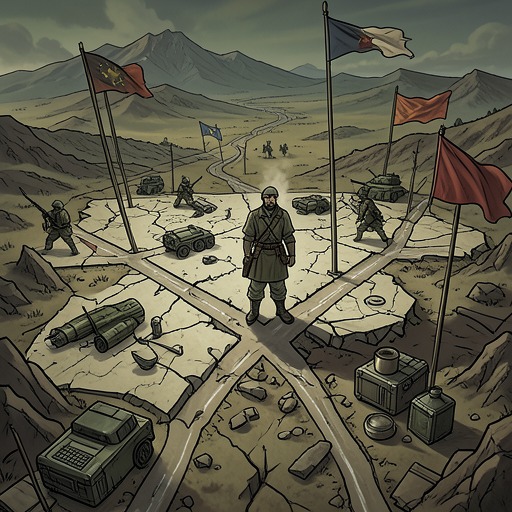
The book’s sparse references to the war’s geography reinforce the sense of an order losing its former boundaries. The Kola Peninsula is evoked as soil once considered sacrosanct, placing the conflict against the memory of territory that had seemed beyond violation. The passage does not specify the full circumstances of that reference, but its contrast is clear: the old assumptions of security no longer hold. Elsewhere, the text pairs the cost of independence with the continued presence of neo-Soviet forces or ideas, without detailing them in the surviving passage. Independence appears as a political break that does not, by itself, settle the contest over power.
Ukraine and the Contested Political Map
Ukraine’s status changes with the fortunes of the wider conflict. During the Norwegian War, it had again become part of the Soviet empire. After Moscow’s central government collapsed and a general civil war broke out, Kiev declared independence once more. The sequence makes Ukrainian independence a response to the failure of central authority, as well as a renewal of an earlier claim; the narrative describes the country as appearing more resolute this time.
That renewed independence does not erase Ukraine’s uncertainties. The book notes that Ukraine had never been wholly comfortable with its role, but the excerpt does not complete the description of that role. It also identifies an old dispute between Kiev and Moscow over ownership, placing territorial questions alongside the political rupture. These elements prevent the declaration of independence from functioning as a simple resolution: the government’s break with Moscow leaves historical claims and questions of belonging in play.
Crimea concentrates those unresolved questions. The book connects the peninsula to a disputed ownership question between Kiev and Moscow and later makes its possible loss a direct threat to Krasilnikov’s position. A brief observation that Crimea is their homeland gives the territorial dispute an additional human dimension: the peninsula is not presented only as a strategic possession, but also as a place bound to collective belonging. The account does not settle the competing claims; it shows why control of the territory carries consequences beyond a change on the map.
International Response and Escalating Danger
As the crisis worsens, United Nations officials hope that a peacekeeping response may help address it. The passage does not establish that such a force has been deployed or specify its mandate; it records peacekeeping as an anticipated possibility amid the civil war. The distinction matters because the conflict has already raised the question of whether outside authority can contain violence without resolving the underlying disputes over sovereignty and control.
The political argument over the United Nations’ powers remains unsettled as well. Admiral Scott expresses doubt that giving the organization more power is a good idea. Heideman responds that he respects Scott’s views but cannot agree with them; the excerpt cuts off before his explanation. Their exchange establishes disagreement over the proposed expansion of international authority, but does not supply enough detail to attribute a specific alternative policy to either speaker. The debate parallels the wider problem of intervention: the worsening crisis creates pressure to act, while the scope and legitimacy of that action remain contested.
The danger is described as increasing day by day, with the northern Black Sea identified across a stretch from Odessa to Gagra. The surviving passage breaks off before completing the condition attached to that geography, so it does not define a specific military development there. Even so, the span of locations broadens the crisis beyond the immediate political contest in Moscow and Ukraine. The war’s consequences are represented as regional, with the Black Sea’s surrounding territories exposed to the instability produced by the collapse.
Krasilnikov and the War’s Unresolved Ending
By the book’s later stage, the possible loss of Crimea is framed as a potentially decisive blow to Marshal Krasilnikov’s hard-line rule over what remains of Russia. This is a conditional prospect, not a report that his government has already fallen. Its force comes from the contrast between the shrinking political entity he governs and the strategic and symbolic importance assigned to the peninsula: losing Crimea could further weaken a regime already ruling over the remnants of the former state.
The civil war therefore persists as more than a background label for the book’s military and diplomatic crises. It links factional rivalry to the collapse of central government, helps explain Ukraine’s renewed declaration of independence, and makes Crimea a focal point where territory, identity, and political survival converge. The book leaves the larger struggle unresolved. Its clearest measure of change is the erosion of old certainties—about central authority, national borders, and territory once thought sacrosanct—while its ending leaves Krasilnikov’s remaining rule vulnerable to the possible loss of Crimea.