Ivanov's Missile Attack on the Jefferson
AfterburnIvanov's Missile Attack on the Jefferson turns an urgently needed refueling stop into a close-range air-defense crisis. On Saturday, 7 November, at 0907 hours (Zulu +3), Major Yevgenni Sergeivich Ivanov attacks the U.S.S. Thomas Jefferson at the Arsincevo fueling dock off Kerch. The carrier is taking on an enormous load of aviation gasoline, and its flight deck is out of operation. Ivanov passes over tempting Marine landing craft but chooses the carrier instead, committing two AS-7 Kerry anti-ship missiles to a target that is both strategically valuable and unusually vulnerable while fueling.
Fueling and strategic exposure
The attack’s danger is shaped by the Jefferson’s dependence on aviation fuel, not by a need to refuel its nuclear propulsion plant. A modern carrier requires replenishment of expendables every two to three weeks; its aircraft, however, consume fuel rapidly. Even under ordinary conditions, the aviation-fuel reserve would not last more than ten days, and heavy flight operations, a major strike, or an extended battle could shorten that interval. The battle group depends on the replenishment tankers that accompany it, leaving its endurance tied to the availability of supply and the routes those ships can use.
That limitation has particular force in the Black Sea. If the Bosporus Strait is closed, the carrier and its escorts can be trapped there; with round-the-clock flying and maneuvering, their remaining operational leeway could fall to two to four days. The broader resupply problem is serious enough that officials later exchange estimates on whether the force can be supplied at all. Against that background, the dock at Kerch is more than a convenient stop: it is a chance to sustain the carrier’s air operations, but also a fixed, exposed point where the ship must pause to take aboard fuel.
The quantity involved magnifies the immediate risk. The avgas has been tested and judged suitable for the Jefferson, but nearly three million gallons—about nine thousand tons—still have to be pumped aboard. Flight-deck operations have been suspended during the fueling. The ship is therefore carrying out a vital logistical task while aircraft are not operating from its deck, and a fire near the fuel or its fumes could turn a missile strike into a catastrophe. Ivanov’s timing exploits precisely this intersection of necessity and vulnerability.
Ivanov’s attack
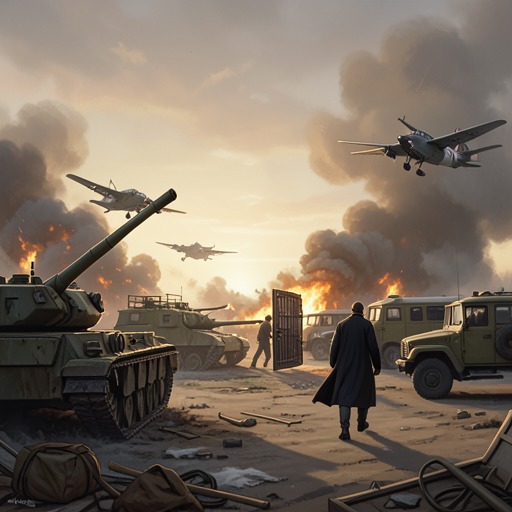
Ivanov approaches over Arsincevo at very low altitude. He pulls out of a dive only about five hundred feet above the sea, then drops lower still, skimming over the water. He notices the tracked vehicles used by the U.S. Marine Corps as landing craft, but passes over them in pursuit of what he regards as the larger prize: the carrier slipping close to the fueling dock off Kerch.
He carries two AS-7 Kerry missiles beneath his MiG’s wings. At a range of three miles—described in the scene as practically point-blank—he launches at the Jefferson. The ship is not an incidental target encountered during the attack: Ivanov has already identified it as the object of his strike, and the two ship-killing weapons are intended to exploit the carrier’s presence at the dock. The attack begins with little distance for the defenders to work with and with the consequences of a hit made more severe by the fuel transfer underway.
The danger is registered aboard the carrier as incoming missiles are reported from the southwest. On the flight deck, the threat is not only impact damage. A fire could spread to the avgas fumes to starboard, where the ship is taking on fuel. The suspended flight operations and the volatile cargo that makes them necessary thus form a stark contradiction: the carrier needs to be still and receptive to refueling, but that same condition leaves it exposed to an attack whose effects could extend beyond the initial explosion.
Interception and immediate consequences
Over Arsincevo, the crew of Tomcat 216 first identifies the launch, then recognizes that the missiles—not Ivanov’s Flogger—have to become the priority. The Tomcat pilot abandons the opportunity to continue an attack on the MiG and directs Cat Garrity to lock onto the incoming weapons and fire both AIM-54 Phoenix missiles. Joyce “Tomboy” Flynn has already ordered the crew to take the missiles; Cat is ahead of the verbal instruction, entering the new target into the computer and firing.
The defense is a reversal of the engagement’s immediate objective. Ivanov is the attacker, but the American aircrew must leave the launching aircraft alone long enough to stop the weapons already in flight. The missiles are moving toward a carrier that cannot simply resume ordinary flight-deck operations while fuel transfer continues, and the crew’s decision gives the incoming AS-7s precedence over the MiG that launched them. At the dock, the warning reaches the ship’s combat information center as the attack closes.
The account specifically shows the second Phoenix intercepting a Kerry missile at the top of its climb, coast, and dive. The explosion is violent enough to feel aboard as though it has struck the bridge, and it shatters windows. This establishes that at least one of Ivanov’s missiles is destroyed before reaching the carrier; it does not, by itself, establish the Jefferson’s final condition or the full result of the engagement. The attack’s immediate significance lies in that narrow margin: the carrier’s fuel operation exposes it to a point-blank strike, while its aircrew must use precious moments to redirect its defense from the attacker to the missiles threatening the ship.