Russian Invasion of Norway
AfterburnThe Russian Invasion of Norway turns a presidential assassination into the pretext for a cross-border war—and, in Dmitriev’s reading, into an attempt by the new Union’s leaders to alter the European balance of power. The invasion was framed as retaliation, but the circumstances leave its justification entangled with suspicion that the crisis had been manufactured from within.
Background and Suspected Motive
Dmitriev was not privy to the Kremlin’s internal decisions. He nevertheless suspected that the assassination of the Union’s president in Norway had been an inside job, planned and carried out by the KGB or perhaps the GRU. The account presents this as his suspicion, not as a proven explanation for the killing.
The possibility mattered because the Union’s real leaders had, in Dmitriev’s view, turned to war as a means of changing the balance of power. The Norwegian crisis therefore appears not simply as a border dispute but as an opening for a leadership seeking to make military action serve a larger political design.
The Incursion and Its Public Rationale
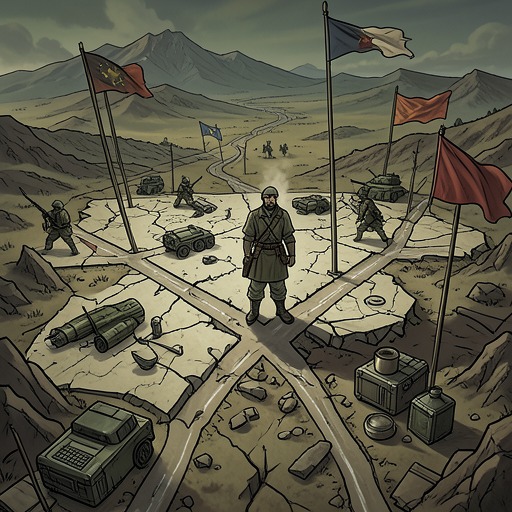
Within hours of the assassination, tanks began rolling across the frozen border between Russia’s Kola Peninsula and Norway. The Union cast the advance as retaliation for the plot and as an effort to restore order in a dangerous neighbor. That rationale gave the invasion an immediate stated purpose, while Dmitriev’s suspicion cast doubt on how much the attack could be separated from the political calculations behind it.
The strategy had a precedent in the Union’s recent dealings with Ukraine: force had brought the breakaway republic back inside the Soviet fold, at least temporarily. That earlier outcome could make another intervention seem effective, but it also showed the limits of coercion. Temporary control was not the same as a lasting resolution.
Western Hesitation and American Intervention
The West was slow to react. Its governments were unwilling, perhaps, to recognize danger in a Soviet Union that most people believed was already dead. That hesitation left the Union’s Norwegian gambit with room to succeed: it might have positioned the new Union to dominate a confused and irresolute Europe.
The plan was thwarted by the Americans. Their aircraft carrier Jefferson, which Dmitriev had previously cooperated with in the Indian Ocean, became part of the force that checked the Union’s ambitions. The contrast is central to the episode: Western delay initially gave the invasion political space, but American military intervention prevented that opening from becoming the strategic victory its planners sought.
Significance in the Wider Conflict
The invasion makes the Norwegian president’s assassination a pivot between domestic suspicion and interstate war. Its public justification rested on retaliation and restoring order; its larger significance lay in the possibility that the new Union was using the crisis to recover influence beyond its borders. Because the inside-job theory remains Dmitriev’s suspicion, the narrative preserves uncertainty about the assassination while making the consequences of the invasion unmistakable.
The episode also establishes a pattern of contested security claims: the Union presents its military action as a response to danger, while its opponents confront the possibility that such claims conceal expansionist aims. American intervention breaks that pattern’s immediate momentum, but the invasion demonstrates how quickly a disputed act of violence can become an excuse for a wider war.