UN Flight 27 Black Hawk shootdown
AfterburnThe UN Flight 27 Black Hawk shootdown turns a mission intended to support peace into an attack by one U.S. service on another. In the Georgia No-Fly Zone, a Navy Tomcat mistakes a U.S. Army Black Hawk serving with a UN team for a hostile helicopter and fires an AIM-9 Sidewinder. The aircraft crashes; the confusion is later traced to a basic but consequential information failure: the Army helicopters were sent into the zone without the Navy aircrews being told, and they had not received the codes needed for radar identification as friendly aircraft. The episode makes the cost of an imposed no-fly zone visible at cockpit scale, where incomplete coordination and seconds-long decisions undo the distinction between protection and attack.
The engagement
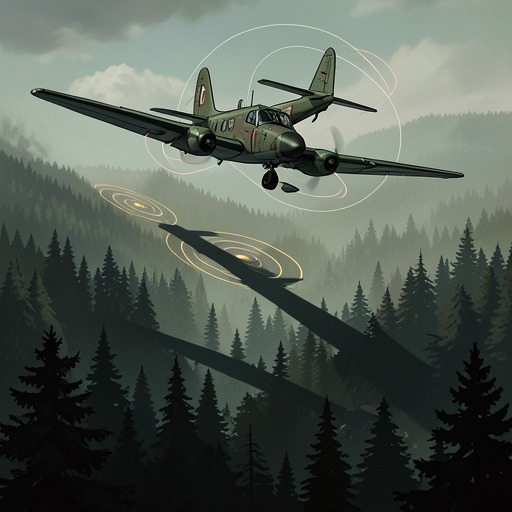
The encounter unfolds in a canyon, where the Tomcat pilot catches sight of a helicopter from a difficult angle. He initially has only a glimpse, but its position—behind the Black Hawk—offers an opportunity to pursue. Dixie identifies the target as a Hind gunship. The Tomcat accelerates into open sky, and the pilot later fires a Sidewinder, announcing the missile launch to friendly aircraft. The engagement has moved from uncertain visual contact to a live attack before the aircraft’s identity is resolved.
The Black Hawk’s crew sees the threat coming. A warning of an incoming missile reaches Cole, who throws the helicopter into a hard turn to the right. The aircraft cannot outrun the missile. The AIM-9 comes down from above and behind at 660 miles per hour, drawn to the heat from the helicopter’s engines. The crew nearly escapes, but the missile strikes before the Black Hawk can recover.
The crash compounds the attack’s immediate violence. The helicopter hits soft ground, and its right-side External Stores Support System crumples and breaks away, partly softening the impact. An engine then blows; a severed fuel line spills aviation fuel onto a hot manifold. With the aircraft burning, Cole and another crew member pull Dombrowski from between the cockpit seats and carry him aft through the smoke and out the right-side door. They reach muddy ground and keep moving. As the Tomcat passes beyond the valley, its pilot can no longer see whether anyone else has survived.
Recognition and the failure behind it
The later examination of the incident focuses not only on what the fighter crew saw, but on what they had been equipped and informed to recognize. Photographs of a Hind are used to explain its identifying features: a five-bladed rotor, tapering anhedral stub wings mounted on the fuselage, and separate, stepped pilot and gunner cockpits. The comparison matters because the Black Hawk’s External Stores Support System could be mistaken for weapons pylons. One observer says the aircraft’s double cockpit was not visible, but that the apparent pylons were; the response identifies them as the ESSS, not evidence that the helicopter was armed as a Hind would be.
That distinction does not establish that a particular visual misreading alone caused the attack. The subsequent account identifies a broader failure: no one had told the Navy aircrew that Army helicopters were operating in Georgia with the UN team, and those aircraft lacked the computer codes that would allow radar systems to classify them as friendly. The incident therefore exposes the interaction of visual ambiguity and an information gap. A friendly aircraft entered a restricted combat environment without the recognition safeguards that might have prevented a fleeting identification from becoming a missile launch.
The crews’ radio exchange also captures the narrowness of the decision window. Before the encounter, Dixie confirms that he is still with the other aircraft, and the flight receives weapons-free authorization with an instruction to mark targets. In the canyon, that permission is followed by a visual identification as a Hind and the firing call. The sequence does not portray an attack planned against an Army aircraft; it shows how authorization, target identification, and weapon release can follow one another faster than a mistaken picture can be corrected.
Immediate aftermath and public acknowledgment
The crash is not resolved from the fighter’s point of view. The Tomcat passes a Russian-made Hip Mi-8 settling nearby, with figures running from its open rear door. From above, the pilot can make out UNITED STATES ARMY stenciled in yellow on the Black Hawk’s olive-drab paint, but by then the aircraft is beyond the valley and he cannot see whether there are survivors. The marking provides a stark confirmation of the aircraft’s identity without supplying an answer about the people left at the crash site. The scene establishes the crew’s rescue effort, but it does not, in these passages, give a final account of every occupant’s fate.
The political acknowledgment comes later. At a Washington meeting, Samantha Reed tells the room that two days earlier a Navy jet had shot down a U.S. Army helicopter on a UN mission. She explains that the Army aircraft had been flying in the no-fly zone without the computer codes that let radar recognize them as friendly. Her statement turns a confused tactical encounter into a publicly stated institutional failure: the aircraft were present on the mission, but the systems and communications meant to distinguish friend from foe had not been brought into alignment.
Reed places the shootdown in a worsening regional crisis rather than presenting it as an isolated technical mishap. The account warns that the northern Black Sea, from Odessa to Gagra, could become a war zone and make the UN-U.S. mission difficult or impossible. When Reed argues that intervention is needed to maintain peace, Admiral Scott challenges the premise, pointing out that the area is already tearing itself apart. The disagreement gives the shootdown a political consequence beyond its immediate casualties: a force deployed to contain danger is itself producing accidents that complicate the claim that its presence is stabilizing.
Significance
The episode recalls the destruction of two U.S. Army helicopters by U.S. Air Force fighters in the no-fly zone over northern Iraq in 1994. That comparison makes the Georgia incident part of a recurring problem in aerial warfare: modern sensors and weapons do not remove the need for accurate identification, shared information, and coordination between units. The helicopter’s visible Army markings, the ESSS that could resemble weapons pylons, the absent identification codes, and the undisclosed deployment all converge in a single brief encounter. The disaster is neither rendered as a simple malfunction nor reduced to an individual act of malice; its account traces how institutional omissions made lethal misidentification possible.
Within the story’s debate over a UN military presence strong enough to defuse regional conflicts, the shootdown is an unsettling counterexample. The mission’s authority and purpose do not guarantee that the force carrying it out can reliably distinguish its own aircraft from a threat. By following the error from the canyon to the later briefing, the narrative links the physical vulnerability of the Black Hawk’s crew to the political vulnerability of the intervention itself: a peacekeeping presence can lose legitimacy when its safeguards fail in precisely the space it was meant to control.