Accidental Sinking of a Russian Submarine
AfterburnThe Accidental Sinking of a Russian Submarine turns a tense undersea encounter into a crisis with consequences far beyond the water where it occurred. The Jefferson carrier group sank a Russian submarine by accident, killing at least fifteen Russian nationals; the surviving submariners, meanwhile, became part of negotiations that brought General Boychenko’s offer of international control over Crimea into view. The incident also gave fresh urgency to a long-running question: whether American forces operating in a United Nations mission should answer to United Nations commanders.
Operational Setting and Rules
The sinking took place amid a wider effort to bring American military power into a United Nations operation. The Jefferson was heading into the waters off Poti, the Georgian port, to add its air wing to the United Nations presence. Whether U.S. forces should be placed under United Nations command had been debated for years. At the same time, the National Command Authority had expressly barred U.S. involvement in fighting between the Reds and the Blues. The deployment therefore carried a tension between contributing military force to a collective mission and keeping that force outside the local conflict.
The submarine encounter brought that tension down to a decision made with incomplete information. In submarine combat, the instruction to fire only if fired upon could not simply be applied as it might in other circumstances: waiting for the other side to shoot first could leave the Jefferson vulnerable to a torpedo capable of sinking or crippling it. The immediate evidence available to the American side was what a sonar operator could hear amid churning water and echoing pings. That uncertainty mattered. The danger was not an abstract possibility, but neither did the sound alone settle what the submarine intended.
The Encounter and the Sinking
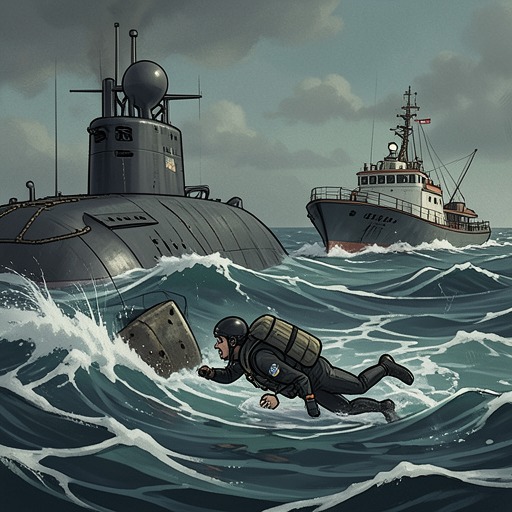
The Jefferson group sank the Russian submarine in the southern Black Sea. The book identifies the sinking as accidental and records its human cost: at least fifteen Russian nationals were killed. It does not present the event as a deliberate attack on Russian forces. Instead, the circumstances place it in the fraught space between threat assessment and irreversible action, where crews must make decisions before uncertainty has been resolved.
A later discussion explains the tactical argument for the action without erasing the loss. At the range involved, a torpedo would probably have been wire-guided; sinking the submarine would therefore stop the torpedo. On that reasoning, the American personnel acted correctly against a possible immediate threat. The logic is stark: the same action that could prevent a torpedo from reaching the Jefferson also destroyed the submarine and killed its crew. The label of accident describes the outcome, but does not make the encounter inconsequential or remove the pressure under which the decision was made.
Casualties and Diplomatic Consequences
The submarine’s surviving crew members were aboard the Jefferson while arrangements for their return were being discussed. That detail makes the carrier group both the site of the deadly encounter and the place where its aftermath had to be managed. Three days after the sinking, General Boychenko, the de facto military ruler of the Crimean Peninsula, offered to surrender the Crimean Military District to international control. His people approached the U.S. ambassador to the United Nations during discussions about returning the Russian submariners.
General Boychenko publicly framed the offer as a way to prevent the civil war from expanding. In Washington, however, officials considered other possible motives, including his concern that Ukraine might assert itself. The proposal thus gave the submarine incident a political dimension: a military loss became entangled with the future status of Crimea and with negotiations involving a powerful regional commander. The offer was not simply a humanitarian or technical question about returning sailors. It raised the stakes of deciding who would control a territory already caught in a divided Russian conflict.
Command and Responsibility
The sinking also figured in a broader argument about the coordination of American forces. In a White House discussion, Secretary of State Samantha Reed cited two recent accidents: a Navy jet had shot down a U.S. Army helicopter on a United Nations mission, and the Jefferson carrier group had accidentally sunk a Russian submarine, killing at least fifteen Russian nationals. Reed argued that placing forces under a shared command infrastructure could help prevent such incidents. Her argument treated the submarine sinking not as an isolated error but as part of a pattern in which forces operating in the same crisis could lack common procedures and coordination.
The helicopter incident made the information problem explicit: the Army helicopters had not received the computer codes that would let their radars identify them as friendly. The book does not equate that failure with the submarine encounter, but places both accidents in the same policy debate. The United Nations requested operational authority over U.S. forces in the Crimean Peacekeeping Operational Zone, and Washington granted it. The American commander told his officers that they would operate under United Nations command until the President said otherwise, while insisting that they continue to obey the commander in chief and maintain military decorum.
The sinking therefore marks more than a tragic result of an undersea confrontation. It connects the risks of acting on sonar evidence, the deaths of Russian personnel, the handling of survivors, and the political effort to place Crimea under international control. Its aftermath shows how an accident can alter the argument about command: the question is no longer only who may give an order, but how separate forces can recognize, coordinate with, and avoid harming one another in a crowded and politically unstable operation.