First Air Battle over the Bosphorus Strait
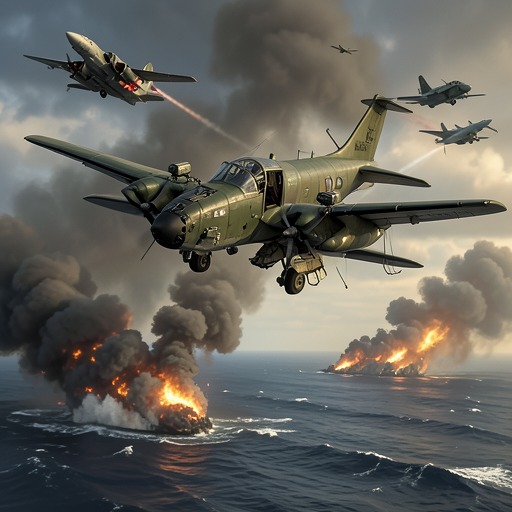
AfterburnThe First Air Battle over the Bosphorus Strait is a sudden, disorienting air engagement in which crews aboard Tomcat 218 confront hostile MiG-29s without being able to identify their national markings. The fight turns on the gap between recognizing an aircraft as dangerous and knowing who is flying it: missiles arrive before certainty does, and an explosion leaves Mickey unresponsive. The available account does not confirm the crew’s final fate or the battle’s tactical result.
Political and Strategic Background
The encounter unfolds amid a larger contest over Crimea and the Black Sea. Ukraine had never been wholly comfortable with its place in the Union, and ethnic Ukrainians were not Russians, whatever outsiders might assume. As Russia was consumed by civil war, Ukrainians sought to strengthen their position, particularly in Crimea. The peninsula was regarded geographically as part of Ukraine, while the Russian Federation bordered it to the east; the old dispute between Kiev and Moscow over Crimea and the Black Sea Fleet remained unsettled.
That dispute sharpened the meaning of military action without making its immediate circumstances clear. In a political argument over intervention, Scott challenged the claim that intervention would preserve peace by pointing to the turmoil across the region. The secretary countered that Ukraine had not attacked yet. The exchange records competing readings of a volatile situation, not a settled explanation for the air battle. In the engagement itself, the crews’ inability to see identifying markings makes that uncertainty concrete: they face an unmistakably hostile aircraft, but cannot tell who is fighting them.
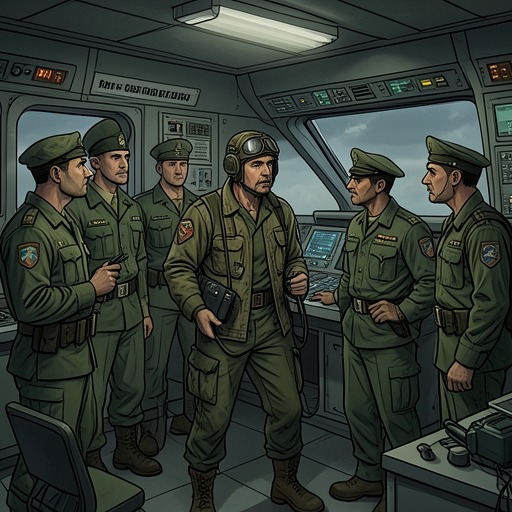
The Jefferson’s position also carried a logistical danger independent of the combat’s immediate result. Although nuclear-powered, the carrier needed replenishment of expendable supplies every two to three weeks, and its aircraft consumed fuel. At a heavy flying tempo, the aircraft fuel margin would not last ten days; an alpha strike or an extended battle could shorten it further. The battle group depended on UNREP tankers following it across the sea. If the Bosporus closed, the Jefferson and its escorts risked being locked inside the Black Sea, with only two to four days of operational leeway under round-the-clock flying rather than the nominal ten.
The Fighters Make Contact
The chapter dates the action to Thursday, 5 November, at 1010 hours (Zulu +3), and places the scene in Tomcat 218. The attackers seem to appear from nowhere. Jamming and the confusion of the moment mask their approach as they come between Dixie and the now-distant Jefferson. The sudden positioning makes the carrier’s distance part of the danger: the crews must respond to the threat in front of them while separated from the ship that anchors their wider formation.
Badger warns Dixie to break left and announces a Fox Two launch, indicating that he has released a heat-seeking missile. The attackers are identified as MiG-29 Fulcrums, aircraft the pilot knew from studying silhouettes, films, and photographs of potential adversaries. Their capabilities make the identification consequential: the MiG-29 is described as able to reach Mach 2.23 at high altitude and climb 50,000 feet in a minute, as well as out-turning and out-climbing its opponents. Yet recognizing the type does not resolve the question of allegiance. The crews cannot make out a roundel or star on the fast-moving aircraft, and the uncertainty frustrates them even as the fight develops.
Missile Threat and Damage
The danger escalates when the Tomcat’s threat display indicates that a hostile aircraft has locked its radar onto them. Badger reports missiles inbound from bearing 302 and identifies them as what appear to be AA-9 Amos missiles. Mickey confirms that the missiles are on the scope at a range of 25 miles. The exchange conveys how the engagement is experienced through instruments and clipped tactical calls: the threat is detectable, measurable, and still immediate.
An explosion jolts Dixie hard enough to compare with the force of kicking in the afterburners. The blast comes from aft and left, followed by a piercing sound; for a moment, the aircraft’s controls go soft. When Badger checks in, Dixie says that the aircraft has taken damage and that Mickey is not answering. The scene establishes damage and a loss of communication with Mickey, but does not confirm that Mickey is dead, that the Tomcat has been destroyed, or that the crew has ejected. Its ending is therefore a suspended crisis rather than a documented resolution.
Consequences and Significance
The engagement’s political uncertainty echoes the dispute surrounding Crimea. The aircraft are hostile, and the MiG-29 identification is specific, but the pilots cannot see markings that would tell them whom they are fighting. The battle thus presents identification as an operational problem with wider stakes: in a region already divided by rival claims, the inability to distinguish an opponent’s identity reinforces the distance between military contact and political understanding.
The battle also belongs to a campaign in which air operations consume the very resources needed to keep the carrier force effective. Later, U.S. officials question whether the battle group can be reached and resupplied, while Magruder distributes estimates at a meeting. A subsequent refueling effort involves nearly three million gallons, about nine thousand tons, of aviation gasoline, with flight-deck operations suspended during pumping. These later details do not establish that the air battle caused the supply crisis, but they show why a prolonged fight and the closure of a narrow exit from the Black Sea could not be treated as merely tactical concerns. In the scene itself, however, the immediate cost remains personal and unresolved: Dixie has a damaged aircraft, and Mickey does not respond.