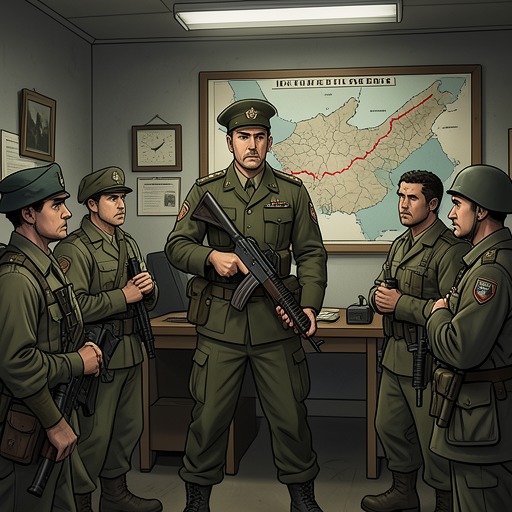
Operation Miaky
AfterburnOperation Miaky is the planned Black Sea Fleet sortie that General Boychenko presents as the last chance to preserve his command rather than retreat. Scheduled for two days later, it is framed not as a routine deployment but as a final gamble: the fleet is being prepared for what may be its last sortie, while manpower aboard Pobedonosnyy Rodina is too scarce to waste on wounded vanity. The operation’s significance lies both in that immediate military urgency and in the larger pressures surrounding the Black Sea, where political authority, mission limits, and the ability to keep forces supplied are all in question.
Political and command context
The plan emerges amid competing claims about who may direct military action. Whether American forces should accept UN command had been debated for years; in the Crimean Peacekeeping Operational Zone, that question becomes an active chain of command when Washington grants the UN operational authority over U.S. forces. The order is explicit in its scope: those forces are to operate under UN command until the President decides otherwise. That arrangement forms part of the setting around Operation Miaky, but it is distinct from Boychenko’s preparations for the Black Sea Fleet sortie.
The limits on the American mission are also sharply drawn. The National Command Authority directs that U.S. forces must not involve themselves in fighting between the Red and Blue Russian factions, and the Marines are permitted to go ashore at Poti only. This restriction sits uneasily beside the broader purpose of sending the Jefferson and its air wing to strengthen the UN’s position. The operation therefore takes place in a crisis where military presence does not mean unrestricted authority: forces may be deployed, but their permitted role remains politically bounded.
Those boundaries carry domestic risk as well. The President is already under pressure over foreign policy, and advisers consider another overseas intervention a potentially ill-advised venture. Operation Miaky is not described as the cause of that political strain; rather, the strain helps define the atmosphere in which wider decisions about the Black Sea crisis are made. The operation’s urgency on the Russian side thus runs parallel to a separate question on the American side: how much authority and risk the United States is prepared to accept in a UN-directed mission.
Preparation and stated purpose
General Boychenko describes Operation Miaky as the one remaining hope, setting it against mass retreat, abandonment of duty, and what he calls treason. The language turns the planned sortie into a test of loyalty and collective purpose. Retreat is not presented as a neutral tactical choice; in his appeal, it would mean surrendering both the mission and the obligations that hold the force together. His framing makes the operation a means of keeping the command intact, even as the available manpower makes prolonged resistance increasingly difficult.
The immediate timetable gives this appeal a concrete edge. The operation is scheduled for two days hence, with final preparations to ready the Black Sea Fleet for what will probably be its last sortie. The wording marks a narrowing horizon: the fleet is not simply preparing to go to sea, but preparing for a mission that may exhaust its remaining capacity to act. The account establishes the schedule and the purpose attached to it, without describing the sortie’s course or outcome in these passages.
Scarcity shapes the decision before the fleet sails. Manpower within Pobedonosnyy Rodina cannot be squandered merely to satisfy ego or wounded vanity, yet Boychenko needs to keep his command together for a little longer. The tension is practical as well as rhetorical: preserving cohesion requires restraint, but the planned operation demands readiness for a decisive commitment. The two-day interval is therefore both preparation time and a brief reprieve for a command under pressure.
The wider logistics of the Black Sea crisis
The American carrier group’s constraints illuminate the wider importance of sustainment in the same theater, though they are not presented as the direct cause of Operation Miaky. A nuclear-powered carrier such as the Jefferson does not need fuel for its own propulsion, but its aircraft consume aviation fuel, and the ship requires replenishment of expendables at sea every two to three weeks. Under heavy flight operations, aircraft fuel may last no more than ten days; a major strike or an extended running battle would reduce that margin further. The group depends on UN replenishment tankers following it across the sea.
The danger becomes acute if the Bosporus Strait closes. With continuous maneuvers and aircraft flying around the clock, the Jefferson’s remaining operational leeway could fall to two to four days, after which the carrier and its escorts would be trapped in the Black Sea with sharply diminished usefulness. Later, officials debate whether the force can be reached and resupplied, and estimates are passed around a conference table. In another stage of the crisis, the aviation-fuel requirement is quantified at nearly three million gallons, about nine thousand tons. These details establish how access, fuel, and the passage through the strait can constrain military choices even when a carrier itself is nuclear-powered.
That logistical picture gives the planned sortie a larger setting without making the two forces’ circumstances identical. Operation Miaky is identified as a Black Sea Fleet sortie; the Jefferson’s fuel and replenishment problems belong to the American battle group. Together, however, the parallel pressures show a theater in which command decisions depend on time, access, and scarce resources as much as on the stated resolve of leaders.
Significance and narrative function
The operation is framed through anticipation rather than a narrated battle. Its date is near, its preparation is underway, and its likely finality is stressed, but the passages establish no completed sortie or battlefield result. That distinction matters: the operation’s immediate force in the story comes from what it makes imminent and from the demands placed on Boychenko before the outcome is known.
Its imagery extends the threat beyond the fleet itself. Boychenko’s description of Miaky as a cold wind that will be felt across the Black Sea and beyond the region enlarges a scheduled military action into a prospective international shock. The image also echoes the operation’s stark timetable: a brief interval of preparation precedes consequences expected to travel far beyond the ships involved. In this framing, Operation Miaky is at once a last attempt to hold a command together and a warning that the crisis may exceed the limits of any single force or mission.