Jefferson Refuels at Arsincevo
AfterburnJefferson Refuels at Arsincevo is a precarious logistical operation that exposes how the Thomas Jefferson battle group’s ability to keep fighting depends on aviation fuel, access to supply routes, and protection during replenishment. The carrier is nuclear-powered, but its aircraft consume fuel rapidly; at Arsincevo, the group attempts to replace a vulnerable dependence on supply ships with a shore-side transfer conducted under enemy threat.
Strategic Need
A modern carrier such as Jefferson requires replenishment of expendable supplies every two to three weeks. Nuclear propulsion removes the carrier’s own fuel requirement, not that of its aircraft, whose consumption can quickly constrain the group’s operations. In the surrounding account, the available margin is estimated at ten days at most, and less under a heavy flight schedule. Maneuvering while flying aircraft around the clock could reduce that leeway to just two to four days.
The group’s usual resupply depends on UNREP tankers following it at sea. That dependence becomes especially dangerous in the Black Sea: if the Bosporus Strait closes, the carrier and its escorts risk being trapped with dwindling supplies and no dependable route out. After the remaining margin is spent, the account warns, they would be little more than costly, ineffective ships. Refueling at Arsincevo therefore addresses more than an immediate shortage. It is an attempt to sustain the battle group in a confined sea where the routes and time available to it are limited.
Preparing the Arsincevo Dock
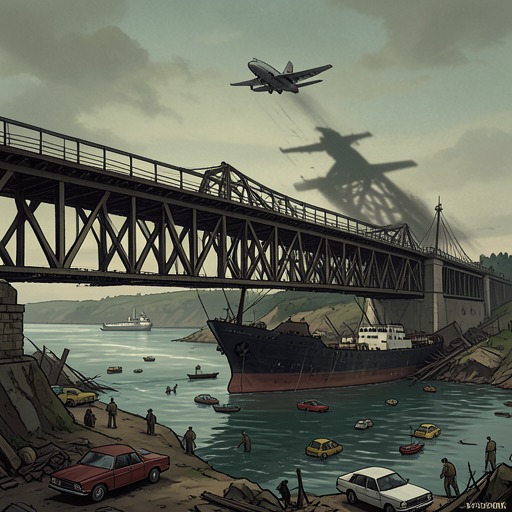
The fueling dock lies offshore south of the naval base at Kerch, linked to the shore by a bridge and a large bundle of petroleum-loading lines. Before the carrier approaches, the frigate Leslie checks the dock’s approaches, confirming that the channels are clear and deep enough for Jefferson’s substantial draft. The approach itself is thus part of the operation: the fuel source is useful only if the supercarrier can reach it safely.
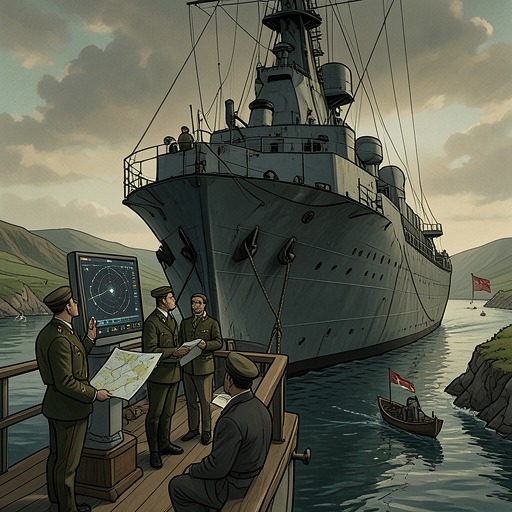
Two hours before the bridge scene, fuel handlers from the Air Wing’s V-4 Marines had boarded the dock and begun preparing it for the transfer. Commander Tom Hadley watches from the starboard side of Jefferson’s bridge, looking down at the dock and across the water toward the shoreline a mile away. The scene frames the operation as a threshold: the group’s ability to continue depends on bringing a vulnerable ship into position beside infrastructure on shore.
The avgas is inspected before it is taken aboard. A V-4 officer judges it suitable for Jefferson’s demanding standards, clearing the way for the next step: pumping nearly three million gallons, or about nine thousand tons, onto the carrier. The scale of the transfer makes the dock more than a convenient stop. It is a substantial, exposed supply point on which the group’s immediate operational endurance rests.
The Transfer Under Threat
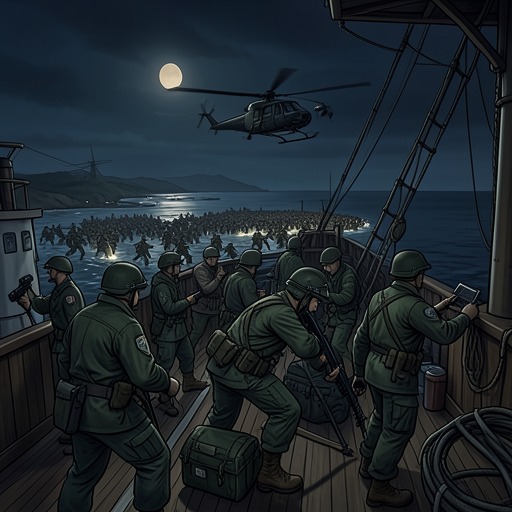
Flight-deck operations are suspended during fueling. For roughly thirty minutes—the critical period needed to move the fuel from shore to ship—Jefferson must rely solely on its fighter cover for defense from the enemy. The carrier cannot simply continue its normal rhythm of launching and recovering aircraft while the transfer proceeds; its effort to replenish the aircraft instead temporarily restricts activity on the deck.
The fuel itself compounds the danger. Nearly three million gallons of avgas are highly flammable, and the passage notes the possibility that weapons fire could ignite gasoline fumes spilling from the carrier’s starboard side. The operation therefore joins logistical necessity to immediate tactical exposure: Jefferson needs the fuel to preserve its air operations, but taking it aboard creates a period when fire and attack could have catastrophic consequences. The fighter cover is not incidental protection; during the transfer, it is the battle group’s stated defense.
Significance and Limits
The scene makes the carrier’s nuclear power an incomplete answer to the problem of endurance. Jefferson does not need fuel for its own propulsion, yet its aircraft do, and their consumption links combat tempo directly to the availability of replenishment. A heavy schedule shortens the margin; a shore transfer offers a possible remedy, but only by pausing flight-deck operations and accepting concentrated risk alongside the dock.
Arsincevo also changes the geography of the supply problem. The battle group’s ordinary dependence on tankers at sea gives way, at least for this operation, to a dock connected to shore by a bridge and petroleum lines. The same arrangement that makes large-scale transfer possible leaves the carrier alongside a fixed facility during its most vulnerable half-hour. The episode thus presents sustainment not as background administration but as a combat condition: without fuel, the carrier’s air power cannot be maintained; while taking on fuel, that power cannot operate in its usual fashion. The available account establishes the preparation, the quantity to be transferred, and the defensive constraint, but does not describe the transfer’s completion.