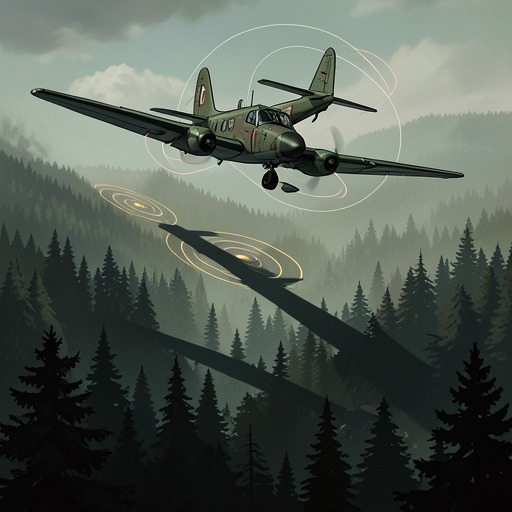
Shilka Radar Lock on the Bird Dog Flight
AfterburnThe Shilka Radar Lock on the Bird Dog Flight is a sudden shift from visual suspicion to confirmed danger in a confined valley. Dixie and Cat approach a squat vehicle beside the road, then lose a radar contact around a canyon bend; when it reappears, Cat identifies the signal as a Shilka rather than a helicopter. The episode makes the terrain part of the threat: the aircraft are moving through a rock-walled passage while a short-range antiaircraft system tracks them.
Approach through the valley
The flight is following a valley that, according to the map, runs toward Chaisi among the ice-capped peaks ahead. Dixie spots a squat vehicle parked alongside the road and points it out to Paul Dombrowski, remarking that it looks like a “Zoo.” The term is slang for the ZSU-23-4 Shilka, a tracked antiaircraft vehicle mounting four AZP-23 cannons. Its presence turns an otherwise ordinary roadside sighting into a warning: the aircraft are passing through a route where a ground-based weapon can threaten them.
The terrain soon narrows the flight’s options. The valley makes a sharp left turn, and steep slopes rise vertically on either side, forming a tight, rock-walled canyon. A radar contact less than two miles ahead disappears from the screen as it passes around the bend. The contact’s temporary absence does not mean the danger has passed; the curve has simply put it out of view, while the walls channel the aircraft toward the same concealed stretch of valley.
Contact and identification
Dixie tells Cat to keep watch because the contact should be just beyond the bend. Cat interrupts with a new warning: radar contact has returned, and the flight is being painted. When Dixie asks whether the source is the helicopter, Cat answers that the signal is not a helicopter and reads it as Gun Dish. Dixie immediately recognizes the designation as a Shilka.
That exchange is the decisive turn in the episode. The earlier vehicle had looked like a “Zoo”; now the radar indication identifies the immediate threat as the Shilka system. The scene moves from inference based on a roadside shape to a warning that the aircraft have been detected and tracked. Cat supplies the crucial contact report, while Dixie interprets the signal and makes the flight’s immediate response.
Dixie’s response and the tactical danger
Dixie’s first instinct is to pull back on the stick and climb for altitude. He restrains that reaction, keeping the Tomcat’s altitude steady as he eases into the canyon’s dogleg. The choice is presented in the context of the narrow route and the sudden radar lock: he does not simply turn away or make an immediate climb, but continues through the bend while maintaining the aircraft’s existing altitude.
The Shilka’s range makes altitude especially relevant. It is described as relatively short-ranged and unable to reach targets more than about a mile above it. Yet that limitation offers no easy protection in the moment: Dixie is already committed to the canyon’s turn, and the radar has confirmed that the ground weapon is tracking the flight. The episode leaves the encounter at that point, establishing the danger and Dixie’s response without stating here how the aircraft ultimately evade or engage the system.
Narrative significance
The scene builds suspense through delayed identification. The first clue is a vehicle seen beside the road; then the radar contact disappears behind terrain, briefly withholding what lies around the bend. Cat’s report resolves the uncertainty, but the answer is more dangerous than the helicopter Dixie asks about: the flight is being painted by a Shilka. The canyon’s geometry makes that reveal consequential, because the aircraft are already inside a narrow corridor rather than in open sky.
The lock also gives the threat a specific tactical shape. The Shilka is formidable at the flight’s present level but has a stated altitude limit; the same terrain that obscures the contact also constrains the aircraft’s immediate maneuver. By coupling a precise radar warning with a concrete, familiar vehicle and a sharply turning valley, the episode makes danger legible before its outcome is known.