Conservatory
AsylumThe Conservatory is an ornate, once-abandoned glasshouse at the far end of the Vegetable garden by the Deputy superintendent’s house. Restored by Max Raphael with Edgar Stark’s labor, it becomes the secluded setting where Edgar and Stella Raphael begin their sexual relationship. Its changing condition—ruin, repair, then desolation—registers the affair’s course in the material landscape around the Raphael family’s home.
Setting and condition
Built in the nineteenth century to cultivate orchids, lilies, and other delicate tropical plants, the Conservatory had once been an airy and imposing structure. By the time Max and Stella arrived at the hospital in the summer of 1959, however, it was so run-down that demolition had been discussed. Many panes were broken; the remaining glass was dulled by dust and cobwebs. Paint had flaked away, wood was rotten or splitting, and birds, mice, and spiders had taken shelter inside. Weeds pushed through cracks in the stone floor. The building’s elaborate workmanship survived, but its intended cultivation of fragile plants had given way to neglect.
The glasshouse stood at the far end of the Vegetable garden, apart from the large, dark Deputy superintendent’s house near the Main Gate. The garden itself had been neglected before the Raphaels came. Max took an interest in putting the house’s grounds in order, cleaning and restocking the goldfish pond and cutting back the rhododendrons. Of his projects, the Conservatory’s restoration particularly engaged him: its intricate glazing and joinery, Romanesque window arches, and Victorian character appealed to his affection for the period. Its isolation at the end of the garden would also give it a different role from the orderly domestic spaces Max was repairing.
Restoration and Edgar Stark
Max found a potential restorer among the hospital’s parole patients: Edgar, a sculptor whose artistic reputation preceded his admission. Edgar had been at the hospital for five years and could function with considerable intelligence, but he remained convinced that his wife, Ruth Stark, had been unfaithful and that her murder was justified. The everyday details he treated as evidence—a stain, a flushed toilet, or a box of washing powder on a windowsill—showed how fixed his delusion remained. Because he had no insight into the killing, the hospital did not consider him ready for release, even though he had otherwise recovered his sanity and took part in hospital activities.
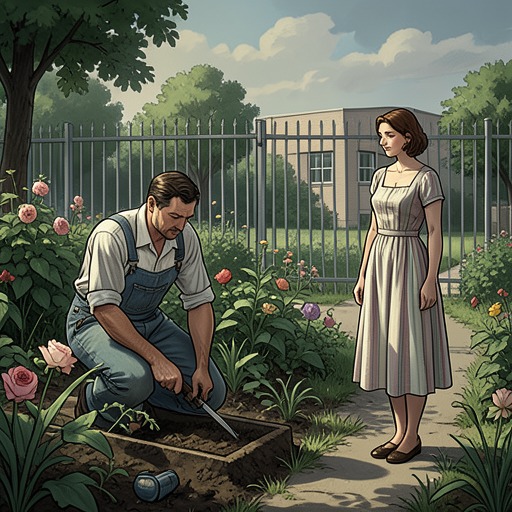
Edgar’s assignment placed him in the Raphael garden as a working parole patient, under the supervision of an attendant. He began replacing the Conservatory’s damaged woodwork. The restoration joined new struts and sashes to the sound old wood with a precise fit; afterward, the pattern of old and new was described as pleasing to the eye. That visible improvement makes the building more than a backdrop to the affair: it is a work in progress entrusted to a man whose apparent competence and charm coexist with a dangerous, unresolved conviction. Max’s project brings Edgar into Stella’s daily surroundings, while the routine work parties and the attendant’s supervision mark the institutional rules that their encounters will evade.
A place of clandestine intimacy
Stella often went into the garden to pick vegetables or flowers and saw Edgar working. When the attendant was not in sight, she sat with him and talked. She recognized her attraction but tried to dismiss it, finding reasons to visit the garden and telling herself that befriending a patient could do no harm. The Conservatory’s restoration thus supplies a practical reason for their proximity, while its broken and partly screened interior offers a space beyond the ordinary household routine.
Their first sexual encounter takes place inside it. Stella crosses the overgrown former lawn and waits in an arched opening in the garden wall near the Conservatory. She hears Edgar at work and the sound of broken glass going into a dustbin; her shadow falls across the path. When he appears, she pulls him inside and kisses him. They lie on the floor, hidden from view by the low stone wall at the base of the frame. The building’s damaged fabric becomes part of the scene’s privacy: the encounter occurs amid the repair work, behind a low barrier, in a structure that is neither fully restored nor wholly abandoned. Afterward Stella returns to the house and takes a long bath, unable to acknowledge plainly what she has done, though she is already aware that she will do it again.
Absence and significance
Edgar later escapes from the hospital wearing Max’s clothes, which he retrieves from hiding in the woods at the end of the Raphaels’ garden. After his disappearance, no working party comes out to the estate. Stella notices the absence of the yellow-corduroy-clad patients and enters the Conservatory, now desolate to her. The new pieces of wood remain carefully fitted among the old, but that evidence of Edgar’s work sharpens rather than eases his absence. She lies on the cracked stones where she and Edgar first lay together, cries, then leaves to pull rhubarb and attend to the neglected garden. Flowers droop, the hydrangeas have collapsed for want of water, and the hose hangs unused. The garden’s missed care and the unfinished history of the restoration become inseparable from her loss.
The Conservatory holds several stages of the same story in one bounded place: deterioration, skilled repair, forbidden intimacy, and abandonment. Its restored joints preserve a tangible trace of Edgar’s work even after he is gone, while its cracked floor and surviving weeds recall the encounter that Stella cannot bring herself to examine directly. It is not the site of Edgar’s escape itself, but its position within the garden links private desire to the larger grounds through which he leaves. The building’s changing appearance therefore gives physical form to the affair’s instability: what seems to be recovering remains exposed to damage, and what has been repaired becomes a memorial to an absence.