Maximum-security hospital and grounds
AsylumThe Maximum-security hospital and grounds is a walled institution whose architecture makes order visible and whose gardens give that order a porous edge. It is where Max Raphael’s household takes shape, where Edgar Stark is allowed to work under parole, and where the limits of supervision become consequential. The estate is not simply a backdrop to confinement: its walls, wards, paths, and cultivated spaces organize the characters’ contact and their chances of crossing the boundaries imposed on them.
Site and architecture
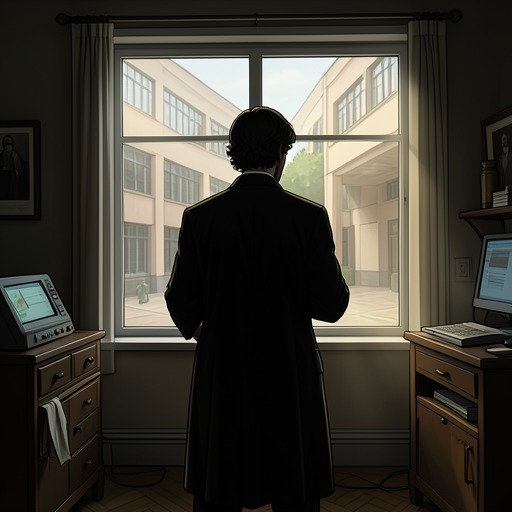
The hospital stands on a high ridge, dominating the surrounding country. Dense pine forest stretches to the north and west, while marshland lies to the south. Its scale and position give it the character of a walled city, set apart from the landscape it overlooks. The hospital follows a Victorian linear plan, with wings radiating from the main blocks so that ward windows look over terraces towards open country and the Hospital perimeter wall.
The building’s arrangement is described as a moral architecture: regularity, discipline, and organization are built into its form. Doors open outward, making them impossible to barricade, while windows are barred. These measures define the wards as controlled spaces even as the outward-facing views keep the surrounding countryside in sight. Below them, the terraces descend by flights of stone steps towards the perimeter. Trees, grassy banks, and flower gardens soften the severity of the carceral setting without removing its boundary.
The deputy superintendent’s house and garden
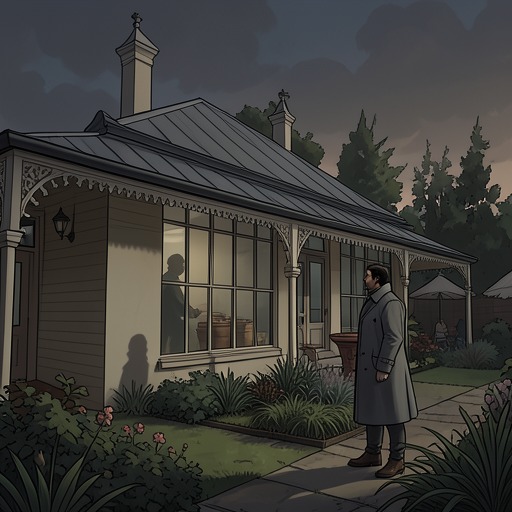
The Deputy superintendent’s house stands about a hundred yards from the Main Gate, set back from the estate road and screened by pine trees. Built of the same grey stone as the hospital, it is a large, dark house, oversized for the Raphael family because it had been designed for doctors with large households and at least two servants. It had stood empty for several years before their arrival, and its garden had grown neglected and wild.
Max takes an immediate interest in restoring the place. He clears and restocks the goldfish pond behind the house, then cuts back the rhododendrons around the lawn until they flower. His most ambitious project is the Conservatory at the far end of the Vegetable garden. The nineteenth-century glasshouse was built for orchids, lilies, and other delicate tropical plants, but by the Raphaels’ arrival it is close to ruin: much of the glass is broken, the remaining panes are obscured by dust and cobwebs, paint has flaked away, and parts of the woodwork have rotted. Birds, mice, and spiders have settled inside, while weeds push through the stone floor. Max’s affection for Victorian design makes the damaged structure an object of particular interest rather than a building to demolish.
Work parties and parole
The garden’s restoration brings the hospital’s internal system into the household’s daily surroundings. Edgar Stark, a sculptor and parole patient, is assigned to work on the Conservatory for Max. Each summer morning, supervised groups of parole patients leave through the Main Gate to maintain the estate grounds. They wear baggy yellow corduroy trousers and blue shirts, with white canvas jackets slung over their shoulders. Their work takes them outside the wards and into the hospital landscape, but they remain under attendant supervision.
Edgar is placed in the group working in the deputy superintendent’s garden. Stella Raphael regularly sees him when she goes out to gather vegetables or flowers. If the attendant, John Archer, is not visible, she sits with Edgar and talks. The arrangement makes contact possible within an apparently authorized routine: the patients are at work, the garden belongs to the deputy superintendent’s household, and Stella can present her visits to herself as friendly rather than dangerous. The estate’s cultivated openness thus permits an intimacy that the ward system would otherwise restrict.
Wards, supervision, and escape
The hospital’s control depends on more than its walls. Edgar has a room in the ground-floor ward in Block 3, where the dayroom, attendants’ office, and two small interview rooms are arranged along the ward. One interview room contains a telephone connected through the hospital switchboard. Edgar manages to use it to call Max Raphael, apparently by impersonating an attendant to the switchboard operator. How he gains access is never established; the call is risky because discovery would cost him his parole status. The interior’s supervised routine contains a small point of access that he is able to exploit.
The grounds also expose the limits of supervision beyond the wards. After telling John Archer that he is wanted in the chaplain’s garden, Edgar leaves the work party and retrieves Max’s clothes, which he has hidden in the woods at the end of the Raphaels’ garden. Wearing them, he keeps away from the road until he is clear of the estate, then makes his way onward by an unknown combination of hitchhiking, bus, or train. The hospital raises the alarm only after his absence is discovered. The account identifies lax security on the outside work parties as a concern, while also drawing attention to the delay before Max reports that Edgar is missing. A landscape designed to contain patients has provided both the cover and the route for escape.
Institutional order and its limits
The hospital’s wards impose distinctions that patients learn to read as carefully as the architecture. On the admissions ward, disruptive or visibly distressed behavior is expected and therefore does not necessarily distinguish one patient from another. In the downstairs women’s ward, by contrast, patients are understood to have taken an initial step towards recovery when they can appear to accept confinement and regulate their conduct in front of attendants. From the patients’ perspective, this can mean performing calm while privately enduring bitterness, grief, or frustration; from the institution’s perspective, the self-control involved is treated as part of getting better.
Moving downstairs brings greater privacy and some freedom of movement, and patients are permitted to wear their own clothes. For Stella, the change is visible in her dark skirt, elegant cream blouse, and brooch, as well as in her slower, more deliberate manner. The shift from ward to ward therefore changes not only supervision but also how a patient may present herself and where she can be unseen. Across the estate, the same tension recurs: the hospital classifies, observes, and restricts, yet patients find degrees of privacy and movement within those arrangements. Its terraces, gardens, work sites, and wards make institutional power tangible while showing that control is never complete.