Horsey Street warehouse loft
AsylumThe Horsey Street warehouse loft is the hidden London refuge where Stella Raphael reunites with Edgar Stark after his escape from the hospital. Its deserted yard, decaying stairways, and shadowed industrial rooms make it an unsettling place to enter; its studio and makeshift sleeping platform then become the setting for the intimacy and imagined freedom that draw Stella back. The contrast between refuge and menace gives the loft a central role in the secret life she builds around Edgar.
Setting and Approach
The loft stands at the top of a warehouse building reached from an empty yard near the river. On Stella Raphael’s first journey there with Nick, the car turns off a deserted street into the yard behind a warehouse. Buildings enclose three sides; on the fourth, a railway viaduct spans a wholesale fruit and vegetable market. The market is empty, and padlocks hang from its gates and fences. This is not an inviting entrance into a private home but a back route through a shut-down commercial landscape.
The approach makes Stella’s apprehension physical. Nick leaves her by the car, then leads her through a rear passage that is dark and foul-smelling. At its end, a steep, narrow staircase rises into damp, chilly shadows. The steps sag and creak, and a loose wooden rail runs along the plaster. Nick stays at the foot of the stairs, gesturing for her to continue alone. As Stella passes several landings, the building’s height and isolation prolong her uncertainty before she reaches the top floor.
A dusty window on the upper landing looks down into the yard. When Stella sees Nick opening the car door below, she draws back and knocks over a metal pipe; its clatter raises dust in the empty building. The loft door opens onto a room so large that the light from a row of windows does not reach beyond the beams down its middle. At the far end are more doors, set in walls where missing plaster exposes the underlying laths and studs. The scale, darkness, and disrepair make the place feel both abandoned and difficult to read.
The Studio and the Reunion
Stella finds Edgar Stark waiting in the shadows. She calls his name, steps into the room, and runs to him when his sudden appearance startles her. In her recollection, the reunion gives way quickly to sex: they hurry to the room Edgar calls his studio, climb to a sleeping platform, and lie together on a mattress. The loft’s interior is therefore not merely a hiding place. It gives their relationship a private room and a bed beyond the hospital grounds where their earlier intimacy had to remain quiet.
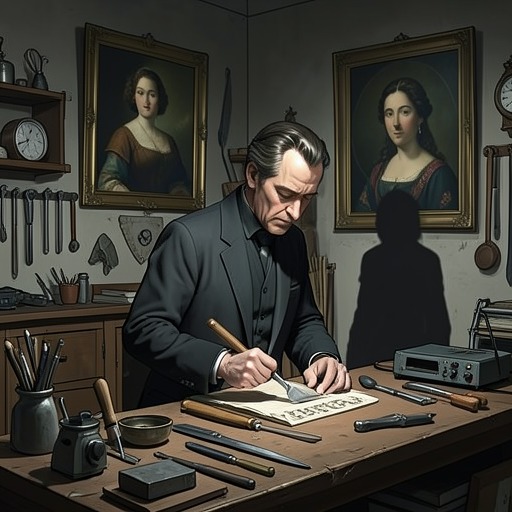
Afterward, they talk about the days since Edgar’s escape. He has reached London, where Nick brought him to the loft and gave him the studio. Stella describes the space as raw industrial room: grimy brick walls, high ceilings crossed by pipes, and three large dusty windows facing a shuttered warehouse. A huge trestle table against one wall is scattered with drawing paper and other materials. These concrete signs of work give the room an identity as an artist’s studio even amid its neglect.
Stella wanders through it in her open raincoat, drink in hand, picking up and examining objects. She says the artist’s room makes her feel bold, original, and free. That response contrasts with the room’s grime and isolation: the same neglected interior that makes the meeting frightening becomes, to Stella, a space of possibility. The studio’s makeshift openness seems to offer release from the social forms and family routines she has left behind, although the conditions of their life there remain precarious.
A Place for Repeated Visits
The first reunion establishes a pattern rather than a settled home. Stella returns to the loft on Fridays, with Nick acting as driver and intermediary. On a later visit, she recognizes Horsey Street and climbs the familiar stairway with little attention to its gloom, creaking steps, or foul smell. She goes straight into the loft, where Edgar comes toward her, and they spend the afternoon together in bed. The building’s disagreeable route has become familiar enough to recede when she is intent on seeing him.
Stella brings Edgar clothes, soap, and whisky. Their time together passes quickly, and drinking on an empty stomach leaves her unsteady when she comes down into the studio and struggles to pull on her skirt. On the walk along Horsey Street, she realizes that she must regain control before going home: arriving visibly drunk from an ostensible shopping trip would defeat her effort to remain unnoticed. Her return journey includes coffee and a sandwich at Victoria Station before she boards her train. The trip links the warehouse to the ordinary life she must continue to perform elsewhere.
That double existence gives the loft its particular function. At home, Stella maintains responsibilities, appearances, and routines pragmatically, because attracting attention or interference might prevent her from visiting Edgar. At Horsey Street, those structures fall away for the hours she spends with him. The loft supports the affair not by offering comfort or security, but by allowing a temporary separation between Stella’s concealed visits and her public domestic life.
Waiting, Secrecy, and Narrative Significance
The loft also becomes a place of uncertainty. When Stella arrives carrying a suitcase, she finds the top-floor door locked and receives no answer. She has not considered that Edgar might be absent. After knocking and calling through the door, she waits on her suitcase at the top of the stairs, with nowhere to hide. Twenty minutes later, footsteps approach, and the figure who appears is Nick. Her relief at seeing him shows how much she depends on the route and its intermediary, but his explanation that her arrival was unexpected exposes the limits of the arrangement: she has no assured access to Edgar or to the refuge she has chosen.
Nick asks whether Stella is with them, and she confirms that she is. He throws an arm around her neck, and the two enter the loft embracing in the middle of the floor. The gesture marks her move from visitor to participant in the life organized around Edgar and the warehouse. Yet the building does not erase the people she has left behind. Recalling her departure, Stella can imagine Max Raphael returning home to find her gone and Charlie Raphael coming back from school; she has deliberately avoided thinking about the effect of her disappearance on Charlie. The loft’s separation from home makes that evasion possible for a time, not harmless.
In the novel’s account, the location gathers opposing meanings without resolving them. Its locked gates, hidden approach, exposed walls, and dark upper room give secrecy a physical form; its studio, bed, and open floor allow Stella to experience the relationship as an escape from constraint. Repeated journeys make the loft a focal point for the affair, while the precariousness of those journeys keeps it from becoming a secure home. It is a refuge sustained by concealment, and the freedom Stella associates with it depends on her continuing to ignore what that concealment costs.