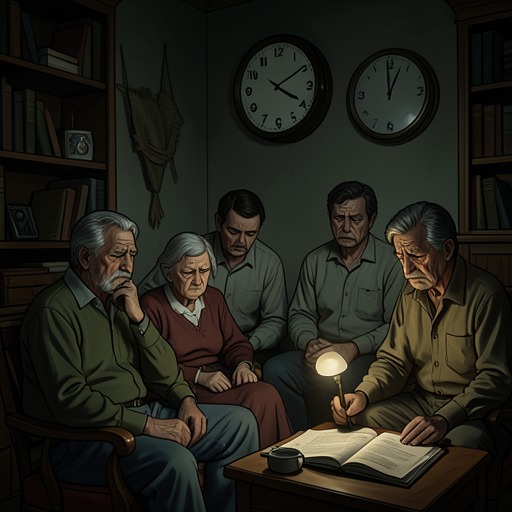
Deputy superintendent’s house
AsylumThe Deputy superintendent’s house is the Raphaels’ residence beside the hospital grounds and the domestic setting in which the public order of their household begins to conceal a private life. Its gardens are first presented as a neglected estate to be restored; later, the back door, hall, and upstairs bedroom become points of entry into the family’s intimate world. The house’s significance lies in that contrast: it is both an official home near a place of confinement and the setting where Stella Raphael’s relationship with Edgar Stark becomes increasingly difficult to keep separate from family life.
Identity and Setting
The house stands only a hundred yards from the Main Gate, set back from the estate road and screened by pine trees. Built of the same gray stone as the hospital, it is large and dark, and its scale reflects an earlier household arrangement: it had been designed for doctors with large families and at least two servants. By the time the Raphaels arrived, it had stood empty for several years. Its neglected garden made the residence feel less like a completed home than an inherited space awaiting renewed care.
That proximity to the Main Gate places the house close to the institution without making it part of the wards. The residence gives Max Raphael and Stella a household of their own, yet the hospital remains immediately nearby, and people connected to it cross the threshold. The house therefore occupies a divided position: private in its rooms and routines, but closely bound to the institution through Max’s office and the patients who work on its grounds.
Garden and Conservatory
Max takes an immediate interest in rehabilitating the neglected grounds. He has the goldfish pond at the back of the house cleaned and restocked, and the rhododendrons around the lawn cut back so they can flower. These practical improvements establish a pattern of care through restoration: Max responds to disrepair by making the estate orderly and usable again.
His principal project is the old conservatory at the far end of the vegetable garden. The large glasshouse had been built in the previous century for orchids, lilies, and other delicate tropical plants. When the Raphaels arrive, its panes are broken or filmed with dust and cobwebs; paint has flaked away, sections of wood have rotted and split, and weeds grow through the stone floor. Birds, mice, and spiders have taken shelter inside. Max’s affection for Victorian design makes the conservatory’s intricate glazing, joinery, and Romanesque window arches a source of particular pleasure, even though the building is dilapidated enough that demolition has been discussed.
The restoration brings Edgar Stark into the garden as a parole patient confident he can do the work. The conservatory thus connects the private grounds of the deputy superintendent’s home to the hospital’s parole system. It also places Edgar within the Raphaels’ domestic orbit before the affair is openly apparent: his work in the garden creates the circumstances for his later presence at the house.
Thresholds and Family Life
The back entrance becomes significant when Charlie Raphael falls from the garden wall beside the old apple tree. While Edgar is working up a ladder, Charlie climbs onto the wall and then into the tree. A branch breaks as he tries to step back, and he falls onto the path, briefly losing consciousness. Edgar carries him through the back door and into the house, calling for Stella and taking him through the kitchen and hall in search of a place to lay him down.
The arrival unsettles the household’s ordinary boundaries. Mrs. Bain, who helps with the housework, is at the kitchen table shelling peas; she objects to a patient entering without knocking and addressing the doctor’s wife by her first name. Stella comes downstairs in alarm, but Charlie recovers within minutes. She holds him while Mrs. Bain fetches a damp facecloth, then thanks Edgar for bringing him in. The episode makes the house a place where the hospital’s social distinctions meet the urgency of family care: Edgar crosses the threshold improperly in Mrs. Bain’s eyes, but his action has brought an injured child to his mother.
The house also holds the aftermath of Stella’s first sexual encounter with Edgar. Afterward she returns upstairs to the bathroom and stays in the bath for an hour, avoiding direct acknowledgement of what she has done even as the possibility of repeating it remains beneath her thoughts. Later, seated on the back lawn beneath an ash tree with a drink and a novel in her lap, she hears Max arrive at the front door. She welcomes him with unusual warmth, and the embrace carries an irony sharpened by her awareness of her guilt. The movement from bathroom to lawn to front door traces the affair’s immediate passage into the routines of married life.
Secrecy and Intrusion
On another morning, Edgar enters Stella’s upstairs bedroom while Brenda is staying in the house. Stella is startled by his appearance and conscious of the danger of being discovered, yet the risk also excites her. She and Edgar have sex in the marital bedroom, with their clothes left in a heap at the end of the bed. The scene makes the house’s privacy unstable: a room associated with Stella and Max’s marriage becomes the site of her concealed relationship with Edgar, while Brenda’s presence makes the possibility of exposure immediate.
The interruption is narrowly avoided when a car arrives in the drive earlier than expected. Stella and Edgar scramble to dress, laughing together, before he leaves the room carrying a bundle of Max’s clothes. Stella later sees that clothes are missing from several hangers on Max’s side of the cupboard. The house records the affair not only in the bedroom encounter but in this small, concrete disturbance of Max’s belongings and the household’s apparent order. Brenda then asks to use the bath while Stella is remaking the bed with clean sheets, an ordinary domestic request that follows the clandestine encounter without resolving its danger.
The Deputy superintendent’s house consequently changes in narrative function without changing its physical identity. Its garden first appears as a landscape Max can restore, and the conservatory draws Edgar into the household’s orbit. The same residence then becomes a place of accidental entry, concealed sex, and traces left among the family’s rooms and possessions. Its thresholds and private spaces expose the strain between the Raphaels’ orderly domestic appearance and the life Stella is trying to hide within it.