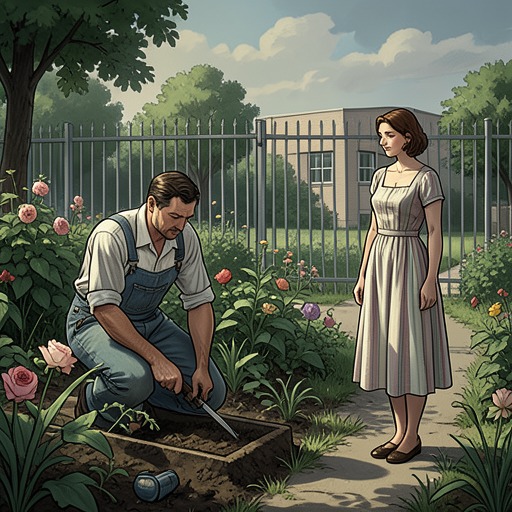
Vegetable garden
AsylumThe Vegetable garden is both a working part of the hospital estate and the setting in which Stella and Edgar’s acquaintance takes shape. Patients maintain its grounds under supervision, but its paths, workbench, and conservatory also become the places where Stella seeks Edgar out and where their relationship begins to acquire a private structure.
Setting and Daily Use
In summer, groups of parole patients leave through the Main Gate each morning to maintain the estate. Dressed in baggy yellow corduroy trousers and blue shirts, with white canvas jackets slung over their shoulders, they work under an attendant’s supervision. Edgar is assigned to the deputy superintendent’s garden. Stella sees him while picking vegetables or flowers, and when the attendant, John Archer, is not in sight, she sits with Edgar and talks. The repeated, ordinary nature of these encounters matters: his presence becomes part of her daily view of the garden, while her visits can be presented to herself as incidental.
The garden is also a worksite, not simply a secluded meeting place. Edgar works on the conservatory, removing broken glass from its frame and later chipping crumbling mortar from the brickwork at its base. Panes are stacked against a wall; a dustbin stands beside the ladder; the sound of breaking glass interrupts the afternoon quiet. The practical tasks give Stella a reason to approach and give the encounters their own visible circumstances. Her visits take place amid maintenance work, rather than in a space wholly set apart from the institution.
First Encounters and Growing Attraction
Stella’s interest develops through repeated observation and small incidents. One day, Edgar lifts Charlie Raphael from the ground by means of a spade, while Charlie clings to its shaft and counts as he hangs there. Edgar appears not to strain under the task. Stella notices his long, slender hands and wonders what work he did outside the hospital. The moment joins physical strength to the attentive way he handles Charlie; it is while watching the child suspended from the spade that Stella identifies the first stirrings of her interest.
The next day she chooses to return to the conservatory. Edgar is working on a ladder, carefully freeing broken glass from the frame and dropping it into the dustbin. When he sees her, he climbs down and removes his heavy gloves. He wipes the sweat from his face and hands with a red bandanna, watching her with an expression Stella experiences as both affable and challenging. She is at ease with their verbal sparring and immediately likes him. What begins as repeated viewing therefore changes into deliberate contact: she goes to see what he is doing, and the garden gives that choice the appearance of a plausible visit to a worksite.
The Garden as a Space of Crossing
The garden’s social boundaries are present even when no one states them. Stella is a doctor’s wife; Edgar is a patient; John Archer, the attendant, is responsible for supervising the work. In one encounter, Edgar kneels by the conservatory while Stella pauses on the path and Archer sits nearby. Edgar rises and silently holds her gaze. Stella understands the delicacy of the situation: Archer is owed deference in his institutional role, while Edgar occupies a lower status as a patient. Yet she also reads Edgar’s silence as a direct physical overture between a man and a woman. Rather than speak to Edgar, she asks Archer whether Charlie may help the men with the bonfire, and Archer agrees.
A later encounter makes the garden’s mixed character clearer. Edgar is at an old potting table used as his carpentry workbench. Stella has decided to act coolly and behave according to their respective situations, but seeing him makes her heart sing. He waits until she is almost beside him before turning; they stand face to face, and he touches her cheek as she trembles. The workbench remains part of the ordinary garden setting, but the encounter has become intimate. The space does not erase the difference between a patient and a doctor’s wife; it lets their private gestures occur within that difference.
From Repeated Meetings to Assignations
After an earlier incident in which Edgar behaved familiarly with Stella in front of another member of the household, Stella does not explain his behavior or distance herself. The episode helps establish a bond, and she later regards the other person’s attitude toward patients as absurdly hierarchical. Edgar’s accounts of hospital life deepen her involvement: she hears about an overcrowded ward, inadequate plumbing, lack of privacy, bullying, boredom, and uncertainty about the future. Although he has a room of his own as a parole patient, Stella begins to question whether he is mentally ill and thinks of his crime as a crime of passion. The garden is where this developing identification with him is sustained by face-to-face contact.
Their meetings eventually become assignations: they establish times and places despite Edgar’s limited freedom of movement. After Edgar is intercepted by John Archer, Stella goes to the garden the following day and tells him that they ought to get organized. The Vegetable garden has thus shifted from a place where supervised work makes conversation possible to a setting within the arrangement of their clandestine relationship. Its everyday routines provide cover and opportunity, while the conservatory and workbench mark the spots around which their encounters gather.
Narrative Significance
The garden’s importance lies in the contrast between its visible order and the private meanings Stella and Edgar make within it. Patients arrive in work clothes under supervision and carry out assigned tasks; Stella can plausibly be there to pick flowers or vegetables. Yet she repeatedly chooses to see Edgar, and the details of labor—glass, mortar, tools, and the potting table—become the material surroundings of attraction and secrecy. The garden is not outside the hospital’s authority: Archer’s presence and Edgar’s restricted movement remain consequential. It is a limited opening within that system, where an ordinary workday allows the relationship to begin and, eventually, to be organized.