Plas Mold
AsylumPlas Mold is the house in which Max Raphael, Stella Raphael, and Charlie Raphael begin their life after the move to the Welsh countryside. Part home and part landlord’s residence, it offers Stella no assured refuge: its exposed rooms and shared bedroom sharpen the strain of living with Max, while its surrounding landscape becomes the setting for Charlie’s drowning. After the tragedy, the house remains the place where Max stays, increasingly alone with his grief.
Arrival and setting
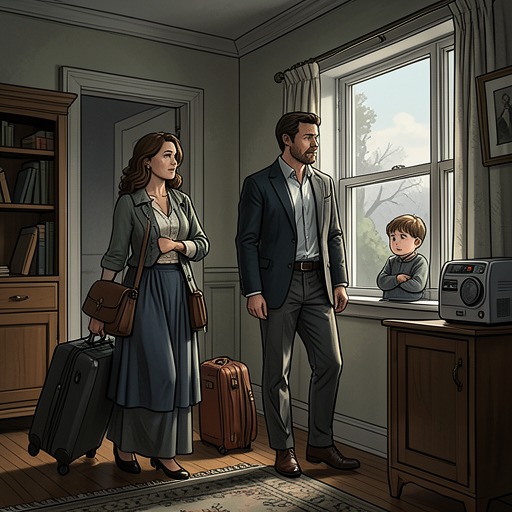
When the Raphaels first reach Plas Mold, Stella cannot tell whether the large grey house will shelter her. The sign at the gate gives the place its name; inside the yard, a removal van has already arrived, its tailboard down as the men wait among the boxes. The weather is windy, the air smells strongly of manure, and a dog barks somewhere behind the house. Stella initially remains in the car while Max and Charlie meet the man who has come with the keys. The scene makes the move feel less like a welcome than an uncertain entry into an already occupied world.
The owner is Trevor Williams, who lives in the other side of the house with his wife, Mair. His first act is to show the family around. The house is arranged vertically: a long kitchen occupies the ground floor; a sitting room of similar dimensions is one flight above; and two bedrooms, with a bathroom off the landing, fill the top floor. The domestic layout has an immediate consequence for Stella. She realizes that she and Max will have to share a bedroom and wonders why he had not told her. She says nothing while Trevor watches her, but the plan of the house has already made private space a source of unease.
A divided household
The house is not wholly the Raphaels’ space. Trevor and Mair occupy its other side, and Stella’s first impressions of them are shaped by watchfulness and reserve. She sees Trevor as silent and suspects he would prefer to have as little as possible to do with the newcomers. When Mair appears carrying damp laundry to a line across the grass, Stella notices the contrast between the couple’s shared austerity and the different impressions they make on her. Mair’s attention appears bound to work and disappointment; she has no children. In the wind, her washing snaps on the line while the removal men carry a double bed into the house.
Mair asks whether the Raphaels have come from London. Stella answers that they have not, though they have come from nearby. Mair accepts the reply without discovering the scandal that has marked Stella’s life elsewhere. For Stella, the encounter is part of a broader first impression of the people around Plas Mold: suspicious, watchful men and women whose lives seem constrained by hard work. That impression is presented through Stella’s perspective, not as an independent account of the community. The shared house brings its residents into close physical proximity without producing intimacy.
Domestic strain and the surrounding landscape
Stella later describes the pattern of days at Plas Mold through an episode that ends with her going upstairs in her clothes and falling asleep. After an expedition outdoors, she returns with a bottle of gin and pauses in the sitting room, tempted to throw it through the window to provoke Max, but decides the loss of the gin is not worth it. Laughing, she goes upstairs. Max is furious the next morning, and she apologizes. The previous night she had also hammered on the Williamses’ door and called for Trevor, without telling them what she wanted. The incident shows the house’s divided arrangement turning private conflict into a disturbance that can reach the neighboring household.
Beyond the house, the family’s outing into the hills brings Stella and Charlie to a pool. On the walk, Stella struggles with a return of the blackness that has troubled her; she has little capacity to talk, while Charlie marches ahead, checking that she is keeping up. At the picnic site, he asks whether she wants to see the other side of the hill, and they leave the group together. At the pool, Stella sits back as Charlie searches the shallows for newts. Her perception becomes distant and indistinct; when he loses his balance and struggles in deeper water, she watches and turns away to smoke. Hugh Griffin arrives, sees Charlie in the water, and rescues him, but the attempt to revive the boy fails. The outing ends with police being called and Stella taken to the police station; after Max arrives, he drives her home, gives her a pill, and she sleeps. The landscape around Plas Mold thus becomes inseparable from the family’s loss, even though the drowning takes place away from the house itself.
After the drowning
A few days later, Peter Cleave visits Plas Mold to discuss his plans with Max. The household and fields appear much as Stella had described them; the dog is barking, and the manure smell remains unmistakable. Max still has not left his job in Cledwyn or moved out of Trevor Williams’s house, but Peter finds him living like a recluse. He emerges in shirtsleeves, suspenders, and bedroom slippers, thin and defeated, and leads Peter through a spotlessly neat kitchen to the upstairs sitting room, now used as his study.
The study is starkly furnished: an armchair, a few shelves of books, a desk, and no paintings, radio, or television. On the desk, framed photographs show Charlie alone or with his father; there is no photograph of Stella. Max confirms the absence directly. The room’s order and narrow inventory stand in contrast to the crowded emotional history attached to the house: Plas Mold contains the remains of family life, but its most visible images center on the dead child. For Max, it has become not simply a residence shared with its owner, but the setting of an increasingly solitary life organized around Charlie’s memory.