Edgar Stark’s escape from the hospital
AsylumEdgar Stark’s escape from the hospital was a carefully enabled breach of a maximum-security institution, concealed for hours by stolen clothes and delayed reporting. Its immediate means were practical: Edgar took Max Raphael’s clothes, while Stella Raphael had secretly given him enough money to reach London. But the escape also depended on their intimate relationship, which made Max’s home both a place of concealment and the source of Edgar’s disguise. The delayed alarm gave him a substantial head start and exposed the cost of the secrets surrounding him.
Background and opportunity
Edgar had been at the hospital for five years after murdering his wife, Ruth Stark. Although he had regained his sanity in most respects and functioned with high intelligence, Peter Cleave remained troubled by his unshaken belief that Ruth’s supposed infidelity had justified the killing. When asked for evidence, Edgar offered ordinary details—a flushing toilet, a floor stain, a box of washing powder placed on a windowsill—and assigned them extravagant meanings. He regretted drinking so much and agreed the murder should not have happened, but still blamed Ruth’s taunts and insults. The unresolved delusion kept him inside when his general recovery might otherwise have led to release.
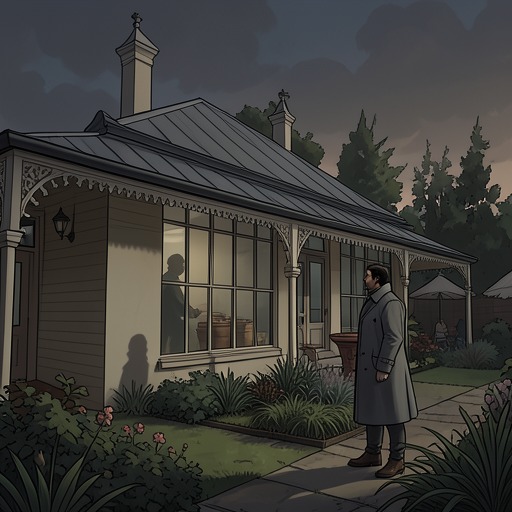
In the summer of 1959, patients on parole worked outside the Main Gate in supervised parties, maintaining the hospital estate. Edgar was assigned to the garden of the Deputy superintendent’s house, where Stella often saw him while picking vegetables or flowers. She made excuses to talk to him when the attendant, John Archer, was not present, telling herself that befriending a patient could do no harm. Their attraction became an affair, and Stella gave Edgar money on more than one occasion—enough, Peter later understood, to get him to London. The routine of the work party created access to the household; the affair supplied the hidden assistance that made escape possible.
The disguise and the hidden clothes
The decisive breach began inside the Raphaels’ home. One morning Stella heard footsteps coming quickly upstairs and called out, thinking it might be her ten-year-old son, Charlie Raphael. Instead, Edgar appeared in her bedroom. Stella was startled because her mother-in-law, Brenda Raphael, was staying in the house, but the danger intensified the encounter rather than stopping it. Edgar stripped off his blue shirt and yellow corduroy patient trousers, and Stella joined him. She later described an impulse to expose her love for him, though practical caution soon returned when a car arrived earlier than expected.
As they dressed hurriedly, Edgar left carrying a bundle of Max’s clothes. The stolen garments included a shirt, trousers and a linen jacket; Max’s estate keys were in the jacket pocket. Stella quietly watched Edgar cross the yard, then went back upstairs. The theft was not immediately announced to Max. Later, when she realized that the clothes were missing, she ran through the Vegetable garden to the Conservatory, where Edgar’s white jacket hung by the door. On an empty seed packet she wrote him a note in pencil, put it in the jacket pocket and left it protruding so that he would see it. She had no further opportunity to intervene before the working party returned.
The hospital’s later reconstruction was that Edgar had hidden Max’s clothes in the woods at the end of the Raphaels’ garden. After lunch, he told John Archer that he was wanted in the chaplain’s garden and went off alone. He retrieved the clothes, changed into Max’s clothing, and made his way away from the estate without using the road until he was clear of the grounds. The account does not establish exactly how he travelled onward; staff thought he might have thumbed a lift or used a bus or train to reach London.
Discovery and delayed alarm
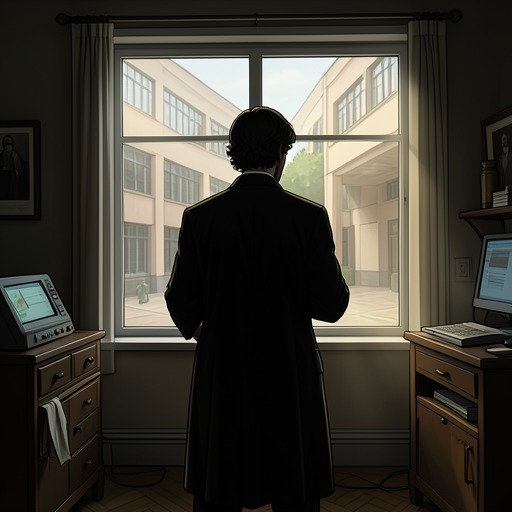
Max noticed that clothes were missing and found the loss difficult to reconcile with the order of his household. He apparently tried to establish what had happened before informing Jack Straffen, the superintendent. After returning to the hospital, he checked with staff in Block 3, went to his office, and then waited about another half-hour before telephoning Jack. By then the work parties were due back, and John Archer had discovered that his patient was missing. The interval between the discovery of the missing clothes and the confirmation of Edgar’s absence was close to three hours.
Peter was with Jack when Max finally called. Jack already knew Edgar had gone; what Max still had to report was that the escaped patient was wearing his clothes. Peter regarded Max’s delay as a serious failure, both because the search for Edgar had been postponed and because Max had allowed Peter’s patient to escape. The stolen clothes also made the breach personal: the deputy superintendent’s authority and home had furnished the disguise. Stella, meanwhile, responded to the announcement by simulating acute concern for Charlie, who had not yet come home. Brenda had thought of the boy first, and Stella hoped Max would not notice the difference.
Search and consequences
Jack and Peter initially chose not to sound the siren. They hoped a quick sweep of the estate would find Edgar before the countryside was alerted, and attendants spent two hours searching the farm, marsh and part of the forest. The staff knew an escaping patient needed clothing and money; Edgar had secured one necessity by taking Max’s clothes, while Peter knew Stella had supplied the other. As dusk approached, the searchers could not tell how much of a lead Edgar had. After he had not been found, the local police were informed.
The escape revealed the weakness of supervision on outside work parties, a problem Peter and Jack recognized, but it also showed how the institution’s ordinary arrangements could be turned to a fugitive’s advantage. Patients left the grounds each morning under an attendant’s supervision, and Edgar’s assignment put him in regular contact with Stella and close to the house where his disguise was obtained. His removal from the hospital did not resolve Peter’s concern about the delusion that had made him dangerous; Peter explicitly considered Edgar still sick and still in need of him.
Narrative significance
The escape changes the meaning of the household’s earlier disorder. Max’s missing clothes were not a mere domestic loss: they were part of a plan that joined Stella’s secret assistance to Edgar’s physical departure. The note in the Conservatory, the jacket left where he could find it, and the cash she had already given him make clear that the escape was not simply an opportunistic flight devised by a patient acting alone. Stella’s concealed participation also explains why she redirects attention toward Charlie when the alarm sounds.
The event turns the hospital’s boundary into a practical, rather than absolute, barrier. Its walls and security procedures contain Edgar only while staff can account for him; a work assignment, a change of clothes and several hours of silence are enough to carry him beyond the estate. The escape thus marks the transition from a hidden affair within the hospital’s orbit to a flight toward London, while leaving the danger at the heart of Edgar’s condition—and the consequences of Stella’s concealment—unsettled.