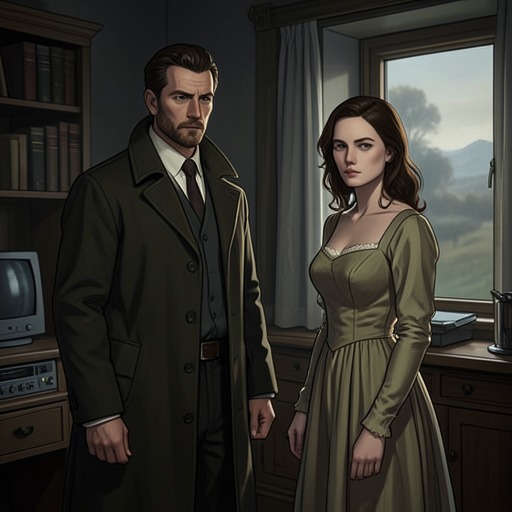
Murder of Ruth Stark
AsylumThe murder of Ruth Stark was the defining crime in Edgar Stark’s history: an act rooted in his delusion of her infidelity, it brought his marriage to a violent end and eventually became the focus of renewed public scrutiny.
Marriage and Murder
Before the killing, Edgar Stark had worked as a sculptor for several years. Ruth Stark modeled for him and often supported him financially; she was remembered as quiet and sensible. About a year before his admission to hospital, he became obsessed with the idea that she was having an affair. His accusations grew wild and violent, placing severe strain on the marriage, and Ruth threatened to leave him.
One night, after they had been drinking, a terrible quarrel ended with Edgar bludgeoning Ruth to death with a hammer. He then mutilated her corpse. Her screams had been heard along the street, but no one came to help her. The violence and what followed were taken as signs of how profoundly disturbed he was. When Edgar reached the hospital, he was in a state of profound shock.
Hospitalization and Public Reckoning
The initial shock soon gave way to a striking absence: Edgar showed no grief or guilt over Ruth’s death. Within weeks he had regained his equilibrium and was participating in hospital activities, while retaining high intelligence and appearing otherwise sane. Yet he showed no insight into why he had killed her and remained fixed on the claim that the murder had been justified. Asked for proof of Ruth’s infidelity, he offered ordinary details—a flushing toilet, a stain on the floor, a box of washing powder on a windowsill—and assigned them extravagant meanings. He regretted drinking so much and conceded that the killing should not have happened, but continued to blame Ruth’s supposed taunts and insults. Because that conviction endured, the doctors did not consider him ready for release; after five years in the hospital, his continued confinement seemed likely.
The case returned to public attention when Edgar’s history was revived in the press, forcing Stella to confront the crime that had brought him into care. At trial, two psychiatrists testified that he suffered from paranoid psychosis, and the court accepted the insanity defense. He was admitted to the hospital the following day. The renewed attention quickly widened from Edgar’s individual case to the institution’s decisions: reporters asked why a man who had killed and mutilated his wife had been permitted to leave the hospital each day to work in its gardens. The murder thus remained consequential not only as the origin of Edgar’s confinement, but as the point at which his unresolved delusion and the hospital’s supervision became matters of public scrutiny.
A Later Echo in Stella’s Story
The murder’s later significance lies partly in the way its aftermath becomes a grim point of comparison when Charlie drowns. At the pool, Stella experiences the episode through a dissociative haze: the black water and Charlie’s movements seem distant, and she smokes while he struggles. Hugh Griffin comes over the hill, sees her standing by, and rushes into the water. Whether an alarm from Stella could have saved Charlie is later disputed because of the distance, but the stillness Hugh witnessed transforms public sympathy into horror. The response centres on her failure to cry out or move, which people interpret as evidence that she is monstrous or mad.
After Charlie’s death, Stella is remanded on a manslaughter charge and remains numb and detached as she is questioned. In the hospital, Max predicts that shock will give way to devastating guilt and that, with Peter Cleave’s help, she may eventually come to terms with what she has done. That forecast throws Edgar’s earlier response into relief: after Ruth’s murder, he regained his equilibrium without grief or guilt and continued to insist that the killing was justified. The contrast does not make the two events equivalent; rather, it distinguishes Edgar’s persistent delusion from Stella’s dissociation and the guilt Max anticipates. In both cases, however, the aftermath becomes a test of how others interpret an apparent absence of feeling.
Responsibility and the Limits of Judgment
The account places two moments of failed rescue beside one another without making them equivalent: Ruth’s screams were heard along the street, yet nobody came to help her; at the pool, Hugh Griffin intervened when he saw Charlie in danger, while whether Stella could have changed the outcome by raising an alarm remained disputed. That contrast sharpens the distinction between a known act of violence and judgments made under uncertainty. Edgar’s insistence that Ruth’s supposed conduct justified the killing turns delusion into an excuse; the later dispute over Stella’s possible chance to act shows how an outcome can harden public judgment even when the counterfactual cannot be settled. The murder therefore remains more than the origin of Edgar’s confinement: it establishes a charged measure of responsibility against which the novel’s later, morally different tragedy is read.