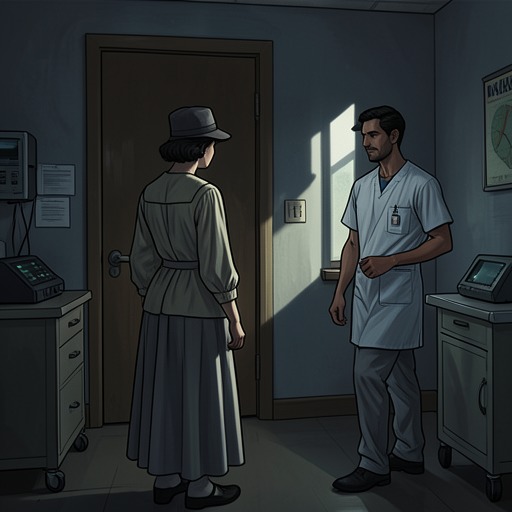
Stella returns to Horsey Street and is taken into police custody
AsylumStella’s return to Horsey Street is the reversal that ends her short attempt to hide from Edgar. After days of fear, dependence, and growing hostility with Nick, she decides that evading Edgar makes no sense and walks back toward the place where he had been hiding. She reaches the loft but not Edgar: men inside recognize her, and she is taken back upstairs. The flight she had hoped to control ends with her in police custody, followed by an encounter with Max that begins as comfort and becomes, in her recollection, the start of another ordeal.
The failed refuge with Nick
Nick is too afraid to return to the loft and too frightened to go out. The two remain together, but their enforced closeness offers Stella no security. She has almost no money and no clear way to get more; she spends as much time as possible in the shared bathroom at the end of the corridor to escape Nick’s smells, anxiety, and sexual advances. The house around them feels equally alienating: it smells of boiled cabbage, and its shabby, gray residents avoid her eyes on the stairs and in the corridor.
On the morning of their third day together, after another restless night, Stella gives in to Nick’s persistent desire. She is passive and sore, and the experience offers her satisfaction only by recalling what it was like to make love to Edgar. The memory of her lover does not turn the encounter into intimacy with Nick; instead, it makes the distance between them more stark. In her despair, she uses the image of Edgar to endure an experience she does not want for its own sake.
Afterward, Nick’s satisfaction provokes Stella’s anger. She mocks his weakness and his inability to be the hard surface against which she wants to press herself. When he tries to offer sympathy and concern, she rejects both. She dresses in front of him and leaves without saying where she is going, because she does not know. Her departure is abrupt and punitive, leaving Nick behind as she walks alone into the streets.
The decision to return
Stella wanders with her coat hanging open and a cigarette between her fingers. She no longer cares how she looks or whether passers-by notice her. The account presents her as slow-moving and ghostlike, scarcely real even to herself. Out of that desolation comes a decision: it suddenly seems absurd that she is running and hiding from Edgar rather than from the hospital authorities. The thought changes the direction of her flight. Instead of seeking another hiding place, she takes a bus as far as Blackfriars and walks to Horsey Street through the rain.
The return does not feel safe or triumphant. Boys are kicking a ball against a wall in the street; they stop and watch as Stella turns into the alley leading to the yard. Their silent attention intensifies her dread until it is physically sickening. More than once she falters and thinks she cannot continue. When she reaches the passage into the building, the children have followed her into the yard and remain watching. Their attention acquires a clear explanation when she sees that the loft door is open and men are inside.
Recognition and custody
Stella immediately turns to go back down the stairs, but she has already been seen. A man calls after her and catches her halfway down, placing a hand on her shoulder. He recognizes her as Mrs. Raphael, though she has never seen him before. He shouts to the others; two more men appear on the stairs, equally surprised. They lead her back up to the loft and say they want to ask her questions. Edgar is not there, and the men do not appear to know where he has gone. Stella’s decision to return to the hideout therefore brings her into their hands without bringing her back together with Edgar.
The narrator explains that Stella’s return brings her back into his field of vision and grounds the account once more in his observations. Stella says she is grateful that the men are not rough with her. The narrator judges that surprise, rather than aggression, shapes their response: they had not expected her to walk so clumsily into their grasp. Once they establish that she does not know Edgar’s whereabouts, they do not question her immediately at the loft. The scene turns on the gap between Stella’s fearful approach and the unexpected gentleness of the men who find her.
Max’s arrival and the next ordeal
The hours that follow remain indistinct in Stella’s memory, carrying the unreal quality of a nightmare. She remembers a room in a police station and a uniformed woman giving her a cup of tea. About an hour later, Max arrives. Like the police, he appears to have chosen a gentle approach, treating Stella as a victim who had been seduced, manipulated, and abandoned by Edgar. She initially tries to meet him calmly, but she cannot sustain the pose. Before Max can speak, she is in his arms, clinging to him after days of weakness, loneliness, and desperation.
For that moment, Stella needs the kind of care Max gives her. She accepts his touch even though it feels to her like the attention of a doctor or psychiatrist, not simply that of a husband. The distinction changes only later, as the doctor recedes and the husband advances. Her return has ended the immediate flight and placed her in police custody, but it does not resolve the danger or conflict surrounding her. The embrace that briefly offers relief becomes the threshold of what Stella remembers as a new nightmare.