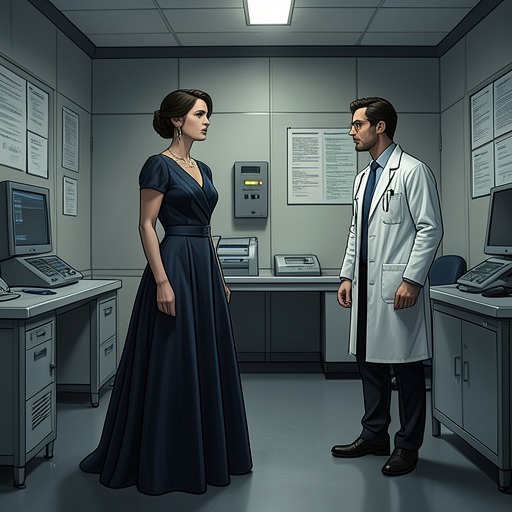
Stella is remanded and returned to the hospital
AsylumStella is remanded and returned to the hospital after Charlie’s drowning, a sequence that turns a family catastrophe into a public accusation and a psychiatric admission. Her failure to call for help is treated by witnesses as evidence of monstrous indifference; Peter Cleave understands it instead as a crisis involving dissociation and profound depression. The return places Stella once more inside the institution where she had previously lived, but reverses her position: she enters not as the deputy superintendent’s wife, but as a patient under Cleave’s authority.
The drowning and its public interpretation
During a family outing, Stella followed Charlie to a pool below a hill. As he played in the shallows, she experienced black waves, a sense that the ground was undulating, and the creeping numbness that followed. She smoked while Charlie lost his balance, struggled in deeper water, and disappeared beneath the surface. Her movements remained rigid and controlled; she turned aside and brought the cigarette to her lips rather than raising the alarm. The scene establishes both the observable fact at the heart of the case—Stella did not try to rescue him—and the altered, detached state through which she experienced it.
The group’s response hardened after Hugh Griffin insisted that he had found Charlie screaming in the water while Stella stood smoking. He believed that an alarm might have saved the boy, although that claim was later disputed because of the distance between the hilltop and the pool. The dispute did not soften the public judgment. What horrified the others was her stillness and silence: they recast her as a mother without feeling, even as they considered whether she was mad. The same behavior therefore carried two sharply opposed meanings, moral depravity to the witnesses and possible mental illness to those seeking a clinical explanation.
The authorities remanded Stella and moved her through a cell, repeated questioning, and a court appearance. She remained numb and detached, experiencing herself as if from behind a barricade in her mind and, at the same time, from a point slightly above and to the side of her body. She could not explain what had happened in terms the police wanted. The legal process established the immediate stakes—her detention and the prospect of a manslaughter charge—without resolving what her state of mind had been at the pool.
Cleave’s intervention and decision to treat her
Peter Cleave’s visit broke through Stella’s emotional numbness enough for her to cry. He recognized that she was profoundly depressed, and she was able to tell him what she had seen in the water. His later clinical interpretation was that the figure she had perceived in extremis was Edgar Stark, not Charlie or Max. Cleave also interpreted the drowning through a theory of maternal filicide: he considered the possibility that Stella’s hostility toward Max had been projected onto Charlie. This was Cleave’s psychiatric formulation, not a finding established by the legal proceedings described in the episode.
Cleave took an active role in the case. He attended interviews and tried to make Stella’s court appearance as little distressing as possible; she left the events to him rather than attempting to understand them herself. When he told her he wanted to treat her in a hospital, she agreed. He was convinced that he was best qualified to care for her and believed he could bring her back to his institution despite recognizing that the decision might seem unorthodox, or even dangerous, under the circumstances. His action joined therapeutic concern to personal and institutional authority: he could offer Stella care because he also controlled the hospital to which she would be sent.
Cleave required Stella to meet Max before her admission, presenting the meeting as necessary for both of them. Stella was deeply anxious as they faced one another in a bare room, with only a wooden table and a high window between them. She brought a packet of cigarettes and a lighter; Max offered her a cigarette. His physical fragility and weight loss registered the strain of the family’s losses. Stella, in turn, understood that Max might now see her both as the woman who had damaged his life and as the mother who had failed to save their son. The meeting did not undo the rupture, but it formed part of Cleave’s plan for her return to treatment.
Admission to the female wing
The hospital’s female wing consisted of two blocks with enclosed yards, flower beds, lawns, and benches, opening south onto the terraces. Parole patients could walk among the gardens and down the stone steps, though an internal wall kept the women apart from the men. This ordered setting was also a place of confinement: Stella was brought in by police through the female-wing gate, rather than through the Main Gate by which she had once entered the estate as Max’s wife.
Stella arrived with three suitcases and said she needed only a few essentials, but she had packed most of her evening clothes, including her black silk dress. After the police handed her paperwork to Cleave, he conducted a brief formal interview and accompanied her to the admissions ward with Mary Flynn, an attendant. Stella was asked to undress in a communal bathroom, bathed, examined by Cleave, and given a cotton shift. She was then taken to a room with a barred window, a toilet and basin, and a barred grate in the door. When the door shut and Mary locked it, Stella could not ask them not to leave her there. The locked door made plain that the hospital was not simply a refuge from questioning: admission also meant confinement.
An hour later, Mary brought tea and pills prescribed by Cleave. Stella asked what they were but was told to take them. She learned informally from a staff member that Jack Straffen had retired and Cleave had become superintendent. Cleave had accepted the post reluctantly, but his new position made it possible for him to direct Stella’s care. The change was a further reversal of their relationship: the doctor who had previously treated her as a friend now had formal control over her treatment and setting.
Clinical meaning and aftermath
Cleave distinguished the circumstances of Charlie’s death from what he considered the more complex psychiatric problem. In his view, the drowning could be approached through a recognizable account of depression, guilt, and the integration of trauma into memory and identity. He found Stella’s attachment to Edgar more clinically striking, and understood the image in the water as evidence that Edgar continued to occupy her inner life even in the moment of Charlie’s death. His account gives the admission a double purpose: treating the immediate aftermath of the drowning and investigating the relationship he believed lay beneath it.
The narrative also presents Cleave’s confidence as a source of tension. He believed himself best qualified to treat Stella and used his authority to bring her into his hospital, even while acknowledging the possible danger or impropriety of doing so. The admission thus cannot be reduced either to a neutral medical procedure or to an answer to the legal question of responsibility. It moves Stella from remand into psychiatric custody, places her under the care of a doctor who has become superintendent, and begins a treatment shaped by his interpretation of her conduct and memories.
In the following period, Stella’s progress is judged partly through her behavior within the institution. Cleave describes the downstairs wards as places where patients gained more privacy and freedom of movement after demonstrating self-control; from the patient’s perspective, appearing to accept confinement could itself be the performance that earned transfer. Stella was moved downstairs after a relatively short stay on the admissions ward. That change did not erase the locked-room admission or settle the meaning of the drowning. It marked the beginning of a longer effort to manage her guilt, her depression, and the memories that Cleave believed she had kept at a distance.