Stella’s fatal overdose
AsylumStella’s fatal overdose is the culmination of a death that the hospital almost recognizes in time: Stella prepares quietly, while Peter Cleave gradually understands that her composure, engagement, and apparent progress have concealed an unbroken fixation on Edgar Stark. The episode turns on the difference between what the institution can observe and what Stella has kept private, ending in her death shortly before dawn and a funeral beyond the hospital wall.
Background and Risk
Stella’s admission follows Charlie Raphael’s drowning at Cledwyn Heath. Hugh Griffin’s account—that Charlie was in trouble in the water while Stella stood smoking and did not raise the alarm—turns public sympathy into horror and suspicion. Stella is remanded, questioned repeatedly, and returned to the hospital. During this period she is numb and detached, experiencing herself as if from within a barricaded part of her mind and from a point a few feet above and to one side. Peter Cleave initially understands her case through the death of her child, but he considers her relationship with Edgar Stark the more persistent clinical danger: he believes the child in the water had, for Stella, become Edgar in her imagination.
The danger has a history. Edgar Stark had murdered his wife, Ruth Stark, with a hammer after becoming convinced she was unfaithful. Although he regained his equilibrium and functioned intelligently in the hospital, he remained fixed in the belief that the murder had been justified; trivial household details served as supposed evidence of Ruth’s infidelity. He therefore remained in the hospital rather than being released. His escape in Max Raphael’s clothes, followed by the renewed press attention, forced Stella to confront what he had done, but did not end her attachment to him. The history makes the overdose more than an isolated response to bereavement: it follows a relationship that Stella had repeatedly hidden and transformed into a story of great passion.
Confinement and Concealment
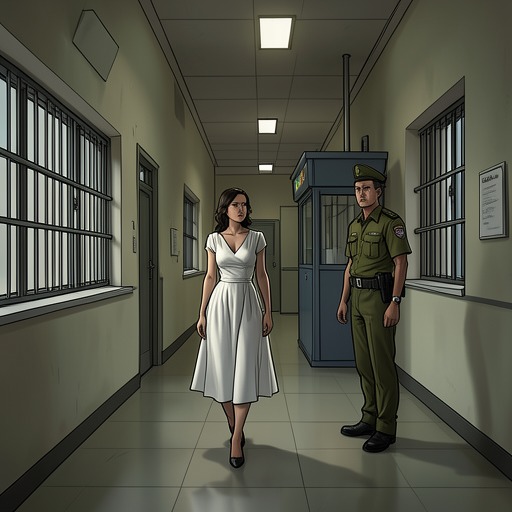
In the hospital, Stella’s conduct becomes a performance shaped by the rules and expectations of confinement. After she is moved from the admissions ward to a downstairs ward, she understands that patients there are expected to appear composed and to behave as though they accept their circumstances. The transfer brings greater privacy and some freedom of movement, as well as permission to wear her own clothes. It also gives her opportunities to conceal distress from attendants. Her outward calm is therefore not reliable evidence that her inner life has settled.
The hospital’s trust in parole patients helps make concealment possible. They are allowed a degree of privacy, and staff do not expect them to hoard their medication. Peter later calculates that on the night of the dance, or perhaps the night before, Stella stopped swallowing her tablets and kept them in her palm. He can only guess where she hid them: at the back of her cupboard or in the lining of a brassiere. The uncertainty is important. The preparation is reconstructed after the fact, not witnessed directly, and the very privacy intended as part of the parole system leaves the decisive act beyond the staff’s view.
The Dance and the Recognition
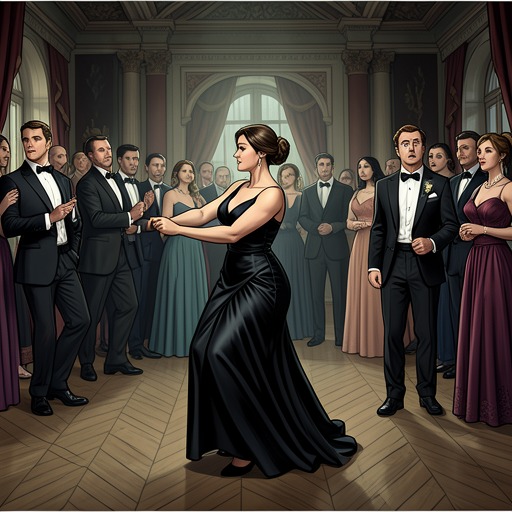
On the evening of the hospital dance, Stella stays in her room and dresses carefully. The smart clothes she brought from Wales are now too tight. She counts her pills and believes she has enough. Her calm appearance among the other women makes her seem ready to take part in the evening, and she becomes the most striking figure in their company. They regard her as their flower of beauty; she moves among them in a loose black shawl, in what the scene presents as a final appearance as the woman of sorrows.
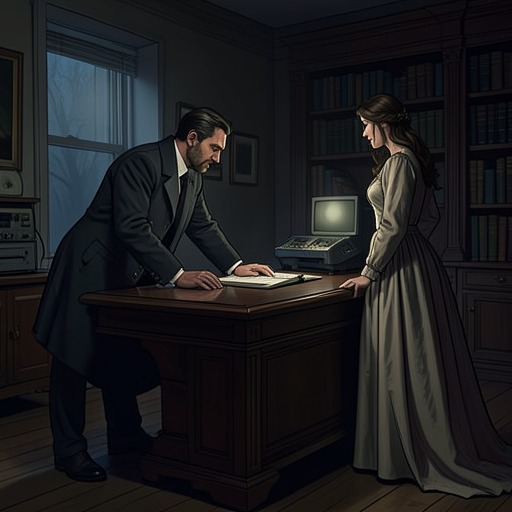
Peter’s understanding changes when he sees her in the black silk dress. Earlier, he had treated her engagement to him as evidence that she had turned toward a different life. Now the dress recalls the night Edgar took her in his arms, and Peter recognizes it as the dress in which she had been joined to Edgar in her own private understanding of their relationship. He realizes that he had mistaken its meaning, and that his personal hopes had clouded his clinical judgment. His recognition is not immediate proof that Stella is in danger: he first telephones the downstairs ward, where an attendant checks her room and reports that she appears asleep and is breathing deeply. Peter nevertheless remains uneasy, and reviews the recent signs of Stella’s hope that Edgar might be present in the hospital.
The Overdose and Death
After the dance, Stella returns to her room. The ward settles, the lights go out, and the other patients retire. A little later, she quietly gets out of bed, turns on the cold tap, lets water run into the basin, opens her cupboard, and reaches inside. The account does not show the tablets being swallowed. Peter’s later reconstruction is that Stella had saved enough sedatives to calculate a fatal dose, and the quiet actions in her room mark the point at which his suspicions become urgent.
Peter leaves his office and hurries across the terrace and through the hospital’s cloisters and courtyards toward the female wing. The staff fight through the night to save Stella, but she has gauged the dose with precision. She never regains consciousness and dies shortly before dawn. Peter imagines that at daybreak she had looked out at the courtyard bricks and understood that neither psychiatry nor time could erase what she had seen at Cledwyn Heath: a head breaking the surface and an arm clawing at the water. The image remains unresolved in his account, as does the exact moment she took the medication; what becomes clear is that the trauma and her attachment to Edgar have not been contained by her apparent recovery.
Aftermath and Significance
Stella is buried three days later in the hospital cemetery, outside the wall behind the female wing. Few mourners attend apart from staff. Max Raphael comes with Brenda Raphael, visibly changed and stooped, and leans on his mother for support. Brenda offers a hope that Stella is now at peace; Peter turns away, troubled by the platitude and by the unspoken history surrounding the burial.
The episode exposes the limits of outward signs of improvement and of Peter’s own confidence in reading them. Stella had appeared composed, had taken part in the dance, and was engaged to Peter, but none of these facts proved that her attachment to Edgar had ended. Peter’s late recognition also implicates his feelings in the failure: he acknowledges that private concerns compromised his objectivity. The fatal overdose thus closes not with a definitive clinical explanation, but with the consequences of concealed preparation, incomplete knowledge, and a relationship whose hold survives both institutional confinement and Stella’s efforts to perform recovery.