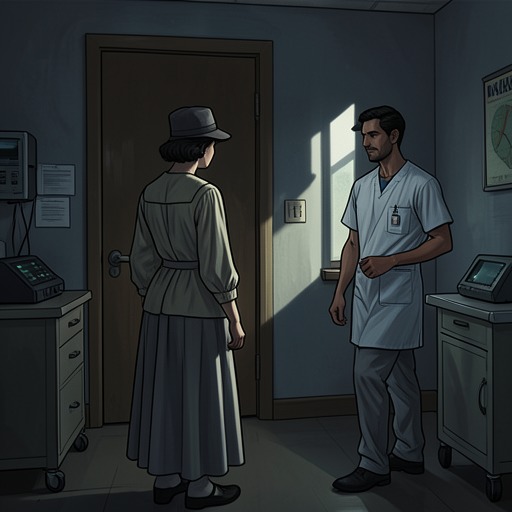
Stella and Nick flee Edgar’s arrival at the flat
AsylumStella and Nick flee Edgar’s arrival at the flat after he tracks them to the building at dawn. The episode turns a locked door into a brief barrier against discovery, then makes escape—not safety—their immediate goal: they leave within the hour, frightened and carrying suitcases, and find a temporary room where Stella continues to fear what Edgar may do next.
The arrival at dawn
Stella and Nick are awakened by the sound of someone turning the door handle. The front door is locked, and neither of them ever discovers exactly how Edgar got into the building. That unexplained entry sharpens the threat: the barrier on which they might have relied has already failed, even though Edgar has not yet reached their room. They sit up and stare at the door in horror.
Edgar calls for Nick to open it. Stella recognizes the voice as not quite his, but as the other one, with its strange artificial accent. Nick looks wildly at her and shakes his head; in the gloom, she can read the terror on his face. Edgar insists that he will not hurt Nick, then says that Stella is inside. His words make clear that he knows where she is, while the locked door leaves the two people in the room with only silence and the uncertain hope that he will not force his way in.
Stella thinks that Edgar will not want to make a disturbance or risk drawing attention to himself, but she also considers the possibility that he no longer cares about the consequences. Nick appears unable to decide what to do. When Edgar says that the situation is not Nick’s fault and that he knows what Stella is like, Nick’s eyes widen. The encounter is therefore not only a threat from outside: Edgar is trying to draw Nick into answering him and to turn his account of Stella against her.
Silence and the kiss
Stella prevents the conversation from becoming a negotiation through the door. She silently crosses the room, sits on the arm of Nick’s chair, puts one hand over his mouth, and grips his wrist with the other. Her finger at her lips and the shushing shape of her mouth make silence a deliberate action. When she removes her hand, she leans forward and kisses him.
Edgar calls Stella no good, then shouts Nick’s name. Nick tries to turn toward the door, but Stella grips his hair and keeps her mouth against his. When Edgar thumps the door hard once, Nick almost jumps out of the chair. Stella continues kissing him, and his hand slips under her open dressing gown to touch her thigh. The scene’s bodily closeness sits uneasily beside the terror at the door: Nick is frightened, but his tentative touch develops into a more intimate advance as Stella tries to hold his attention and keep him from responding to Edgar.
The silence outside leaves Stella unsure whether Edgar has gone or is waiting in the corridor. She pushes Nick’s hand away, listens at the door, and hears nothing. Nick has slumped into the armchair and turned gray. Stella then looks through a fraction of the curtain and sees Edgar emerge from somewhere along the side of the building. His walk has become gangling and ill-coordinated. She finds it difficult not to call out to him, but lets him walk away. Only after watching him leave does she tell Nick that he is gone.
Leaving the flat
The escape follows quickly. Within the hour, Stella and Nick slip out through a side door, each carrying a suitcase. Nobody is about yet, and the street is almost deserted. They pass two loud men in evening clothes who are looking for a cab, a small encounter that places their hurried departure among the ordinary movements of the city without making them any less exposed.
Stella has only one pair of shoes left, her high heels, and stumbles as she tries to keep pace with Nick. He is still badly frightened, but takes her suitcase; she clings to his arm. They catch a bus going west, away from Southwark. Among silent, sleepy passengers occupied with newspapers and ill humour, Stella is a bruised woman in a raincoat beside a tall, shabby, nervous man. The bus carries them through a public space in which no one appears to pay them any attention, but that anonymity offers concealment rather than security.
The day is overcast, and flurries of rain sweep against the bus windows. After a few minutes they get off. Nick says he knows where they are and leads Stella down a side street to a run-down square of large Georgian houses. A patch of brown grass, a tree, and a surrounding fence occupy its centre. Their hotel looks no different from the other houses. A tired woman takes them up two flights of cheaply carpeted stairs to a room overlooking a high brick wall topped with cemented shards of glass and an alley crowded with dustbins, washing lines, and cats.
The refuge and its limits
The hotel gives them somewhere to go after Edgar’s departure, but the account of Stella’s next two days makes clear that escape has not brought relief. She remembers those days with Nick as the grimmest yet, and says that only a few details stand out. He is unclean, and his eating and drinking are messy; he is also considerate and devoted. Yet he watches her constantly, not tenderly but hungrily, and she wonders whether he is capable of rape. Her unease complicates the apparent shelter of their flight: the man who has helped her leave the flat is himself a source of fear.
Stella spends hours lying on a sagging double bed beneath a weak, yellow overhead light that makes the room—and the two of them—seem uglier. She worries about Edgar, fearing that he has become too disturbed to avoid attracting attention and may do something foolish. The departure therefore resolves only the immediate standoff. Edgar is out of sight, but remains the focus of Stella’s anxious thoughts; the hotel’s shabby room and enclosed view mark a precarious pause, not a secure end to the pursuit.