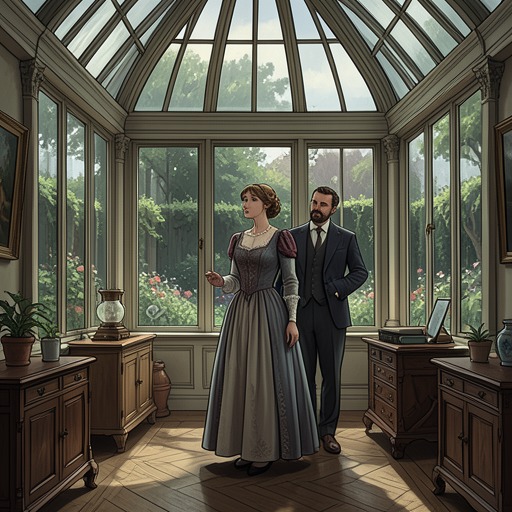
Stella and Edgar’s affair
AsylumStella Raphael and Edgar Stark’s affair turns the grounds of a maximum-security hospital into the starting point of a relationship that moves from concealed encounters on the estate to life together in London. Recalled by Stella in conversation with Peter Cleave, it emerges not as a simple romance but as a collision between sexual desire, institutional proximity, and Stella’s conviction that what happened could not be avoided. Her later account also reveals how firmly she preserved her romantic image of Edgar, even when his actions contradicted it.
Background and First Attraction
Stella was married to Max Raphael, a forensic psychiatrist, and they had a ten-year-old son, Charlie Raphael. She had married Max while barely out of her teens. In Peter Cleave’s assessment, Max was reserved and melancholy, competent as an administrator but weak and lacking imagination; he did not seem suited to satisfy a woman like Stella. The Raphaels moved from London to the hospital in the summer of 1959, when the Mental Health Act had just become law. The deputy superintendent’s house stood close to the Main Gate, with a neglected garden that Max set about restoring.
Edgar was a patient, not a visitor from outside the hospital’s world. He had been admitted after murdering his wife, Ruth Stark, whom he had accused of infidelity. Although he recovered his general sanity and functioned at a high intellectual level, his delusion persisted: he interpreted ordinary details as proof of betrayal and continued to insist that the murder had been justified. The hospital therefore kept him in residence. When he was assigned work restoring Max’s Conservatory, his daily presence brought him into Stella’s view.
That summer, supervised groups of parole patients worked on the estate. Edgar was assigned to the deputy superintendent’s garden, and Stella often saw him while picking vegetables or flowers. If John Archer, the senior attendant responsible for the group, was not in sight, she would sit and talk with Edgar. She later acknowledged that she had been attracted to him almost from the beginning. She tried to disregard the attraction, but the regularity of his presence made it easy to invent reasons to see him. She justified the contact to herself as no more than befriending a patient, even as that explanation gave her a way to continue seeking him out.
The Affair on the Estate
Years later, Peter asked Stella when she had first seriously considered having sex with Edgar. She located the decisive moment in the Vegetable garden. As she recalled it, the possibility had taken on the force of an inevitability: risk did not deter her once she believed that sex between them could neither be avoided nor postponed. Her account gives the encounter the shape of a necessity rather than a choice, a framing that helps explain how she could recognize the danger and still move toward it.
The Vegetable garden was the beginning, not the only place where the affair unfolded. Stella named the Conservatory and then the Cricket pavilion as further locations. These places belonged to the same estate where Edgar worked under supervision and where Max held his hospital post. The affair thus developed inside the daily arrangements that had brought the couple together: the Raphaels’ household, the garden work, and the hospital’s managed grounds. Its concealed spaces were not far removed from the institutional routines around them.
London and Stella’s Retrospective Account
Stella told Peter that the affair continued both on the estate and when she was in London with Edgar. She described a relationship lasting a few weeks and remembered desiring him with a physical and emotional intensity she had not previously experienced. In her account, this desire was direct and personal, unlike an intensity she said she had previously only sensed as coming from men. Peter listened as she struggled to put words to the feelings and disorder of that brief period; her effort to describe them made the affair’s force legible without making it an uncomplicated love story.
Edgar’s escape connected the estate relationship to the London phase. The hospital’s later reconstruction was that he left his work party, retrieved Max’s clothes from hiding in the woods at the end of the Raphaels’ garden, and wore them to get away from the estate. He then made his way to London. The escape exposed how the setting itself had enabled both access and concealment: Edgar had worked in the Raphaels’ garden, and his disguise depended on clothing belonging to Stella’s husband. Max delayed establishing Edgar’s whereabouts, leaving almost three hours between discovery of the missing clothes and confirmation that Edgar was gone; the delay meant that the alarm was not raised as early as it might have been.
Idealization, Harm, and Significance
In the later interview, Stella did not make a moral judgment of Edgar, either for leaving without telling her or for hitting her. Asked why, she could not accept the premise that she should love him only conditionally. Her response reveals the persistence of her romantic understanding: his behavior did not become, in her telling, a reason to revise the meaning she assigned to the relationship. Peter, by contrast, approached the affair as a destructive pattern and questioned whether Stella was trying to let Edgar go. When she deliberately summoned his image, she said it seemed separated from her by a screen, suggesting distance in memory even as she continued to struggle to describe what she had felt.
The affair also sits within an unequal institutional arrangement. Edgar was a patient whose access to the estate depended on parole work and supervision; Stella was the deputy superintendent’s wife, moving through the garden on ordinary household errands. Their contact grew through that repeated proximity, but the setting did not make the relationship safe or private in any lasting sense. In Peter’s account, Stella’s romantic narrative helped protect fragile psychological structures by keeping him from seeing the truth too clearly. Her recollection, with its language of inevitability and its refusal to condemn Edgar, shows how desire became a story she could sustain even after abandonment and violence had entered it.