Lin Zexu's destruction of the opium shipment
BabelLin Zexu's destruction of the opium shipment is the turning point at Canton: a controlled burning of confiscated opium that transforms diplomatic deadlock into the immediate political and military crisis later recognized as the Opium Crisis. The act is presented not as an isolated seizure, but as the enforcement of Qing law against a British commercial system that treats trade, property, and foreign privilege as superior to Chinese jurisdiction.
Causes and Political Background
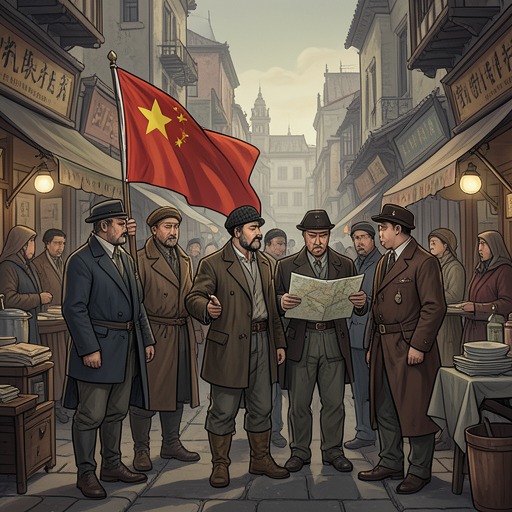
The destruction follows a mission in which Professor Richard Linton Lovell has prepared Robin Swift and the delegation to negotiate on behalf of private trading companies, foremost among them Jardine, Matheson & Company. British merchants want free trade, wider market access, open ports beyond the restricted foreign enclave, and the removal of limits on imports such as opium. The Qing court, wary of foreign influence, has instead sought to contain British and other foreign traders at Canton and Macau. Their opposed aims are intensified by a long history of failed British diplomacy: the Macartney Embassy of 1793 and the Amherst Embassy of 1816 both foundered over British refusals to kowtow, while the Napier affair of 1834 ended in cannon fire and Lord William Napier's death from fever in Macau. The delegation is therefore described as the fourth attempt to expand British trading rights, with Babel translators brought in to prevent the cultural miscommunication that had accompanied earlier failures.
The immediate confrontation exposes a deeper clash between legal orders. Commissioner Lin asks whether opium is not prohibited with the utmost severity in Britain itself, and whether that prohibition demonstrates that Britain knows the drug is harmful. His argument turns British domestic law against British commercial policy: a substance treated as dangerous at home is being defended as an article of trade when exported to China. Lin also contrasts the opium trade with Chinese exports, asking whether China has ever sent a noxious article from its soil or sold Britain anything other than goods for which Britain has great demand. The dispute is thus framed as a question of responsibility as well as commerce.
The Burning at Canton
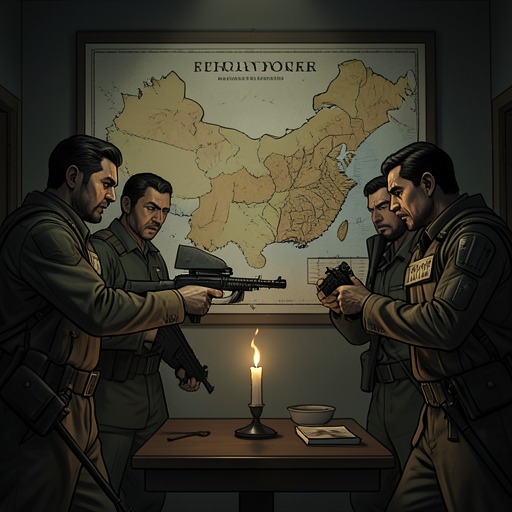
Lin declares that foreigners wishing to trade with the Qing court must obey the laws established by the Emperor. The new law he invokes provides that foreigners who bring opium into China for sale will be decapitated and that the property aboard the ship will be confiscated. Harold Baylis answers that British citizens and British property cannot fall under the Commissioner's authority, but Lin rejects that distinction: when foreign traders choose to become criminals, their nationality and ownership do not protect them. He insists that the delegation is standing inside Chinese territory and that Chinese authorities will enforce Chinese law as they see fit.
The consequence appears to Robin and his companions as a sudden catastrophe across the water. Letitia Price sees a great fire on the opposite bank and points toward it in horror. When the group rushes to the window, the flames prove to be a controlled burn, made visually catastrophic by the smoke and the height of the fire. The chests are piled on deep-bellied boats pushed into the shallows, where they are being destroyed at their source. The wind carries the sickly sweet smell of their contents across the coast and through the windows of the English Factory. The substance becomes unmistakable: opium. Commissioner Lin is burning the opium.
The scene's value reversal is immediate. What the British merchants regard as valuable property is treated by Lin as contraband and a public danger; what the delegation hopes to preserve as a matter of negotiation becomes a visible act of confiscation and destruction. The burning also gives physical form to the legal argument that preceded it. Lin's words claim jurisdiction, while the fire enacts it before the foreign community's eyes.
Immediate Consequences
Professor Richard Linton Lovell reacts with a fury Robin has never seen from him. He storms into the room with Harold Baylis and shakes Robin by the collar, demanding what Robin has said to the Commissioner. The reaction wrongly places the diplomatic failure, and perhaps the destruction itself, upon the translator. In Lovell's eyes, Robin's assigned task had been to act as Baylis's mouthpiece, present a friendly face to the Chinese, and smooth over the negotiations. The fire makes that expectation impossible to sustain, whether or not Robin's words could have changed Lin's decision.
The material loss is enormous. Professor Richard Linton Lovell later tells Robin that the burned chests were worth over two million pounds, much of it now a personal liability for William Jardine and James Matheson. The scale of the destruction converts the burning from a symbolic protest into a financial disaster with consequences for merchants, insurers, and the British commercial interests represented by the delegation. It also explains the violence of the British response: the destroyed opium is not merely an abstract policy issue but a vast body of property that powerful trading interests can claim has been unlawfully taken.
Pretext for War
The burning unexpectedly advances the very imperial strategy that the British delegation was meant to serve. Robin and Ramiz Rafi Mirza later recognize that the British still needed a pretext to take before Parliament, one capable of proving that their demands could be achieved only through force. Their interpretation is that Harold Baylis was meant to humiliate Commissioner Lin rather than compromise with him, baiting Lin into declaring hostilities first. Lin's destruction of the opium does not follow the script in exactly the expected form, but it produces the desired political effect: British interests can present the confiscation and destruction as an attack on British property and authority.
The irony is central to the event's significance. Lin acts to defend the Qing court's law and to stop a trade that Britain itself recognizes as harmful, yet the forceful enforcement of that law becomes the justification for British retaliation. Ramiz Rafi Mirza observes that the British did not count on Lin blowing up the opium in the harbour, while Robin concludes that they are receiving the just cause they wanted anyway. The destruction therefore marks both a Qing assertion of sovereignty and a British opportunity to recast commercial coercion as defensive war.
Narrative Significance
The event concentrates the book's conflict over translation, jurisdiction, and imperial power into one public spectacle. The negotiation is conducted through several intermediaries, none speaking directly to the person being heard, while the parties attach incompatible meanings to words such as trade, property, criminality, and authority. Lin's position is not simply mistranslated into British terms; it is resisted because accepting its legal meaning would require the British delegation to acknowledge that foreign merchants are subject to Chinese law. The fire makes that refusal visible and forces every side to confront the consequences of its chosen vocabulary.
Its later political shadow reaches back into the unresolved question of Professor Richard Linton Lovell's role. When Robin is eventually challenged about what happened to Richard Linton Lovell, he identifies him as one of the architects of the war and says that he went to Canton to obtain military intelligence from British spies and was in direct contact with Palmerston. In that accusation, the opium burning appears not as a self-contained incident but as one stage in a larger design linking commercial pressure, diplomatic provocation, intelligence gathering, and military intervention. Lin's act closes the possibility of a negotiated settlement while opening the path to the war the British interests had been preparing to justify.