London
BabelLondon, also called the Silver City, is the heart of the British Empire and the novel’s clearest image of imperial modernity: a city made larger, faster, richer, and more powerful by silver-working, yet rendered unstable by the same global appetites that sustain it. Robin Swift’s first sight of London is therefore both an arrival and an initiation. The city promises belonging and opportunity, but it also reveals how language, trade, technology, and military power have been assembled into a single imperial machine.
First Sight and Contradictory Metropolis
Robin Swift first sees London from the Countess of Harcourt after a cold morning crossing. Mist initially hides the prow of the ship, then clears to reveal a grey-black silhouette on the horizon: the Silver City, the center of the British Empire and, in that era, the largest and richest city in the world. The scene gives London an almost emblematic entrance. It appears not as an ordinary destination but as the promised country toward which Robin, Professor Richard Linton Lovell, and Mrs Piper have been traveling. London immediately presents itself as a city of incompatible qualities. As the Countess of Harcourt moves inland along the River Thames toward the Port of London, Robin sees a place that is drab and colorful, noisy and eerily quiet, crowded with life yet haunted by ghosts and graveyards. Its contradictions recall Canton, but the resemblance has limits. Both cities function as mouths opening onto the wider world, absorbing people, goods, and languages; London, however, possesses what Robin perceives as a mechanical heartbeat. The city’s contradictions are also social and political. London is described as unimaginably rich and wretchedly poor, expanding through its spoils while remaining hungry for more. It is simultaneously beautiful and ugly, spacious and cramped, virtuous and hypocritical. Its prosperity has not resolved deprivation; it has intensified the scale at which wealth and misery coexist. The city stands near a reckoning because its appetite can lead either to internal collapse or to outward expansion in search of new labor, capital, resources, and culture.
Silver, Infrastructure, and Imperial Power
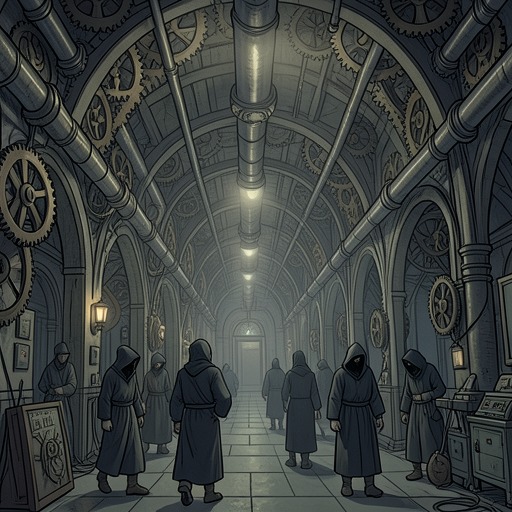
Silver gives London its distinctive sound and motion. It glimmers in the wheels of cabs and carriages and in horses’ hooves, shines on buildings and shopfronts, lies beneath streets, and rises through the ticking arms of clock towers. It amplifies the apparent virtues of commercial goods, while its presence in canals makes water cleaner, its presence in gutters disguises the smells of rain, sludge, and sewage, and its use in clock towers carries bells farther across the city and countryside. London’s modernity is therefore not merely architectural or industrial; it is materially organized through silver. The resulting city is faster and brighter than nature would ordinarily permit, but its brilliance has an ominous edge. London’s metallic timbre is compared with the harsh scrape of a knife against a sharpening steel and with a monstrous labyrinth of wheels moving compulsively together. The image makes infrastructure feel both miraculous and coercive. Silver-working does not simply improve urban life; it disciplines movement, time, trade, communication, and labor by embedding imperial power in the city’s ordinary mechanisms. London’s position depends on a global accumulation of silver and languages. Professor Griffin Harley Lovell explains that silver became an international currency after the Hapsburgs found immense deposits in the Andes and extracted them through the labor of Indigenous miners who were not fairly paid. Spanish silver financed the purchase of Indian cotton, which was used to pay for enslaved Africans sent to colonial plantations. The wealth of empire thus travels through London as a chain of extraction, trade, enslavement, and accumulation rather than as an isolated national achievement. By the nineteenth century, Spain has declined, France has been weakened by the Napoleonic Wars, and Britain has taken the leading position, supported by large European silver reserves, the world’s foremost translation institute, and the best navy on the seas after Trafalgar. Yet the flow of silver is turning against Britain. China absorbs British silver in exchange for porcelain, lacquered cabinets, silks, and tea, while British manufactured goods find little reciprocal market in China. London’s wealth therefore contains the fear of depletion: the empire’s own appetite may exhaust the reserves on which its power rests.
Trade, War, and the Chinese Connection
London’s docks display the global system that feeds the city. At the Port of London, ships loaded with tea, cotton, and tobacco wait to be emptied and prepared for voyages to India, the West Indies, Africa, and the Far East. Silver worked into their masts and crossbeams helps them sail more quickly and safely; British goods travel outward, and chests of silver return. The docks make visible the physical circulation behind London’s imperial economy. That circulation produces conflict with China. Professor Lovell prepares Robin Swift for a mission to Canton in which Babel translators will negotiate on behalf of private trading companies, foremost among them Jardine, Matheson & Company. British merchants seek open ports, broader market access, and the removal of restrictions on imports such as opium, while the Qing government seeks to contain foreign trade at Canton and Macau. London’s commercial demands thus reach across the world through companies, translators, diplomats, and the threat of force. The negotiations are presented as the fourth British attempt to obtain broader trading rights after the failures of the Macartney Embassy, the Amherst Embassy, and the Napier affair. In London, these diplomatic failures are not treated only as misunderstandings; they become arguments for better translation and, increasingly, for coercion. British officials and merchants interpret Chinese restrictions as obstacles to prosperity, while their demands for legal opium sales, an apology, and compensation for more than twenty thousand seized chests turn commercial interest into a claim of national injury. Robin’s work as translator places London’s imperial language inside a confrontation with Commissioner Lin. He is required to render demands that Jardine, Matheson, and their allies want the Qing government to legalize the coastal opium trade, apologize for its treatment of foreign traders, and compensate them for the seized cargo. The meeting exposes the violence hidden inside the rhetoric of free trade: the language of mutual benefit is used to demand access to another country’s market and protection for a commodity its government has prohibited. The war plans Robin discovers make London’s connection to the crisis still more explicit. Documents include a detailed sketch of Canton’s docks, lists of Chinese naval vessels, accounts of coastal defenses, the number and placement of forts, and the precise numbers of troops stationed at them. Professor Lovell is not a neutral scholar caught in a commercial dispute; he has helped design the conflict and argues that China can be defeated easily. London’s translation culture, trading companies, diplomatic offices, and naval strategy are therefore parts of the same system. The proposed war is debated in the House of Lords as a question of national honor, but its deeper stake is silver. A British victory would open access to China’s enormous reserves, making warships faster and guns more accurate while enabling the British Empire to pursue wider agendas across Africa, Asia, and South America. London’s imperial ambition is consequently shown not as a response to a single diplomatic insult but as a strategy for preserving an economic order threatened by the movement of silver toward China.
Telegraphic and Networked London
London is also the destination of Babel’s first working telegraph line in England. After Samuel Morse demonstrates his electrical device in Morristown, New Jersey, scholars from the Royal Institute of Translation bring him to Oxford. Babel’s silver-workers are astonished that the machine requires no language match-pairs and operates through pure electricity. By July 1839, the line connects Babel with the British Foreign Office in London, joining the capital to an instantaneous communications network that bypasses the older dependence on resonance-based silver bars. Professors Jerome Playfair and Jerome De Vreese expand Morse’s original numerical code into an alphanumeric system capable of transmitting messages of any kind. The new system quickly attracts businessmen, government officials, and occasional clergymen, who crowd Babel’s lobby with messages for London. Jerome Playfair recognizes the commercial potential and orders the conversion of a former storage area in the northwest wing into a telegraph office. London thus becomes not merely a political destination but the principal node that turns a technical experiment into a commercial and governmental service. The contrast between the telegraph and Babel’s resonance network clarifies London’s place in the novel’s infrastructure. Babel is the center from which resonance-dependent bars throughout England draw power, like British outposts calling on the imperial center for soldiers and supplies. The metaphor joins technological dependence to colonial administration. London is the capital that receives and distributes power, but its apparent centrality rests on networks whose resources, labor, and knowledge originate elsewhere.
Dependence, Breakdown, and Consequences
The city’s reliance on silver-working becomes vulnerable when the system is disrupted. London’s conveniences are shown to depend on silver in kitchens, breweries, flour mills, locomotives, railways, water systems, and the machines that spin, weave, card, and rove textiles. Silver is also embedded in agricultural equipment, including plough-frames, seed drills, threshing machines, and drainage pipes. If the supply fails, the consequences extend from urban comfort to transport, manufacturing, sanitation, and the possibility of national starvation. The disruption is not immediate enough to appear as a single clean catastrophe. Regional silver-working centers in London, Liverpool, Edinburgh, and Birmingham can temporarily compensate, but they lack Babel’s maintenance ledgers and cannot fully replace the central institution. The delay makes the city’s vulnerability more revealing: London can continue to look powerful while the systems beneath its prosperity are already failing. By the third day, the breakdown reaches transportation. Carriages that rely on speed-based match-pairs no longer move safely, and drivers accustomed to letting silver-working manage difficult turns fail to compensate when the bars stop functioning. Oxford’s roads fill with overturned wagons and cabs, while a family of eight in the Cotswolds falls into a ravine after a driver loses control. The postal system also collapses when bars using the French-English pair parcelle-parcel cease to reduce the apparent weight of parcels; overloaded mail carriages break down mid-route. These failures expose the difference between London’s image of mastery and the practical fragility of its systems. The same silver that makes roads, clocks, trade, and industry seem autonomous has trained users to depend on effects they no longer understand. Infrastructure becomes an instrument of control precisely because ordinary people have been encouraged to treat it as natural. When the silver fails, the city’s speed, convenience, and authority are revealed as maintained conditions rather than permanent facts.
Narrative Significance
London concentrates the novel’s central relationship between language and empire. It gathers the world’s silver and languages, converts both into political and commercial power, and projects that power outward through translation, trade, telegraphy, and military planning. Robin Swift’s arrival marks his entry into this system, while his later work reveals the human cost concealed by London’s polished claims of prosperity and free exchange. The city’s greatest irony is that its wealth both sustains and imperils it. London seeks China’s silver to preserve British supremacy, but that pursuit drives the diplomatic crisis toward war. Its infrastructure offers unprecedented speed, cleanliness, communication, and abundance, yet those benefits depend on a centralized network designed to create reliance and demand. London is therefore not simply the capital of an empire; it is an imperial machine whose magnificence makes its dependencies harder to see and whose breakdown makes them impossible to ignore.