The Thames
BabelThe Thames is the principal waterway through which London’s global power, industrial wealth, and vulnerability become visible. It carries Robin Swift into the capital from Canton, frames the city’s colonial commerce, and later stands at the centre of a logistical crisis: when the silver-work sustaining bridges and transport begins to fail, the river becomes not merely a route through London but the space into which the city’s infrastructure may collapse.
Setting and Urban Contradictions
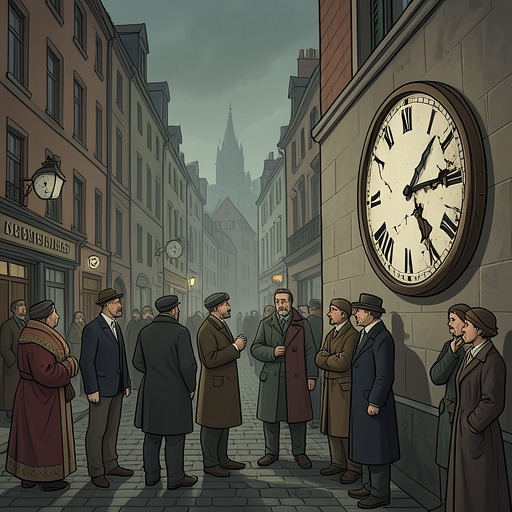
The Thames first appears as the route by which the Countess of Harcourt sails inland toward London. From the river, Robin Swift sees a capital of contradictions and multitudes, comparable to Canton because both cities function as mouths to the world. London is at once drab and grey, explosively colourful, raucous with life, and eerily quiet beneath the presence of ghosts and graveyards. The Thames therefore introduces London not as a unified civic landscape but as a concentration of incompatible energies gathered around an international waterway.
The river also marks the difference between London’s industrial system and Canton’s older mechanical texture. London has what the narrative calls a mechanical heartbeat: silver hums through its cabs, carriages, buildings, clock towers, and shopfronts. Its metallic sound contrasts with the rickety clacking bamboo that underwrites Canton. Seen from the Thames, the city’s power is inseparable from the artificial, industrial network that silver has built around and beneath it.
Commerce and Imperial Circulation
When Robin Swift, Professor Richard Linton Lovell, and Mrs Piper reach the Port of London, the docks are shown at the apex of colonial trade. Ships loaded with tea, cotton, and tobacco wait to be emptied and prepared for new voyages to India, the West Indies, Africa, and the Far East. They carry British wares outward and return with chests of silver, making the Thames the visible hinge between metropolitan consumption and imperial extraction.
The river’s traffic is supported by silver at every level. Silver has been used in London and elsewhere for a millennium, but the city has become unusually dependent on its power. Silver lining the canals makes water cleaner, silver in the gutters disguises the smells of rain, sludge, and sewage, and silver in clock towers carries bells across distances beyond what ordinary construction would permit. The Thames is consequently set against a wider silver-worked environment: even where the river itself is not directly transformed, the city around it has been engineered to exceed natural limits.
Passage, Communication, and Networked Power
The Thames remains a place of movement and speculation for the students of Babel. During a weekend visit to London, Robin Swift and his companions walk to the Port of London and marvel at the massive ships, their white sails, and the interlacing of masts and rigging. They try to identify the flags and company marks of vessels departing for Greece, Canada, Sweden, or Portugal. The scene turns the river into a prospect of possible futures, especially when Letitia Price imagines that the graduating cohort will board one of those ships after their fourth-year examinations.
Yet the river’s international circulation is matched by newer forms of instantaneous connection. By July 1839, Babel has established England’s first working telegraph line, linking Oxford with the British Foreign Office in London. The line requires no match-pairs and operates through pure electricity; after Professors Eveline De Vreese and Jerome Playfair develop an alphanumeric code, messages can serve commercial, personal, governmental, and religious clients. The Thames belongs to the older geography of ships and cargo, but the telegraph reveals a system beginning to overcome distance through electrical communication.
Infrastructure and the Threat of Collapse
The Thames becomes a site of danger when Robin Swift examines the maintenance ledger for Westminster Bridge. The bridge’s silver-work was contracted when the New London Bridge was built in 1825, and its bars were designed to expire after fifteen years. The ledger lists silver bars and match-pairs in several languages, with resonance links extending across multiple pages. Robin concludes that the bridge will not simply lock its turnstiles when the bars fail; its foundation will give way and the structure will fall into the river.
The consequences extend far beyond the bridge itself. Westminster Bridge carries the heaviest traffic across the Thames, and its collapse would obstruct steamers, houseboats, sculls, and canoes. With the wreckage blocking the river, the whole city’s movement would stop. The threatened fall thus converts the Thames from a backdrop for commerce into the physical point at which London’s dependence on engineered silver becomes catastrophic.
The broader crisis demonstrates how deeply the river city depends on hidden systems. Silver powers ice-making machines, breweries, flour mills, locomotives, rail construction, water supply, and the machinery of the textile industry; it also lies in agricultural equipment such as plough-frames, seed drills, threshing machines, and drainage pipes. When those systems fail, transportation breaks down, accidents multiply, and postal carriages collapse under loads that silver-working had made deceptively light. The Thames concentrates this danger because its bridges and shipping lanes connect the city’s many other mechanisms.
Narrative Significance
The Thames embodies the book’s contrast between mobility and dependence. It opens London to ships, commodities, languages, and imperial wealth, while the river crossings and transport routes that make that wealth usable depend on a central institution whose power is distributed through resonance. The comparison between Babel and colonial outposts is explicit: bars across England draw power from the centre just as British outposts call upon home for soldiers and supplies. The Thames, crossed by the infrastructure of that centre, becomes a material expression of the same imperial relationship.
Its significance therefore lies in double movement. The Thames carries people and goods toward the future promised by London’s silver-gilded modernity, yet it also waits beneath the bridges whose failure could halt that future. The river is both the artery of an expanding empire and the destination of its most consequential structural failure, exposing how swiftly apparent progress can become paralysis when the systems sustaining it are withdrawn.