Vaults & Garden
BabelVaults & Garden is a café whose significance extends far beyond food and conversation. For Robin Swift, Ramiz Rafi Mirza, Letitia Price, and Victoire Desgraves, it is a recurring meeting place where friendship takes material form; during the group’s later escape, its supply cellar conceals a tunnel leading to a safe room associated with Griffin Harley Lovell. The café therefore links the ordinary pleasures of student life with the covert infrastructure of danger and resistance.
Social Setting
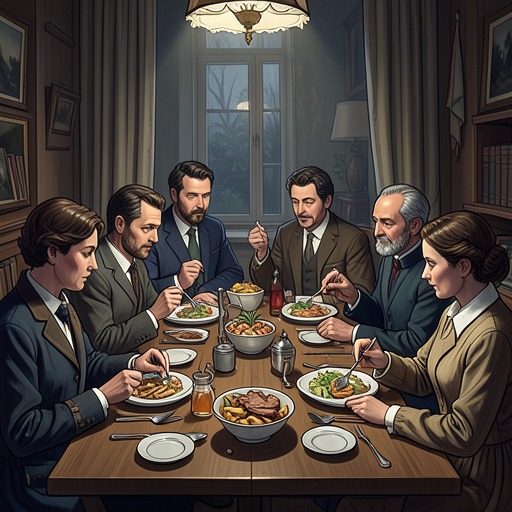
At the café, the four students make Oxford legible through one another’s tastes and habits. Ramiz Rafi Mirza notices a purple scarf in the window of Ede & Ravenscroft; Letitia Price laughs at a young man outside Queen’s Lane Coffeehouse reading a book of sonnets; and Victoire Desgraves becomes excited when fresh scones appear at Vaults & Garden. Because Victoire is detained in a French tutorial, Robin Swift buys one, wraps it in his pocket, and saves it for her until class ends. Such small acts turn the café into a place of remembered preferences, errands, and reciprocal attention.
The café also gives the group a regular setting for argument. On weekends, they sit at a corner table and question Letitia Price, the only native English speaker among them, about unfamiliar English expressions. Robin Swift asks about “corned” and corned beef, while Victoire Desgraves asks about “welcher” and “jigger-dubber.” The scene makes language a shared pastime rather than merely an academic discipline, while also exposing the cultural differences that the friends continually test against one another.
Friendship and Conflict
Vaults & Garden contains the cohort’s disagreements without dissolving its solidarity. Robin Swift and Victoire Desgraves argue over the relative superiority of English and French literature. Victoire Desgraves praises Voltaire and Diderot above England’s best theorists and dismisses Robin’s translated books as inferior to their originals. Letitia Price and Victoire Desgraves clash over money and whether Letitia’s estrangement from her father qualifies as poverty. Ramiz Rafi Mirza and Letitia argue most intensely about British rule in India, with Ramiz attacking Letitia’s authority to discuss the colonies and repeatedly provoking her attachment to England.
These disputes sharpen rather than end the friendships. The arguments define how each member occupies a different position within the group: Robin Swift mediates through observation, Victoire Desgraves guards literary and linguistic distinctions, Letitia Price embodies a defensive English propriety, and Ramiz Rafi Mirza challenges the assumptions behind imperial confidence. Vaults & Garden thus functions as a small public forum in which private affection and political disagreement remain constantly intertwined.
Food, Material Conditions, and Mutual Care
The café’s social warmth stands against the poor food served in the University College, Oxford kitchens. When Ramiz Rafi Mirza complains that the meals are making him visibly lose weight, the friends enter the kitchen and assemble a dish from chickpeas, potatoes, and spices he has gathered from Oxford’s markets. The resulting scarlet stew is painfully hot, but Ramiz Rafi Mirza refuses to concede that it has failed; instead, he treats its poor flavor as evidence that something is wrong with British cooking, especially the absence of proper turmeric and mustard seeds.
The episode turns eating into a form of fellowship and critique. The friends do not simply discuss cultural difference at Vaults & Garden; they cook across it, fail together, and convert the failure into another argument about Britain and empire. The café’s corner table and supply spaces consequently hold both the group’s intellectual play and its response to the material conditions of student life.
Hidden Passage and Escape
Vaults & Garden acquires a darker function when Robin Swift, Ramiz Rafi Mirza, and Victoire Desgraves are fleeing a police manhunt. Victoire Desgraves first considers a safe house near the city centre, but Robin Swift explains that it has been compromised because Griffin Harley Lovell knew about it. He then leads them to another route, shown to him by Anthony Ribben: a tunnel entrance at the back of Vaults & Garden, near the Radcliffe Library.
The entrance is concealed by a hidden door beside the café’s supply cellar. Beyond it lies a cramped dirt tunnel, barely large enough for the fugitives to crawl through on their hands and knees. They have no candle, kindling, or flint, and must advance blindly, trusting Anthony Ribben’s information while their shallow breaths echo in the earth. The familiar café is transformed from a place of sociability into a threshold between exposed public space and secret shelter.
Safe Room and Narrative Significance
The tunnel eventually rises into a small, low-ceilinged room lit by moonlight through a tiny grate. The room has recently been occupied: a fresh loaf of bread remains on the desk, beside a half-melted candle. Victoire Desgraves searches the drawers, finds matches, and identifies the place as the room where Griffin Harley Lovell hid. The food and candle continue Vaults & Garden’s association with nourishment and warmth, but here they also register secrecy, flight, and the immediate presence of someone who has passed through danger.
Vaults & Garden is therefore a layered location. In its ordinary form, it is the group’s café, corner table, linguistic classroom, kitchen, and refuge from institutional routine. In its concealed form, it is an escape mechanism whose cellar opens into darkness and whose tunnel leads to a hidden room. Its decisive narrative function lies in that contrast: the same setting that shelters youthful companionship also reveals the underground geography created when Oxford’s apparently safe, scholarly world becomes inseparable from pursuit and political violence.