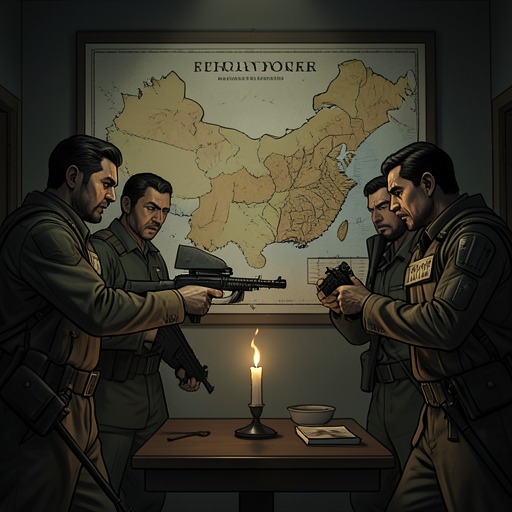
The Thirteen Factories
BabelThe Thirteen Factories are a row of thirteen foreign trading compounds on the southwestern edge of Canton, the controlled gateway through which British and other Western interests conduct business with China. Their decisive significance lies in the contradiction they make visible: they are enclaves of European privilege and commercial power, yet they exist under Chinese territorial law and confinement. Within them, trade, missionary activity, diplomacy, translation, and imperial ambition become inseparable.
Setting and Appearance
The Factories stand in a line of thirteen buildings whose recessed verandahs, neoclassical ornaments, and European flags make them appear violently out of place against Canton. Their appearance suggests that a strip of France or England has been lifted from elsewhere and dropped onto the city’s edge. The buildings are called Factories not because they manufacture goods, but because they house the factors, or agents, who conduct trade.
The compounds accommodate merchants, missionaries, government officials, and soldiers during the trading season. The New English Factory, where Robin Swift, Professor Richard Linton Lovell, Ramiz Rafi Mirza, Victoire Desgraves, and Letitia Price are lodged, contains a ground-floor warehouse, social and dining rooms, visiting chambers, a library, rooftop terraces, and a riverside garden. Its arrangement combines commercial storage, domestic residence, social life, and institutional convenience within one enclosed space.
The enclave’s hospitality is sharply stratified. Letitia Price is placed in a storage unit because the visitors cannot be lodged too near the gentlemen, while the men receive the proper chambers. At dinner, an immense cloth fan suspended above the table is kept moving by a coolie servant who pulls and slackens it without pause. Robin notices the servant and feels guilty whenever their eyes meet, but the other residents treat him as invisible. The dining room therefore reproduces the social hierarchy on which the Factories’ comfort depends.
Rules and Confinement
Foreigners are required to remain within the foreign enclave and are warned not to explore Canton independently. The prohibition extends to the flower boats, while European goods can be purchased at a corner of the Imperial Factory, including necessities that the compounds do not otherwise provide. The residents are also offered access to women brought in by merchant connections, revealing how commercial privilege, racial separation, and gendered exploitation coexist behind the enclave’s respectable facade.
The Factories are thus neither an ordinary neighborhood nor an autonomous foreign colony. They are a bounded space in which foreigners enjoy substantial material advantages while remaining subject to Chinese restrictions. The tension between those conditions becomes central when British merchants demand wider access to Chinese markets and deny the authority of the laws governing the territory in which they operate.
Trade, Translation, and Imperial Pressure
Professor Richard Linton Lovell brings his delegation to Canton to negotiate on behalf of private trading companies, foremost among them Jardine, Matheson & Company. British merchants seek free trade, broader access to ports and markets, and the removal of restrictions on imports including opium. Earlier British attempts had failed: the Macartney Embassy of 1793 and the Amherst Embassy of 1816 were damaged by disputes over court protocol, while the Napier affair of 1834 ended in cannon fire and Lord William Napier’s death from fever in Macau.
The new delegation is presented as different because Babel translators are expected to lead the talks and prevent further cultural miscommunication. Yet the very institution that promises accurate communication is also tied to imperial expansion. Babel collects foreign languages and foreign talent, concentrates the resulting silver-working power in England, and uses translation to serve British commercial and political interests. Its silver technology depends especially on Chinese, Sanskrit, and Arabic, while countries where those languages are widely spoken possess fewer than a thousand such bars, mostly in the homes of the wealthy and powerful.
The contrast between Canton and London clarifies the enclave’s place in this system. London has a mechanical heartbeat: silver moves through its cabs, buildings, clocks, and manufactured goods, producing a metallic industrial rhythm. Canton, by contrast, is associated with the rickety, clacking bamboo that underwrites its life. The Factories sit at the point where these systems meet, converting Chinese goods, language, and legal access into resources for British accumulation.
The Opium Dispute
Inside the trading world represented by the Factories, the opium question exposes the moral and legal contradiction of British demands. Commissioner Lin points out that opium is prohibited with severe strictness in Britain itself, asking whether that domestic prohibition does not demonstrate that the British know how harmful the drug is. He contrasts China’s beneficial exports with the noxious article brought into China for sale.
Commissioner Lin states that foreigners trading with the Qing dynasty must obey the Emperor’s laws. Under the new law, foreigners who bring opium into China with the intention of selling it are to be decapitated, and the property aboard the ship is to be confiscated. When the British representative objects that the offenders are British citizens and that the property belongs to Britain, Lin rejects the claim that nationality places them beyond Chinese jurisdiction.
The exchange turns the Factories into a legal battleground. British merchants treat citizenship and property as grounds for exemption; Commissioner Lin insists that the trade occurs inside Chinese territory and therefore falls under Chinese law. The enclave’s walls cannot resolve that conflict. Instead, they concentrate it, making the foreign residents’ protected position appear to depend on denying the authority of the country around them.
Narrative Significance
The Thirteen Factories function as a miniature model of the imperial world. Their European facades, warehouses, libraries, servants, and social rooms create an image of orderly civilization, but the order rests on restricted movement, unequal labor, commercial coercion, and the export of harm. The same enclave that shelters trade also shelters the assumptions that make war possible.
Its connection to Babel is especially revealing. Babel presents translation as knowledge and infrastructure, while the Factories show how such knowledge operates in practice: merchants use interpreters to negotiate access, challenge regulations, and press for commercial advantage. The translators’ presence may reduce linguistic misunderstanding without correcting the unequal purposes for which communication is being used.
The Factories also stand opposite Babel as a second kind of imperial architecture. Babel gathers languages and silver at the center of England; the Factories gather foreign merchants and commercial capital at the edge of Canton. One is a tower of institutional knowledge, the other a row of enclosed trading houses, but both organize flows of language, goods, labor, and authority. When the story later asks what happened to Richard Linton Lovell and links him to military intelligence and the making of war, the Factories are recalled not merely as lodgings but as part of the machinery through which commerce, translation, and armed power converge.