Oxford Castle
BabelOxford Castle becomes the setting for a perilous escape whose immediate value shift is from imprisonment to freedom, but whose release is shadowed by fire, height, and the unsettling spectacle of Griffin Lovell’s violence. The castle is not merely a gaol: its architecture forces the fugitives into a dangerous descent, while the burning north front exposes the material consequences of Griffin’s abstract commitments.
Setting and Confinement
Oxford Castle is initially understood by Robin Swift as the city gaol on Gloucester Green, but the building’s scale corrects that assumption. From the end of a high hall, Robin sees the ground far below and realizes that the prisoners are not in the two-storey gaol he had imagined. Griffin identifies the site as Oxford Castle’s north tower, placing the escape within a fortified vertical space rather than an ordinary prison.
The castle’s enclosure is made absolute by the lack of an alternative route. Victoire Desgraves asks which way leads to the door, and Griffin explains that the guards are trapped in the stairwell but will soon break through. When Robin asks whether another staircase exists, Griffin answers that there is none. The only exit is therefore the window, turning the building itself into the central antagonist of the escape: its walls offer security to the authorities, while its height makes freedom physically hazardous.
The Escape from the North Tower
Griffin Lovell produces a rope from his satchel and orders the window broken. He descends first, followed by Victoire Desgraves and Robin Swift. The sequence reverses the ordinary logic of a prison escape. Rather than moving through corridors toward a guarded door, the fugitives leave by breaking through the boundary of the cell and lowering themselves down the outside of the tower.
The descent proves much harder than Griffin makes it appear. Robin slips too quickly during the final ten feet when his arms give out, and the rope burns his palms. The detail makes the escape bodily and costly: freedom is achieved not through effortless ingenuity but through pain, exhaustion, and the risk of a fall. Once outside, the fugitives discover that Griffin’s diversion has exceeded anything simple or controlled. The entire north front of Oxford Castle is ablaze, and flames and smoke are spreading rapidly through the building.
Griffin then gives Robin and Victoire plain black cloaks taken from his satchel. At a distance, the garments resemble the cloaks worn by constables, allowing the fugitives to move along the side of the castle toward the main street while the fire distracts the authorities. His instructions are practical and severe: move quickly, do not look behind, remain calm, and leave while the guards are occupied. The escape depends on the combination of architectural danger, disguise, speed, and the catastrophe unfolding behind them.
Griffin Lovell’s Violence Made Visible
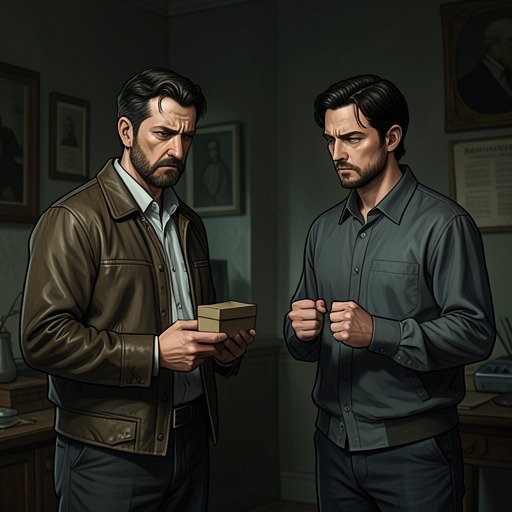
The burning castle changes Robin Swift’s understanding of Griffin Lovell. Robin has previously encountered his brother’s commitments to violence in an abstract form, but the burning north front gives those commitments a material shape. Griffin is no longer perceived only through ideas or declarations; he appears as a hard, sharp-edged man capable of shooting, killing, and burning without flinching.
That recognition is deliberately ambivalent. Robin does not know whether he fears Griffin or admires his sheer ability. Oxford Castle thus becomes a site of moral as well as physical disorientation. Its flames provide the outward image of an order being attacked, while Griffin’s competence offers the frightening efficiency by which such an attack is carried out. The escape frees Robin from confinement but leaves him with a more disturbing knowledge of his brother.
Narrative Significance
Oxford Castle concentrates several pressures of the surrounding plot into one architectural scene. The blocked stairwell represents the authorities’ attempt to contain the prisoners; the broken window marks a breach in that containment; and the rope transforms the tower’s height from an insurmountable barrier into a precarious route outward. The building’s vertical structure makes the transition from captivity to freedom visible as a descent through danger.
The castle also gives the escape a gothic intensity. Its enclosed halls, distant ground, smoke, and advancing flames create an environment in which freedom and destruction arrive together. Griffin’s diversion succeeds, but its success is excessive: the fugitives survive because the prison is burning, and Robin’s escape is inseparable from his first direct encounter with the consequences of Griffin’s violence. Oxford Castle therefore functions as both prison and revelation, a place where physical confinement breaks open at the precise moment when familial trust becomes more difficult to sustain.