The Old Library
BabelThe Old Library is the concealed headquarters and safehouse of the Hermes Society, a place whose physical obscurity embodies the organization’s method of survival. Appearing abandoned and bureaucratically insignificant, it shelters people, books, research, and conversations that Babel and the imperial system would rather keep unseen. Its destruction transforms that hidden refuge into a ruin, exposing not only the violence used against Hermes but also the cost of preserving knowledge outside official institutions.
Setting and Concealment
The Old Library lies roughly two miles from the town centre, though Robin Swift has never noticed it before. From outside, it is a neglected one-storey brick building half-swallowed by overgrown shrubbery. Its doors appear rusted shut, and its walls have the air of a structure abandoned decades earlier. The building’s apparent decay is therefore not merely atmospheric: it is part of the protection afforded by being overlooked.
The site began as an overflow room for old books, built by Durham College in the fourteenth century. When Durham College became extinct in the mid-sixteenth century and Trinity took over its property, the supplemental library was accidentally omitted from the deed transfer. The catalogue listed only materials that had gone unused for decades and had more accessible duplicates in the Bodleian Library. That administrative error left the building at the edge of institutional awareness. Colleges assumed it belonged to another, poorer college, while the wealth of Oxford’s institutions made them insufficiently attentive to their own holdings. Hermes consequently lives in a space that is hidden in plain sight: visible enough to be explained away, but unimportant enough to escape inspection.
The Old Library’s anonymity is deliberate. Anthony Ribben explains that the group does not use a distinctive name beyond “the Old Library,” because a name would mark the building’s importance. The plain designation is designed to be skimmed over in records and confused with something else. Bureaucratic neglect becomes a form of camouflage, allowing a clandestine political and intellectual community to occupy a place that official systems have already taught themselves not to see.
Architecture and Interior
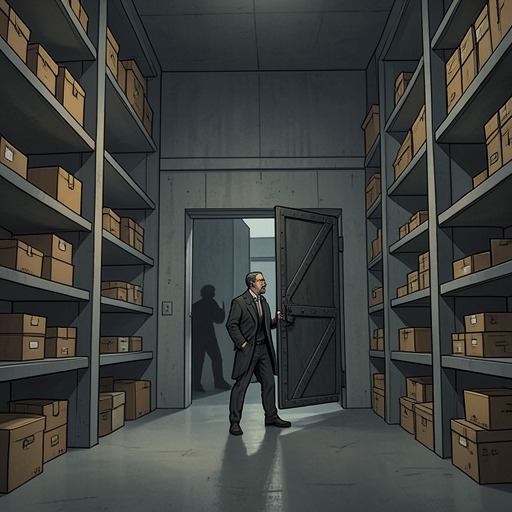
The building’s interior contradicts its exterior. Like Babel, it is much larger inside than its outside dimensions suggest; what appears capable of holding a single lecture hall opens into a space comparable to the ground floor of the Radcliffe Library. Wooden shelves radiate from a central point, while additional shelves follow walls that appear magically and impossibly circular. The spatial contradiction gives the library an almost Gothic doubleness: a modest ruin conceals an expansive interior, and an apparently empty structure contains an active world.
The shelves are meticulously labelled, and a long, yellowed parchment records the library’s classification system. This system also marks the Hermes Society’s intellectual independence from Babel. Anthony criticizes Babel’s categorization because it works only in Roman characters and fails to accommodate languages that cannot be easily Romanized. The Old Library therefore preserves not just books but an alternative principle of organizing knowledge—one less willing to treat the alphabet and categories of empire as universal.
The collection includes material taken from Babel. Near the front, the new-arrivals shelf contains titles Robin recognizes as books he secretly removed for Griffin Harley Lovell over several years. Their Babel serial numbers have been scratched out. The altered books make the library’s political function tangible: Hermes does not merely discuss the circulation of knowledge; it rescues, relocates, and reclassifies texts from an institution that claims authority over them.
Security and Community
The Old Library is protected by layered magical precautions. A rusted iron kettle hangs from the top rung of the coat stand, apparently inexplicable until its bottom reveals a familiar glint of silver. It is a security device that whistles when someone unknown approaches the library. Its ordinary, even absurd, appearance helps it blend into the building’s neglected surroundings, turning an overlooked household object into a sentry.
Hermes keeps the precise mechanism of its defences secret. Like Babel, the society allows individuals to devise their own traps without telling the others how those traps work. Anthony presents this secrecy as a collective security practice rather than a single centralized system. The strongest protection is the glamour surrounding the building, which prevents sound from escaping and keeps passersby from eavesdropping on conversations. The library is thus defended both by magic and by social invisibility: its neighbours fail to recognize its significance, while its occupants prevent its activity from becoming audible.
The building houses a substantial Hermes community. When Robin, Ramiz Rafi Mirza, and Victoire Desgraves emerge into the library, figures appear from among the shelves, including Vimal Srinivasan, Cathy O’Nell, and Ilse Dejima. They are former students or current graduate fellows whom Robin has seen around Babel’s tower. Ilse, previously distant at the tower, is notably friendlier in the Old Library and welcomes them in time for dinner. The contrast suggests that the safehouse permits identities and solidarities suppressed by Babel’s formal hierarchy to become visible. Ramiz’s surprise at discovering how many people are connected to Hermes also reveals the organization’s deliberate breadth and secrecy.
Destruction and Aftermath
The Old Library is destroyed during the attack that Robin Swift and Victoire Desgraves witness from the forest behind its yard. At daybreak, they approach cautiously while dozens of policemen remain stationed around the building, apparently waiting to see whether anyone will return. They cannot enter to recover supplies, but they come close enough to count the damage. Their purpose becomes memorial as much as practical: someone must remember the betrayal and register the loss.
The destruction is physically overwhelming. The entire back of the building has been blown away, leaving a gaping wound through which its interior is exposed. The image reverses the library’s former logic. Previously, the exterior concealed an impossible interior; now the protective shell has been torn open, making the hidden space naked before its enemies. The ruin’s exposed body gives the attack an almost humiliating intimacy, as though the building itself has been violated.
The shelves are half-bare. Books that survived the explosions are piled in wheelbarrows around the site, presumably to be removed and analyzed by Babel’s scholars. The likely fate of the research is not public understanding but absorption into imperial archives, where knowledge can be controlled precisely by being withheld. The Old Library’s destruction therefore threatens two forms of erasure at once: the physical destruction of books and the political disappearance of whatever survives.
Bodies remain beneath the rubble. Robin sees a pale arm buried under fallen bricks, a shoe buckle attached to a charred shin, and a mass of black, dust-covered hair near the side of the building; he turns away before seeing the face. His shock and dizziness, followed by Victoire’s horror, make the ruin a site of unfinished mourning. The failure to clear the bodies intensifies the sense that the attack has not been brought to an orderly conclusion. The Old Library remains both crime scene and grave, its material wreckage preserving evidence of the human cost of resistance.
Narrative and Thematic Significance
The Old Library gives the Hermes Society a physical form. Its forgotten legal status, contradictory architecture, alternative catalogue, hidden security, and communal life all express a politics of marginal survival. Knowledge exists there beyond Babel’s official categories, and people who appear to belong to Babel’s educational world can gather there as members of another order. The library’s secrecy is not a retreat from history: it is the condition under which forbidden histories and intellectual alliances can continue.
Its destruction makes that political meaning unmistakable. A place designed to disappear becomes impossible to ignore only after violence has opened it to public view. The abandoned-looking building is revealed as a living archive, and the ruin reveals the institutions that sought to seize or suppress what it contained. The Old Library thus moves from refuge to testimony: before the attack, it hides resistance; after the attack, its blasted walls, confiscated books, and unburied dead testify to the system’s determination to control language, scholarship, and the people who use them against it.