Oxford
BabelOxford is both a place of arrival and a machine for organizing power. Robin Swift first encounters it as a dignified, ancient city imagined in a painting, then enters its colleges and libraries to discover that its beauty, scholarship, and architectural grandeur are inseparable from the imperial systems that sustain them. In Oxford, language becomes an institution, silver becomes infrastructure, and education becomes a means of concentrating foreign knowledge in the service of Britain.
City and Arrival
Oxford first appears to Robin through a painting in Professor Richard Linton Lovell’s dining room. He cannot identify the city, but immediately senses that it is more dignified and ancient than London; when Professor Richard Linton Lovell tells him that it is Oxford, the name remains unfamiliar enough for Robin to test it as though it were an unknown English word, wondering whether it might mean a cow-trading centre or market. His uncertainty makes the city an object of linguistic interpretation before it becomes a physical home. Robin reaches Oxford after the final miles of his journey pass through green pastureland and herds of cows. Exhausted and suffering from a throbbing headache, he abandons his guidebook, The University of Oxford and Her Colleges, and falls asleep in the coach. He wakes to wheels rumbling over cobblestones in High Street, directly before the walled gates of his new home. The entrance is therefore both literal and institutional: Oxford is the destination toward which his recruitment has been directed, and its gates mark his passage into a world whose customs and knowledge he does not yet understand.
Colleges, Libraries, and Cultural Capital
Oxford consists of twenty-two colleges, each possessing its own residential buildings, coat of arms, dining hall, customs, and traditions. The richest colleges, including Christ Church, Trinity, St John’s, and All Souls, possess the finest grounds, while Worcester and Hertford are dismissed as poor, ugly, and badly fed. These judgments reveal a hierarchy in which wealth shapes not only material comfort but also the city’s social geography and the value assigned to the people who inhabit it. Robin is assigned to University College, commonly called Univ, which houses all students enrolled in the Royal Institute of Translation. Its appearance is sombre and venerable, appropriate to the university’s oldest daughter: a Gothic sanctuary of turrets and regular windows set into smooth white stone. The building gives institutional age a visible form, presenting tradition as an architectural authority into which Robin must fit. During his third day with Ramiz Rafi Mirza, Robin tours Oxford’s major institutions. The city is described as an era of becoming, constantly renovating its colleges, acquiring land, replacing medieval buildings with newer halls, and constructing libraries for expanding collections. Buildings bear the names of wealthy and powerful benefactors rather than functional descriptions, making architecture a record of patronage and accumulated capital. The Ashmolean Museum displays curiosities including a dodo’s head, a hippopotamus skull, and a supposed sheep’s horn; the Radcliffe Library appears grander inside than outside; and the Sheldonian Theatre is ringed by stone busts known as the Emperor Heads. The Bodleian Library is the clearest expression of Oxford’s cultural abundance. It holds England’s largest manuscript collection and continues to expand under Reverend Doctor Bulkeley Bandinel, whose annual book-buying budget approaches two thousand pounds. Oxford’s libraries therefore embody both genuine intellectual richness and the unequal accumulation of cultural resources: knowledge is preserved, purchased, classified, and housed within institutions whose prestige rests on wealth.
Babel and the Language Institution
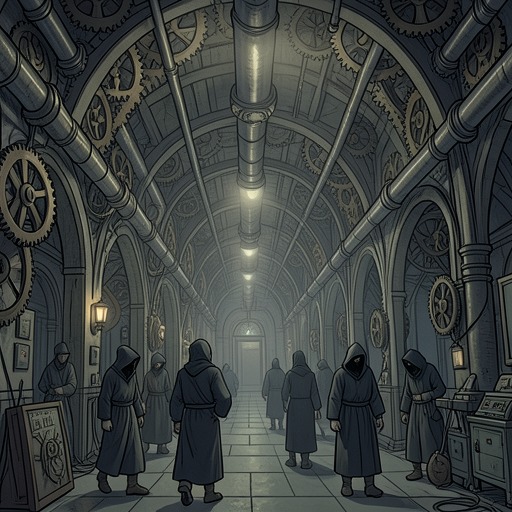
Oxford is home to Babel, the towering centre of the Royal Institute of Translation. The Institute was founded in London in the early seventeenth century and moved to Oxford in 1715, after the War of the Spanish Succession, when Britain decided to train young men in the languages of territories it had gained from Spain. Its official history presents translation training as a practical instrument of governance, connecting the study of languages directly to the management of empire. Babel rises eight stories and nearly three hundred feet, making it the tallest building in Oxford and probably in England apart from St Paul’s. Its height turns the biblical image of Babel into a modern institutional monument. The tower does not merely symbolize linguistic ambition; it houses the collections, teaching, and silver-working systems through which language is transformed into material force. The Grammaticas, displayed on the sixth floor beneath glass, make the Institute’s order of knowledge visible. The identical red-bound volumes are arranged alphabetically by Romanized language name and then by publication date. European languages occupy entire cases, while the Chinese Grammaticas fill only three volumes and the Japanese and Korean Grammaticas only one each; Tagalog, by contrast, occupies five. Many Caribbean and South Asian Grammaticas remain unfinished, and most African Grammaticas are translated into English from German, with no recent Babel specialists working on African languages. The collection’s unevenness records the changing priorities of European empires rather than the relative complexity or importance of the languages themselves. Robin notices that the first authors credited in the Oriental-language Grammaticas are generally white British men rather than native speakers. The observation exposes a central contradiction in Oxford’s intellectual authority: the institution presents itself as the collector and guardian of global languages, yet its catalogues and founding scholarship place British scholars at the centre of knowledge about other peoples.
Oxford and Imperial Infrastructure
Oxford’s intellectual institutions are connected to a broader imperial economy. Griffin Harley Lovell explains that Babel collects foreign languages and foreign talent in the same manner that London hoards silver, then uses translation magic to benefit England alone. The most powerful silver bars depend on Chinese, Sanskrit, and Arabic, yet fewer than a thousand such bars operate in countries where those languages are widely spoken, mostly in the homes of wealthy and powerful people. Oxford’s linguistic expertise thus produces unequal material access: languages originating elsewhere are concentrated in Britain and converted into British advantage. The same structure is represented through Babel’s resonance network. The tower’s rods, engraved with commonly used language pairs, sustain linked bars throughout England. Power manifests at the central rods, allowing peripheral bars to function without constant reactivation. Robin compares this arrangement to British outposts in the colonies calling on the imperial centre for soldiers and supplies. Oxford is consequently not isolated from the empire; it is its linguistic centre, sending power outward through an infrastructure whose dependence on the centre mirrors colonial dependence on Britain. Griffin places this system within a longer history of extraction. Silver mined in the Andes by indigenous labour helped Spain finance trade in Indian cotton and the purchase of enslaved Africans for plantation labour. In the present, Britain’s appetite for Chinese porcelain, lacquer, silk, and tea sends enormous quantities of silver toward China; the annual tea trade alone is worth at least thirty million pounds, while China has little appetite for British manufactured goods. Griffin argues that the resulting imbalance will eventually exhaust Britain’s silver reserves and weaken the British Empire, while power and resources return to places previously exploited. Oxford’s Babel stands at the centre of the mechanism that makes this imperial accumulation possible, even as its own historical logic may help produce the empire’s crisis.
Oxford in the Global Web
The contrast between Oxford and Canton clarifies the city’s place in the novel’s world. London, like Canton, is a contradictory city and a mouth to the world, but London possesses a mechanical heartbeat: silver hums through its vehicles, buildings, streets, and clocks. Oxford belongs to this same silver-driven modernity, though its power is concentrated in colleges, libraries, and the Babel tower rather than in the docks and factories of London. The global system reaches Oxford through goods, languages, labour, and violence. In Canton, the Thirteen Factories form a conspicuous strip of Western architecture containing merchants, missionaries, officials, and soldiers during the trading season. Their separation from the surrounding city resembles Babel’s separation from ordinary life: both are enclaves where foreign resources are gathered, ordered, and redirected through imperial institutions. Ramiz Rafi Mirza explains the personal cost of this connection by recalling an opium plantation owned in part by his guardian, Sir Horace Wilson, in West Bengal. The scarlet fields were cultivated in Bengal, Bihar, and Patna; the crop was transported to Calcutta and then carried by private merchants to Canton under the brands Patna and Malwa. Robin recognizes a web linking Indian cotton to Britain, Indian opium to China, Chinese silver to tea and porcelain, and those commodities back to Britain. Oxford’s libraries and translation systems are not outside this web. They provide the knowledge and silver-working capacity that allow the web to function, while the wealth displayed in Oxford rests on distant colonial labour and suffering.
Narrative Significance
Oxford is the novel’s city of education, initiation, and contradiction. Its Gothic colleges and celebrated libraries offer Robin access to learning, friendship, and a new identity, while its tower reveals that knowledge is never politically neutral within the imperial order. The city’s beauty is sustained by acquisition: land is bought, collections expand, buildings are named for benefactors, languages are catalogued, and foreign expertise is converted into British infrastructure. The result is an Oxford that embodies both the promise and the danger of modern knowledge. It appears ancient yet is constantly becoming; it preserves manuscripts while producing new technologies; it welcomes languages while concentrating their practical benefits in England; and it presents scholarship as universal while organizing it through colonial priorities. Oxford’s decisive significance is therefore structural rather than merely scenic: it is the place where the novel makes visible how cultural capital, linguistic authority, silver, and empire become one system.