Buddenbrook centenary plaque
BuddenbrooksThe Buddenbrook centenary plaque is a family gift marking one hundred years of the firm, from 1768 to 1868. Its four portraits, golden ear of grain, and inherited business maxim make commercial continuity visible as a shared family legacy. Presented to Thomas Buddenbrook on the centenary, it is both a tribute to the firm’s past and an emblem whose confident promise of orderly succession will be tested by the family’s later decline.
Design and Inscriptions
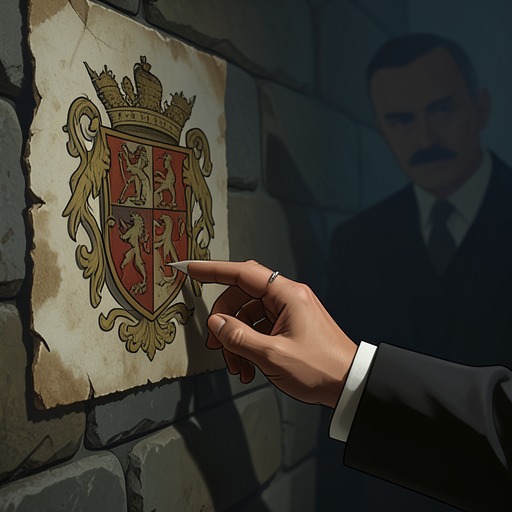
The plaque is a substantial framed display, set in heavy carved walnut and covered with glass. Four portraits of the firm’s successive owners are arranged within it, each identified by a name and dates in gold leaf. At the bottom, the years 1768 and 1868 stand side by side in gilt lettering, turning the span of a century into a compact visual timeline. A stylized golden ear of grain winds among the portraits, linking the family’s identity to the grain business that underpins its prosperity.
Above the portraits, in tall Gothic script familiar from the family records, is the maxim: “My son, show zeal for each day's affairs of business, but only for such that make for a peaceful night's sleep.” The inscription comes from an older generation’s counsel to its descendants. On the plaque, a private rule of conduct becomes a public family motto: the business is to be pursued energetically, but not at the price of moral or personal peace.
The portraits make that ideal concrete through a succession of owners. The founder, Johann Buddenbrook, appears as a tall, stern man with tightly set lips and a strong gaze above his jabot. The next portrait shows Johann Buddenbrook, friend of Jean Jacques Hoffstede, with a broad, jovial face. The third is Consul Johann Buddenbrook, recognizable by his creased mouth, hooked nose, high collar, and intelligent eyes suggestive of religious fervor. Thomas completes the sequence, represented at a younger age. The plaque thus presents commercial succession as a family lineage, at once recorded in individual faces and gathered beneath a single enduring motto.
Presentation to Thomas
The plaque is unveiled at a family gathering on the day of the firm’s centenary. Elisabeth Buddenbrook, Christian, Klothilde Buddenbrook, Ida Jungmann, Antonie “Tony” Buddenbrook, and Hanno are assembled in the salon. Tony and Hanno support the large object together, though the boy has little strength in his arms and his aunt must bear most of its weight. That small strain gives the scene a physical counterpart to the burden of inheritance the plaque celebrates.
Moved by the occasion, Elisabeth embraces Thomas and speaks of the family’s gratitude to God; she weeps as she repeats her thanks. Thomas is affected by the embrace, but pulls himself upright to greet his brother and the others. Tony and Hanno bring the plaque forward, and Thomas props it against the wall beside the piano. Standing surrounded by his family, he examines a representation of the owners who preceded him and his own place among them.
Thomas studies the display for a long time before remarking, with a slightly mocking tone, that a good night's sleep is a fine thing. He thanks his relatives for the thoughtful gift and asks where it should be hung. Tony suggests the office, above his desk. The proposed location would make the plaque a working reminder of the family’s commercial tradition, placed where Thomas conducts the business that tradition has handed to him.
Business Ideal and Family Memory
The plaque’s force depends on the family’s habit of preserving its past through records and objects. The family papers include old letters, citizenship certificates, insurance policies, business correspondence, and a diary, alongside the family genealogy. The genealogy traces names, marriages, births, and entry into the firm; the maxim reproduced on the plaque also appears among the inherited family instructions. The centenary gift gives this archival memory a ceremonial form, selecting portraits and a motto to present the family’s history as a coherent sequence of responsible owners.
That sequence carries more than commemorative meaning. In 1845, Tony, reading the family history and seeing the blank space after her name in the genealogy, writes in her engagement to Bendix Grünlich. The register makes family continuity an active obligation, not merely a record of the past. The plaque performs a related work on a larger scale: it places Thomas within the line of owners and makes his stewardship appear to continue a hundred-year inheritance.
But its motto also supplies a standard by which later business decisions can be measured. Thomas once argues against compensating Gotthold Buddenbrook for a share in the family house, calculating that doing so could open the way to further inheritance claims and remove capital from the firm. In a later financial reckoning, he sets out the estate’s changing sums and warns that business has slowed while the firm’s operating expenses remain fixed. These circumstances give the plaque’s injunction about peaceful sleep a practical edge: business decisions involve not only family honor, but capital, risk, and the consequences of keeping the firm operating.
The Plaque Against the Firm’s Fate
The plaque celebrates a century of ownership at a moment when continuity remains a family aspiration, not a guarantee. Thomas later pursues the Pöppenrade harvest deal as an opportunity to revive his fortunes and demonstrate renewed business daring. Personal connections, discretion, and the possibility of profit shape his decision. This appetite for a consequential deal sits uneasily beside the plaque’s counsel to pursue only business that permits peaceful sleep, underscoring the tension between commercial ambition and the inherited rule of restraint.
After Thomas’s death, his will directs that the firm be liquidated and dissolved within a year. Under Herr Kistenmaker and Friedrich Wilhelm Marcus, contracts and stocks of grain are sold hurriedly or allowed to slip away, and losses accumulate. Though Thomas’s estate is valued on paper at 650,000 marks, within a year the liquidation makes clear that nothing close to that amount can be expected. The business whose century the plaque commemorates is therefore not carried forward by another generation of owners; its dissolution turns the display’s orderly succession into a record of a past that cannot simply be continued.
The plaque’s promise is not erased by this outcome. Its portraits preserve the succession, and its motto keeps the family’s own ideal of responsible business conduct in view. Yet its placement above the office desk, as Tony proposes, also sharpens the irony: a compact monument to continuity watches over a business ultimately ordered to end. The object gives family memory a durable form while the history it commemorates proves fragile.