The Buddenbrook house on Fischergrube
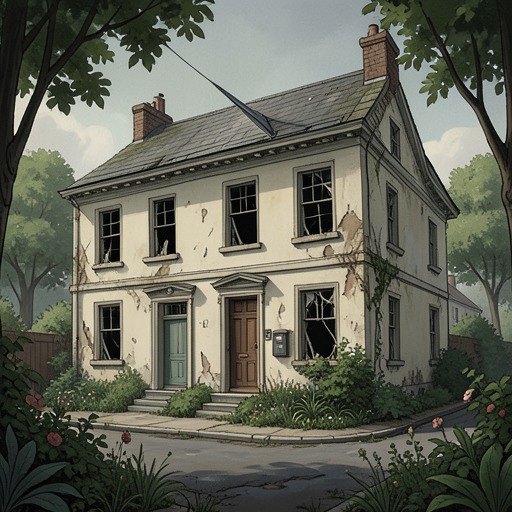
BuddenbrooksThe Buddenbrook house on Fischergrube is Thomas Buddenbrook’s new residence and the most imposing material expression of his rise. Yet its meaning shifts with its owner’s fortunes: the house that had fulfilled a long-held ambition comes to seem too new, too costly, and finally inseparable from the inward weakening Thomas senses in himself. Its spacious rooms and ordered garden embody success in public, while his lonely passage through them reveals how little that success can quiet his private fears.
Design and Domestic Order
The house’s interiors are spacious and deliberately composed. In the earlier landscape room at the family residence on Meng Strasse, thick wall coverings depict idyllic pastoral scenes in pastel colors, matched by yellow upholstery and silk curtains. A small harmonium and a flute case stand opposite the sofa, while stiff armchairs, a sewing table, and a secretary complete the room. This description establishes the Buddenbrooks’ domestic world as one in which furnishings, family life, and music occupy carefully designated places.
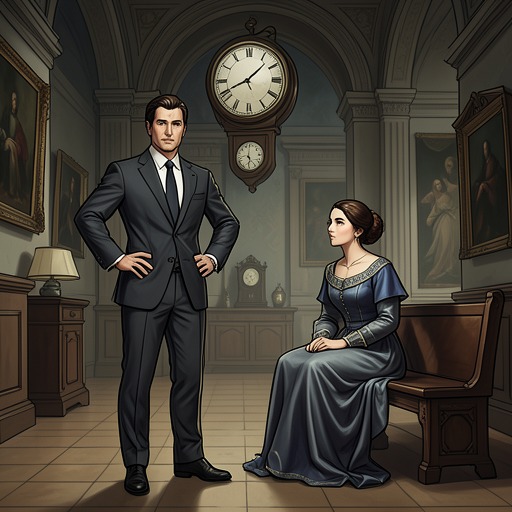
In the new house, music becomes more prominent. The salon and sitting room together fill the front of the residence, their light colors and curved furnishings organized around a large grand piano. Gerda’s violin case rests on it, her music is stacked nearby, and a carved music stand and a relief of cupids playing instruments mark the rooms as a musical domain. Palm trees fill the window bay. These objects give the house an atmosphere associated not only with Thomas’s standing but also with Gerda’s artistic life.
The rest of the floor extends that display of scale and formality. From the smoking room, a small den with a stained-glass window opens into the grand hall, which runs across the width of the house. Wine-red curtains, heavy sofas, stiff high-backed chairs, a fireplace, Chinese vases, and a mirror arrange the hall as a space for receiving and impressing visitors. The rooms are luxurious, but their carefully controlled order also makes them feel like a setting in which the family’s public role must continually be performed.
Ambition and the Meaning of the House
Thomas’s new home is a dream come true, a fact his sister Tony invokes when she tries to understand his low spirits. She points to the house as evidence of what he has achieved through his own efforts, setting it against the comparatively modest home of Hermann Hagenström. Thomas does not deny its grandeur. Rather, he says it is almost too beautiful and still too new; what he had anticipated with pleasure has arrived burdened by the irritating details of reality.
His disappointment reaches beyond the practical experience of occupying a new residence. Thomas remembers that he once expected happiness from its completion, but now feels that a long-desired good arrives too late to be enjoyed as imagined. He connects this feeling to his weakening command over events, including a recent business meeting at which Consul Hagenström prevailed over him. The completed house therefore becomes part of a larger crisis: its success is tangible, but Thomas no longer trusts the inward energy that once made success feel secure.
He recalls a saying that when a house is finished, death follows, qualifying it as an image of retreat and decline rather than a literal prediction. The house’s completion belongs to a series of outward achievements, including Thomas’s election as senator, that seem to arrive just as he senses a loss of influence. In his account, visible tokens of prosperity may appear only after decline has begun, like the light of a star that continues to shine after the star itself has gone out. The new residence thus changes from a reward for ambition into a measure of the distance between public success and Thomas’s private apprehension.
The House as a Stage for Unease
Thomas’s later conduct gives this contrast a physical setting. Although he remains wealthy and the firm’s losses have not endangered its existence, he becomes despondent and increasingly cautious with money. He regrets the expense of the new house and feels that it has brought misfortune. Family meals are made unusually simple for rooms as spacious and formal as the dining room; dessert is reserved for Sundays, and household economies extend to reducing staff and limiting the washing of fine linen.
One evening, a need for movement, space, and light carries Thomas through the house. He lights the chandelier in the music room, then the dining room, passes through the smoking room and its small den, and enters the grand hall. Though the rooms are illuminated as if a gathering had just ended, he is alone. At the hall window, the garden presents a composed arrangement of fountain, walnut tree, pavilion, terrace, obelisks, gravel paths, flower beds, and lawn. Its symmetry does not soothe him; it irritates him. Holding the window catch and resting his brow against the pane, he confronts the difference between an ordered exterior and the thoughts he cannot order.
The building’s public character is clearest on the occasion of the firm’s centenary. On the morning of the celebration, Thomas dresses in a black cutaway coat, light trousers, and a white piqué vest, checks his appearance in the mirror, and curls his moustache before receiving a succession of visitors. He anticipates having to answer a hundred congratulations with carefully adjusted politeness, then attend a banquet at the town hall that will continue from the afternoon into the evening. The house is part of the social world that requires such performance: its owner’s private weariness must remain concealed behind his public composure.
Family Memory and Historical Continuity
The Buddenbrook home belongs to a larger story of family memory carried by rooms, possessions, and records. In the family chronicle, Thomas reads entries about earlier generations, including the genealogy that traces the family from its older origins to the founding of its grain business. The chronicle records business and family events together, treating both as part of an inherited history. That outlook gives a residence built during Thomas’s ascendancy significance beyond its immediate comfort: it is one more visible mark in a succession of family fortunes and obligations.
The older landscape room on Meng Strasse offers a domestic counterpart to that historical record. Pastoral scenes, the harmonium, and the ordered furniture frame family life as settled and continuous. In the new house, the formal hall and music rooms enlarge this world, but they do not guarantee that it will endure. Tony’s confidence in the family’s continuing name and Thomas’s doubts about the meaning of success coexist within the same household history.
Thomas’s will eventually directs that the firm be liquidated and dissolved within a year, despite the presence of his son and heir, Hanno. Tony grieves that the firm’s venerable identity will end, even as she tries to distinguish the dissolution of the business from the continuation of the family. The residence’s grandeur and the family’s inherited ambitions therefore remain in tension with an ending that no house, however splendid, can prevent. Its decisive literary role is to make that tension visible: the completed home records a moment of accomplishment, while the unease Thomas experiences within it anticipates the fragility of the success it represents.