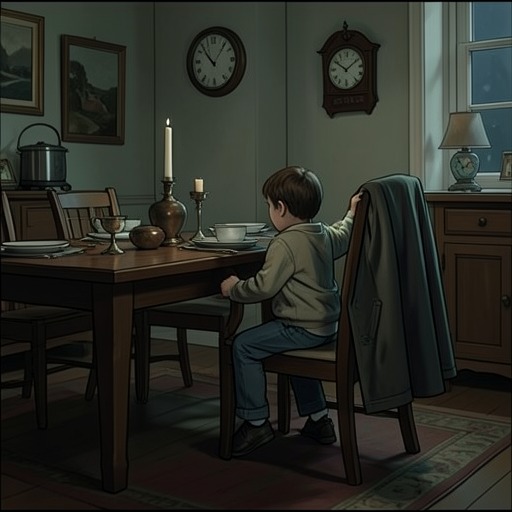
Hanno’s toy theatre
BuddenbrooksHanno’s toy theatre is the elaborate Christmas gift that brings his first encounter with opera into the family home as something he can stage and inhabit for himself. Requested after seeing Fidelio at the municipal theatre, it embodies his sudden passion for the theatre: not only for the music and story, but for the curtain, scenery, and act of performance. Its arrival delights Hanno, draws his uncle Christian into an improvised opera, and makes visible a conflict between artistic absorption and the practical life Christian believes he has failed to achieve.
Origin and expectation
Hanno’s desire for a theatre begins with a visit to the municipal theatre, where he sits beside his mother in the first tier and follows the music and action of Fidelio breathlessly. The experience leaves him thinking almost exclusively about the stage and its scenes; he can scarcely sleep. He envies people known to attend regularly, and imagines the pleasure of returning even once a week to hear the orchestra tune and wait before the closed curtain. His interest embraces the theatre as a whole, from its gas lamps and seats to its musicians and curtain.
The toy theatre therefore stands at the top of the list Hanno gives his grandmother, underlined several times. He wonders whether it will be large, what its curtain will look like, and whether he can cut into it a small peep-hole like the one at the municipal theatre. He also hopes that the scenery for Fidelio has been found. His imagined first use is private: the next morning, he means to shut himself away and put on a performance for himself. In his mind, music is already the link that joins the miniature figures to the living theatre he has seen.
The Christmas gift
When the family enters the room on Christmas Eve, Hanno spots the theatre at once, standing on the table, larger and grander than he had dared expect. But the arrangement of the gifts disorients him: he has been placed directly across from his position the year before, and he doubts whether the theatre is really meant for him. A large unfamiliar object on the floor adds to his uncertainty.
That object is a harmonium, which his grandmother has chosen because she knows he loves to play chorales. She explains that Herr Pfühl will give him the necessary lessons, and that playing requires him to pump the bellows with his feet while changing finger positions gradually. Hanno tries a chord; the instrument releases a gentle organ tone, attracting the attention of the family. He embraces his grandmother, who presses him gently to her. The harmonium momentarily overwhelms the toy theatre, but the abundance of presents soon draws him back to the stage.
The theatre’s details fulfill and extend his expectations. It has a shell-shaped prompter’s box and a red-and-gold curtain that rolls up majestically. The stage presents the final act of Fidelio: the prisoners stand with folded hands, Don Pizarro strikes a threatening pose in the foreground, and the minister, dressed in black, hurries in from the rear to set matters right. To Hanno, the arrangement resembles the municipal production and may be more beautiful still. The jubilant finale sounds in his memory as he sits at the harmonium, intending to play the passage he remembers.
A miniature stage in action
Hanno moves quickly between his gifts, as if trying to take in the whole Christmas display before settling on any one thing. After the theatre and harmonium come a red-bound book of Greek mythology bearing a golden Pallas Athena, sweets, marzipan, gingerbread, writing materials, and a penholder whose tiny glass sphere reveals a Swiss landscape when held up to the eye. These surrounding objects place the theatre within a lavish family celebration, but the stage remains the gift that draws him into imaginative play.
His uncle Christian approaches without the condescension the other adults show toward the treasures of a child. Wearing a new diamond ring given by his mother, he raises and lowers the curtain and admires the scenery. His pleasure is immediate, yet it gives way to seriousness. He asks whether Hanno requested the theatre, where the idea came from, and whether he has been to the theatre. On learning about Fidelio, Christian recognizes the connection and cautions Hanno not to spend too much time thinking about the stage, since it will not get him anywhere. He presents himself as a warning: he, too, has always been too interested in the theatre and has made serious mistakes.
The warning does not end the play. Christian falls silent, then brings a figure forward and sings in a hollow, croaking vibrato. He moves the harmonium stool to the front of the stage and performs an opera, gesticulating, conducting with his arms, and taking the different roles. Relatives gather behind him, laughing and shaking their heads; Hanno watches with genuine delight. The toy theatre has temporarily turned the family gathering into an audience and Christian into performer, making the adult’s caution and his own attraction to the stage coexist in the same scene.
Artistic pleasure and family inheritance
Christian’s performance stops abruptly when his familiar physical discomfort returns. He says he must stop as usual and describes the vague ache in his nerves. The toy theatre is not the cause of his distress, but the interruption gives the scene a pointed contrast: imaginative play briefly animates him, then the bodily complaint cuts it short. Hanno’s enjoyment is uninterrupted, while Christian’s pleasure is shadowed by his insistence that theatrical interest has cost him achievement.
The object thus carries more than a child’s Christmas wish. Its miniature scenes give Hanno a means to transform a recent theatrical experience into repeated, self-directed performance; his imagined Fidelio is not merely remembered but arranged, furnished, and heard again. At the same time, Christian’s divided response—first warning his nephew away, then joining the play with evident relish—shows how closely artistic desire is bound to regret in his view of his own life. For Hanno, the theatre opens a private world of music and invention; for Christian, it recalls a path he believes led nowhere. The stage can be lifted, lowered, and brought to life, but the scene leaves unresolved whether the pleasure it offers will remain play or become a defining vocation.