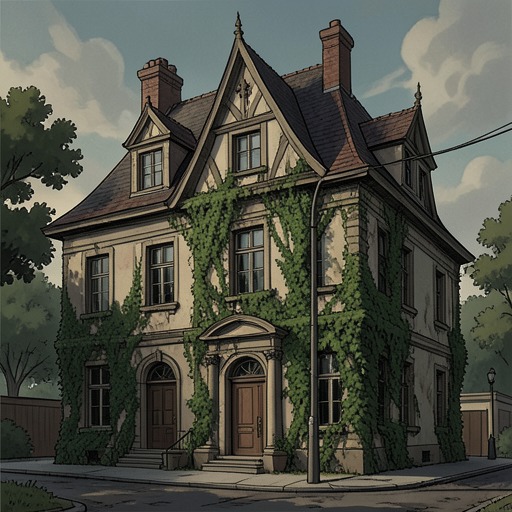
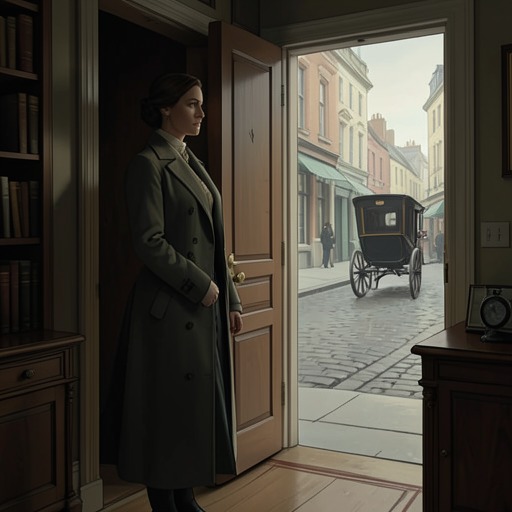
Buddenbrook family house on Meng Street
BuddenbrooksThe Buddenbrook family house on Meng Street is the family’s ancestral residence, a setting for its domestic rituals and a concrete emblem of continuity across generations. Its landscape room, family records, and remembered parental home connect private life to the Buddenbrook name; its eventual sale to Hermann Hagenström makes that continuity tangible but no longer secure. The house survives, but its ownership and use change, leaving Tony to encounter family memory in a place that has become someone else’s property.
House and Domestic Setting
The house had been purchased by the firm of Johann Buddenbrook, and the family had lived there only a short time when the narrative first describes it. On the second floor, the landscape room establishes its characteristic interior: thick wall coverings show idyllic eighteenth-century scenes, with shepherds, farmers, and vinedressers beneath yellowish sunsets. Yellow upholstery and curtains carry the palette across the white-enamelled furniture, while a harmonium, flute case, sewing table, and secretary give the room its domestic and cultivated character. A glass door opens the view toward a columned hallway; folding doors connect the room to the dining room, and a stove occupies a recessed niche. The house is not merely a backdrop: its rooms organize family conversation, memory, and ceremony.
That domestic world also reflects the family’s social position. Tony’s visits to her maternal grandparents’ country villa make Meng Street appear comparatively restrained: at home, she is reminded to help with dusting and is held up against the diligent example of Cousin Klothilde, while at her grandparents’ she can give orders to servants. The contrast places the house within a larger family landscape of different kinds of wealth and status, rather than presenting it as an isolated monument. Its importance comes from the lives and expectations gathered within it.
A Home That Preserves Family Memory
The family’s records are kept among the house’s furnishings. When Johann Buddenbrook reviews the family papers, he encounters a genealogy that reaches back to an ancestor in Parchim and traces descendants through Grabau and Rostock to the establishment of the grain business. The documents preserve business correspondence, citizenship certificates, insurance papers, family letters, a travel diary, and records of family events. Johann carefully puts the papers back into the secretary’s drawer. The house thus contains not only the family in the present, but an organized account of the past that successive members can consult.
Tony later reads the family chronicle in the house and discovers how thoroughly it records even ordinary milestones. Her birth, illnesses, schooling, confirmation, and enrolment at Mademoiselle Weichbrodt’s boarding school have all been entered. She reads the record as evidence that each generation belongs to an enduring family history, and sees herself as one link in that chain. In the genealogy, she finds an open space after her name and writes in her engagement to Bendix Grünlich, dated 22 September 1845. The house’s records do not simply preserve history after the fact: Tony’s act makes the family archive a place where a new life event is formally attached to the lineage.
The house also supplies the setting for family occasions. Tony and Grünlich’s wedding takes place in the columned hall, with relatives gathered in the residence and guests moving between the dining room and corridor during the celebration. Decades later, the Buddenbrooks’ centenary is marked by public ceremony elsewhere, but the date is brought to Thomas’s attention by Tony, the family records’ devoted keeper. These moments make the home part of a broader civic and commercial identity: the family’s domestic address and its business history are closely interwoven.
Inheritance, Deterioration, and the Decision to Sell
After Elisabeth Buddenbrook’s death, the house becomes an inheritance question as well as a family home. Tony asks Thomas what will happen to the furniture and whether the house is to remain with her, Erika, and the baby. Thomas explains that the property belongs to several heirs, including Christian and Pastor Tiburtius through Clara’s share, and says that a sale is the practical course. The decision is not his alone to make, but he believes the property should be sold as soon as possible.
His reasoning is material and specific. Since their father’s death, the rear building has deteriorated: a family of feral cats lives in the billiard room, and the floor is unsafe. Thomas also points to the family’s other real estate, including warehouses and two large homes, and argues that too much of its wealth is tied up in property in relation to its liquid capital. Having built the new house on Fischergrube, he sees no sensible alternative to selling the old one; selling the newer residence instead would mean losing much of the money invested in it. To Tony, by contrast, the house is their mother’s and parents’ home, the place where the family had been happy. Their disagreement sets sentiment and memory against Thomas’s assessment of the family’s property and finances.
Once an interested buyer is identified, Tony’s opposition becomes more direct. The prospective purchaser is Hermann Hagenström, a wholesale merchant and consul for Portugal, whose interest prompts arrangements for a visit to Meng Street. Tony insists that the sale must not happen while she is alive and objects to Hagenström as the prospective new owner. The landscape room, introduced as the family’s harmonious domestic space, becomes the focal point of this dispute: to Tony it stands for the home itself, not simply a marketable asset. Her protest does not reverse the decision. Hagenström visits the house with Siegismund Gosch, and the old residence becomes the subject of negotiation and transfer.
Sale and Afterlife
At the beginning of 1872, Elisabeth’s household is broken up. The servants leave, the furniture is divided and removed, and the family members establish themselves elsewhere: Thomas and his wife take items to Fischergrube, Christian moves to a small bachelor apartment, and Tony’s household settles into an apartment on Linden Platz. The Buddenbrook residence on Meng Street is no longer the family’s shared home. The dispersal gives the sale a domestic consequence before the building itself is altered: people and possessions that had belonged to a common household are separated among different addresses.
Hagenström acquires the property after outbidding an offer from a party in Bremen. He moves into the main house with his family, retaining its basic form while ordering repairs and modern improvements, including the replacement of the old bell ropes with electric bells. He has the rear building demolished and replaced by a new structure containing high-ceilinged storage rooms and shops facing Becker Grube. The property therefore remains useful and profitable, but the rear of the old household is remade to serve commercial purposes. Its transformation belongs to the changing fortunes of two merchant families: the Buddenbrooks relinquish the residence, while their rival makes it his own and adapts it to his needs.
Tony had vowed not to look at the old home again, yet her routes sometimes take her past the leased shop windows or the gabled front. Under the house’s traditional inscription, Dominus providebit, she sees Hagenström’s name. She weeps in public, despite the presence of passersby and her daughter’s efforts to console her. The tears register the limit of the sale’s financial logic: the building can be repaired, modernized, and made to earn rent, but those changes cannot restore its place in Tony’s family life. The house remains standing, yet its altered ownership makes the old promise of continuity visible as something the family has lost.
Significance in the Family’s Decline
The house’s history gives physical form to the novel’s account of generational change. Its rooms hold the Buddenbrooks’ domestic life, while its papers preserve a genealogy and record the acts through which each generation understands inheritance. Tony’s inscription of her engagement into the chronicle illustrates that the family home and its archive once allowed personal milestones to enter an apparently continuous history. The later dispersal of the household and the disposal of the house expose the fragility of that continuity.
The contrast between the old residence and Thomas’s newer home sharpens the change. Thomas’s investment in Fischergrube contributes to his practical argument for selling the deteriorating Meng Street property, but the newer house does not replace the old one in Tony’s memory. Her attachment is not reducible to the value of real estate: she objects because it is the home of her parents and the setting of shared happiness. The eventual sale consequently marks both a business decision and a rupture in the family’s relation to its past.
Hagenström’s renovations complete the reversal. He retains the main house, updates it, removes the old rear building, and turns its replacement into rentable commercial space. The family’s former residence thus passes from a household that treated its records and traditions as links between generations to an owner who makes the property serve current practical and commercial uses. Tony’s grief at the transformed threshold preserves the distinction between a house as an asset and a home as a vessel of collective memory; the novel lets the building endure while the family’s claim to it comes to an end.