Gerda Arnoldsen’s Stradivarius
BuddenbrooksGerda Arnoldsen’s Stradivarius is more than a mark of refinement: through its singing tone, brilliant virtuosity, and capacity to blend with piano and organ, it becomes a force in the family’s musical life. Gerda plays it in courtship and family gatherings, uses it to draw the resistant Edmund Pfühl toward newer music, and joins it to Hanno’s improvisations, where its sound helps make longing, delay, and release perceptible.
The Instrument and Gerda’s Musical Identity
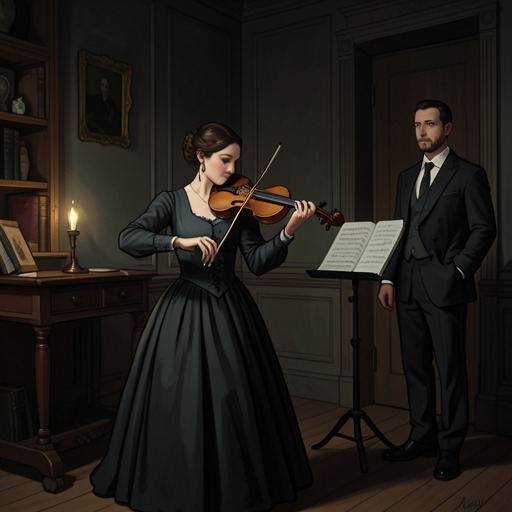
When Thomas first meets Gerda and her father, the violin is already central to the impression she makes. After Herr Arnoldsen plays concert pieces, Gerda performs on a genuine Stradivarius; Thomas, though he admits little knowledge of the finer points of violin playing, hears the instrument sing and finds the effect deeply moving. The scene makes the violin a meeting point between technical distinction and emotional response: its value is not only its celebrated identity but what Gerda can make it express.
At the engagement gathering in the landscape room, Gerda and her father play flamboyant duets beside the harmonium. She has brought the Stradivarius with her, as she never travels without it, and adds a sweet cantilena above her father’s passionate solo. The room’s earlier association with family music acquires a new voice: the instrument carries Gerda’s artistry into the Buddenbrook home, where the performance is both intimate family entertainment and a visible display of her musical confidence.
A Partner in Musical Change
Gerda’s playing also helps mediate the dispute between her enthusiasm for new music and Pfühl’s attachment to older musical standards. She persuades him to approach Wagner calmly, arguing that unfamiliar harmony can initially unsettle ears trained by earlier conventions. Pfühl remains unconvinced about Tristan, though he eventually adapts its Liebestod for violin and piano at her urging; his resistance gradually gives way to an attachment he is reluctant to admit. The violin is thus not simply the instrument of a soloist: in combination with the piano, it participates in the practical experiments through which Gerda changes Pfühl’s musical understanding.
That partnership extends to Hanno’s education. Gerda asks Pfühl to teach her son not merely keyboard technique but a serious understanding of music, and Pfühl’s Monday lessons soon move from elementary exercises to harmony and the relations among keys. His approach is designed to encourage musical comprehension and improvisation rather than burden Hanno with mechanical practice. The violin belongs to the surrounding musical world that makes this instruction possible: Gerda’s example, her playing with Pfühl, and her encouragement give the boy a model of music as expressive thought, not just accomplishment.
The Violin and Hanno’s Improvisations
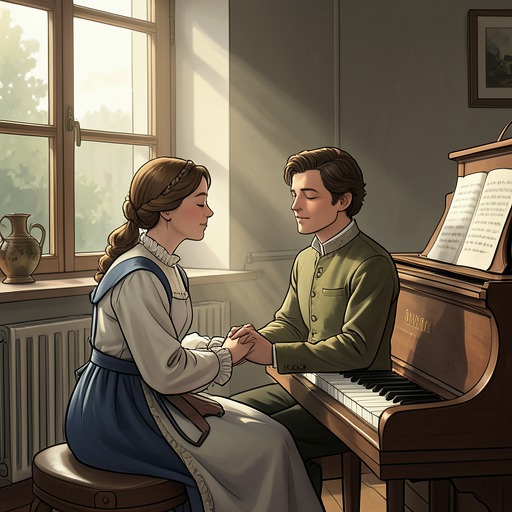
The instrument becomes an especially vivid partner in Hanno’s birthday performance. Pale with excitement, he plays a short, harmonically focused fantasia while Gerda accompanies him on the Stradivarius. Its sparkling runs frame the piano’s recurring E-minor tremolo and unresolved C-sharp dissonance. Hanno delays the return to B major, prolonging the strain before allowing the resolution to arrive; the violin’s bright, bell-like sound moves around the dissonance as he intensifies it. Their performance makes the instrument part of the structure of his musical expression, not a decorative accompaniment: its line sustains the tension that his piano part refuses to release.
Later, in a private improvisation, Hanno begins with a fragmentary theme, develops restless episodes of searching and distress, and lets a plaintive woodwind-like chorus emerge from the turmoil. The passage describes the music as taking shape beyond his conscious command. The Stradivarius is not identified as a participant in this later solo, so its significance lies instead in the musical relationship established elsewhere: it has already sounded alongside Hanno’s work and helped make the household a place where his inward musical life can be heard and supported.
Significance
Across these scenes, the Stradivarius connects several kinds of musical experience. In Thomas’s first encounter with Gerda, it makes skill immediately affective; at the engagement gathering, it joins generations in a shared performance; with Pfühl, violin and piano help test the boundary between old and new music; with Hanno, the instrument takes part in a performance whose suspense depends on an unresolved chord and its eventual release.
The novel gives the instrument a presence that exceeds its status as prized property. Its sound shapes how listeners respond, how musicians negotiate differences, and how Hanno’s fragile, intense sensibility finds form. The Stradivarius does not speak independently of its players, but neither is it a neutral prop: its tone, range, and interplay with other instruments materially help create the moments through which the family’s musical affinities become audible.