Hanno’s piano
BuddenbrooksHanno’s piano is more than an instrument for lessons or performance: it is where musical knowledge becomes a form of perception, and where Hanno can give shape to feelings that ordinary speech does not express. Guided by Edmund Pfühl and joined in music by Gerda, he first explores harmony as an intelligible world; later, alone at the keyboard, he improvises a searching and consuming musical arc that ends in exhaustion. The piano thus connects family instruction and shared performance with Hanno’s inward, increasingly solitary artistic life.
Instruction and Musical Understanding
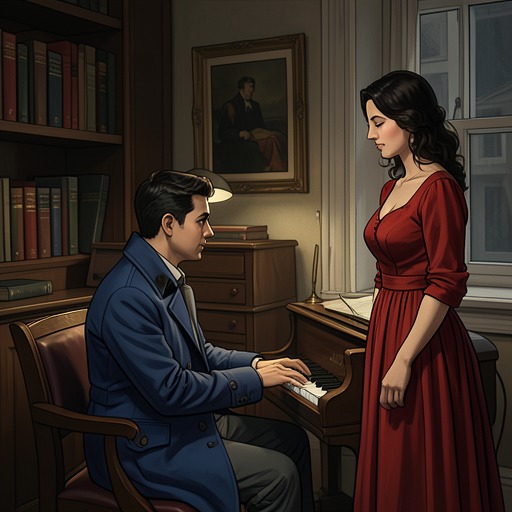
Edmund Pfühl’s teaching begins after Gerda asks him to instruct her son. She regards the piano as uniquely able to reproduce complex harmonies and give a listener an intimate, comprehensive relation to music; she wants Hanno taught not merely how to play, but how to understand. Pfühl agrees, and from then on comes on Monday afternoons to work with him while Gerda joins them in the living room.
The lessons quickly move beyond elementary exercises. Pfühl introduces music theory by demonstrating the fundamentals of harmony, which Hanno grasps as confirmation of something he has long felt he already knew. Rather than making dexterity at scales the governing aim, Pfühl tries to foster Hanno’s understanding of keys and their connections. He hopes that this will give the boy an intuitive command of the keyboard, enabling him to recognize possible combinations and improvise. He also takes care not to burden Hanno’s serious musical sensibility with banal little songs: he lets him play chorales and explains how one chord leads logically to another.
This approach makes the piano a meeting point between discipline and imagination. Its lessons supply Hanno with a vocabulary of relations—keys, progressions, and harmonic possibilities—without treating musical knowledge as rote technique. The instrument can be learned, but the purpose of learning is to widen what Hanno can hear and invent.
A Family Performance
The piano also gives Hanno a way to make music in company. On April 15, he and Gerda play together: she takes the violin’s treble melody and a variation on it, while he repeats his part. Hanno is especially attached to the minor chord and the ending, which Gerda finds amusing enough to keep. Their playing brings his composition into a shared form, and he is so happy afterward that he kisses her.
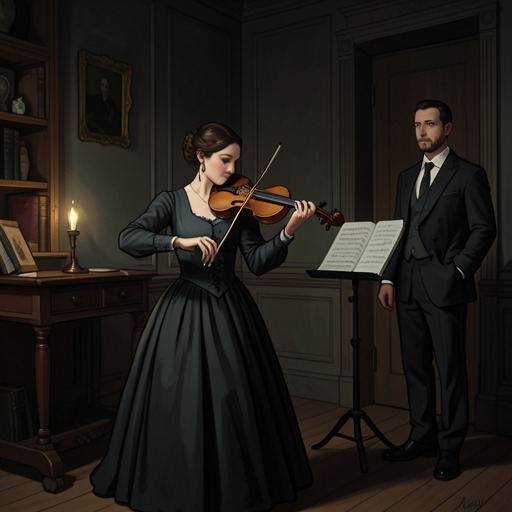
For his birthday, relatives and family acquaintances gather for a four o’clock dinner and then listen in the salon as Hanno sits at the piano in a sailor suit and Gerda plays the violin. Pale with excitement, he has scarcely eaten. His brief melodic fantasia lasts only about two minutes, yet the narration makes its emotional scale much larger than its elementary materials might suggest. The piece is more harmonic than rhythmic, and Hanno gives each modulation weight by tilting and bobbing his head, leaning toward the edge of his seat, and using the pedal to lend each new chord emotional force.
The piano part depends not on elaborate resources but on sensitivity to their possibilities. Hanno retards or accents simple harmonic manoeuvres, making them feel mysterious and precious; changes in his posture and attack give new chords a nervous energy. In the finale, he plays an E-minor chord tremolo pianissimo, gradually swells it, and intensifies a dissonant C-sharp that points toward a return to B major. Rather than resolving the tension at once, he delays the release. The music’s arrival at resolution becomes an experience of longing as much as a musical cadence: Hanno holds fulfilment back, then yields to it, his muscles relaxing and his head sinking back after the effort.
The Private Improvisation
A later music session with Gerda gives the piano a different role. After they play a Beethoven sonata, opus 24, she decides that her violin is out of tune and goes upstairs to rest. Hanno remains in the salon. He looks out at the wet front yard through the glass door to the veranda, then pulls the cream-coloured curtains across it. With the room dimmed to a yellowish twilight, he goes to the piano and begins to improvise.
The music starts from a tiny fragment: a bar and a half of an imagined melody. In the bass, it sounds powerful and declarative; when Hanno repeats and harmonizes it in the treble, the same material becomes a yearning descent from one key to another. The piano lets this small idea change character without losing its identity. Agitated runs and syncopations turn it into restless searching, while cries of fear gather into a plaintive woodwind-like melody. A contrite chorale follows, ending in a churchly cadence and a fermata. After the silence, the first theme returns softly, its simplicity now weighted by what the music has passed through.
The improvisation then surges into rebellion. Fanfaric accents and firmer rhythms introduce a stormy, defiant hunting-song character, while the first theme persists beneath it in distorted harmonies. The musical course does not feel fully controlled by Hanno; he allows a succession of episodes to take shape beneath his busy hands. In the culminating passage, ascending dissonance struggles toward a release that seems urgently necessary. Resolution arrives as a beautiful chord, followed by the first theme’s return and a lavish celebration of its possibilities across the keyboard. The same fragment is at once childish in its modest scope and made to carry a tumult of desire, pain, faith, and self-renunciation.
After the Music
The improvisation finally subsides. Its excesses drain away into a soft minor arpeggio that modulates upward, resolves into the major, hesitates, and dies wistfully. Hanno remains motionless, chin on his chest and hands in his lap. He closes the keyboard, pale, weak at the knees, and with burning eyes, then lies for a long time on a chaise longue without moving. The instrument has been the means of a powerful release, but the scene makes its cost physical: the music leaves him exhausted rather than simply satisfied.
That evening, Hanno plays chess with Gerda, their game ending in a draw. After midnight, he is again at a keyboard, this time at his harmonium, playing the improvisation only in his mind because noise is forbidden. The piano’s earlier music therefore continues beyond the performance as an inward possession. Across the lessons, the birthday duet, and the solitary improvisation, Hanno’s piano links acquired musical understanding to invention, and public family listening to an experience that can only be privately endured.