Hanno’s harmonium
BuddenbrooksHanno’s harmonium is both a practical instrument and a private space for musical thought. In the family’s landscape room, it stands opposite the round table, with a flute case resting on its lid; later, Hanno uses it alone to play Bach and to shape improvisations whose shifting harmonies make his inner life audible.
Appearance and Setting
The harmonium is introduced among the carefully arranged furnishings of the landscape room in the spacious house on Meng Strasse. The room’s pastoral wall coverings, yellow upholstery and curtains, and little objects on a fragile secretary create a composed domestic setting; the instrument faces a round, gold-detailed table, with a flute case on top of it. Its presence places music within the family’s cultivated household, rather than apart from its formal rooms and routines.
Music, Teaching, and Family
Music around the harmonium belongs to a wider exchange among Gerda, Edmund Pfühl, and Hanno. Pfühl, organist of St. Mary’s, initially resists the newer music Gerda admires, but she persuades him to listen and work at it; in time, he plays music from The Meistersinger with her. Gerda then asks him to teach Hanno not merely keyboard technique but an understanding of music. In the Monday lessons that follow, Pfühl moves quickly from elementary exercises to harmony, explains how keys and chords relate, and encourages the intuitive command that supports fantasy and improvisation. This teaching gives Hanno a vocabulary for music, but the evidence also presents his understanding as a recognition of something he already feels.
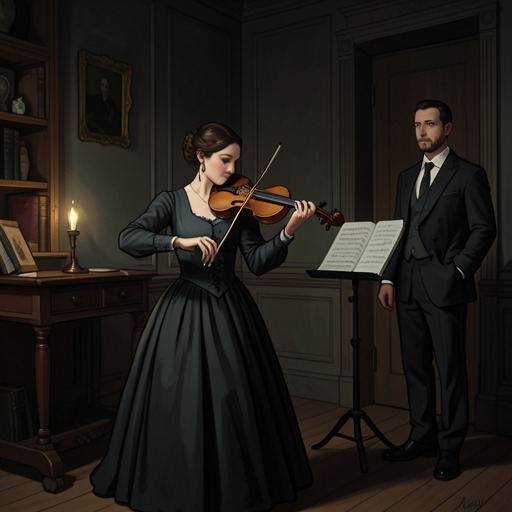
Hanno’s musical world is not confined to solitary practice. At his birthday gathering, he performs a short fantasia at the piano while Gerda accompanies him on violin. Its simple materials acquire force through the way he shapes them: he gives each new chord weight with the pedal, delays the resolution, and holds a dissonance until the release into B major. The harmonium is part of the same household world of music, but this performance makes clear that Hanno’s distinctive gift lies less in technical abundance than in the sensitive handling of harmony, tension, and expectation.
Solitary Playing and Improvisation
On a snowy day, after walking home with Kai, Hanno goes to his room, eats the lunch left for him, smokes a Russian cigarette, and plays a difficult, austere Bach fugue on the harmonium. The scene locates the instrument in a private retreat from the family’s social rooms and the grey wall outside his window. Later, after playing a Beethoven sonata with Gerda, he remains alone in the salon when she leaves to rest. He draws the cream-coloured curtains across the glass door, dims the room, and turns to the piano; the ensuing improvisation is thus distinct from his earlier harmonium playing, though it develops the same inward musical impulse.
The improvisation begins with a brief, plain fragment, first sounded in the bass and then repeated in the treble. It opens into unsettled runs, syncopations, cries of fear, a chorale-like passage, and a sudden return of the initial theme. From there the music gathers into defiant, fanfare-like gestures and a stormy hunting-song character, before its episodes spend themselves and subside through a minor-key arpeggio toward a hesitant major resolution. Hanno does not seem to control the whole course of the music; he lets it take shape, and afterward sits pale and physically spent. The instrument is therefore not simply a tool for rehearsing compositions: in solitude, music becomes a process that carries him through agitation and exhaustion.
The Instrument and Hanno’s Inner Life
The harmonium also marks the difference between audible performance and inward continuation. After supper and a drawn game of chess with Gerda, Hanno sits at it by candlelight well after midnight and plays only in his mind, because noise is not permitted at that hour. The silent playing extends music beyond the moment when the instrument can sound. Across the scenes, the harmonium connects formal musical learning, disciplined study of Bach, and solitary reflection; it offers Hanno a means of engaging with forms that the household’s social and practical routines cannot express for him.