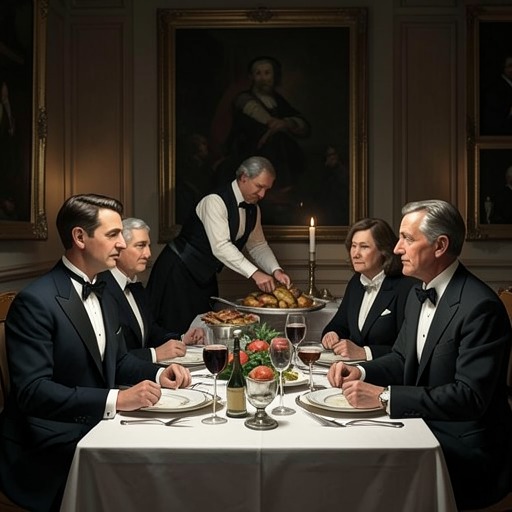
Buddenbrook housewarming at Meng Strasse
BuddenbrooksBuddenbrook housewarming at Meng Strasse marks the family’s entry into a spacious old residence recently purchased for the Johann Buddenbrook firm, making a homecoming into a display of domestic order, kinship, and civic standing. Its recurring dinners give the house a social life, while the family papers kept within it make the residence a repository of memory and inherited obligation.
The New House and Its Rooms
The gathering takes place in the landscape room on the second floor. Its thick wall coverings depict pastoral scenes in pastel colours: vinedressers, farmers, shepherdesses, lambs, and shepherds beneath yellowish sunsets. The yellow upholstery and silk curtains extend that palette across the white enamelled furniture, producing an interior where comfort and cultivated taste appear carefully composed. The room is spacious but sparsely furnished, with a harmonium facing a round table, stiff armchairs along the walls, a sewing table by the window, and a fragile secretary crowded with ornaments.
The house is not merely a picturesque backdrop. Through its glass door, the columned hallway appears in semidarkness; folding doors connect the room to the dining room, while a fire glows behind the wrought-iron stove door. Outside, cold rain falls across the street from St. Mary's Cemetery, and storm windows have been installed for the older Madame Buddenbrook. The contrast between the sheltered, ordered interior and the chill beyond it makes the house’s provision for family life tangible.
A Recurring Family Gathering
The housewarming belongs to a settled household routine: every other Thursday, the family gathers, and on this occasion relatives in the city and a close family friend are expected to join a simple dinner. As evening wanes and the clock approaches four, the company waits in the landscape room. The domestic gathering thus combines regular family practice with the larger social work of receiving guests.
The meal is introduced ceremonially, though without losing its air of familiar abundance. Johann Buddenbrook, senior, offers his arm to Madame Köppen and announces that the party may proceed if everyone has an appetite. Mamselle Jungmann and the kitchen maid open the white folding doors, and the guests move at an easy, confident pace toward the dining room, anticipating the nourishing hospitality associated with the Buddenbrook household. The scene makes food, service, and movement through the house part of the family’s public presentation.
Family Life and Social Performance
The residence also contains competing domestic ideals. During summer visits to her maternal grandparents, Tony enjoys a grand country villa with orchards, gardens, servants, and meals served in rooms opening onto a terrace. There, she can order the staff about; at Meng Strasse, her father and grandmother remind her to help with dusting and point to the devout, diligent Cousin Klothilde as an example. The contrast distinguishes the Kröger family’s aristocratic ease from the Buddenbrooks’ merchant household, where comfort coexists with expectations of work and discipline.
The house’s social life extends beyond its regular dinners. At Tony’s wedding, relatives and friends dance in the dining room and corridor, both strewn with talcum; Peter Döhlmann breaks crockery against the flagstones for good luck. The domestic interior can therefore shift from a site of measured hospitality to a crowded ceremonial space, accommodating the alliances and public rituals through which the family sustains its standing.
The House as a Storehouse of Memory
The Buddenbrook residence shelters more than its occupants. In the secretary, the consul keeps a leather case of family documents: the large gilt-edged notebook, old letters, citizenship certificates, insurance papers, congratulatory poems, business correspondence, travel records, and the record of Gotthold’s appeals to his father. The notebook traces the family line and records both commercial injunctions and intimate events, preserving the household’s sense that private lives belong to a continuous history.
Tony later finds the notebook left out and reads how even her birth, childhood illnesses, first day at school, boarding-school enrollment, and confirmation have been entered. The family’s restrained record-keeping gives these ordinary milestones weight as parts of a history understood through providence and inherited responsibility. Looking at the open space after her own name, Tony writes in her engagement to Bendix Grünlich, turning the family archive into a place where she can inscribe a decisive new event in her life.
The archive’s meaning changes with the next generation. Hanno studies the family tree among its old and newer handwriting, finds his own name beneath his parents’, and draws two lines across the page. The same genealogical record that gives Tony a sense of obligation becomes, for Hanno, an object of detached scrutiny and an occasion for a quiet, consequential mark. In this way, the house’s rooms and papers preserve the family’s claims of continuity while also revealing how differently its descendants inhabit them.