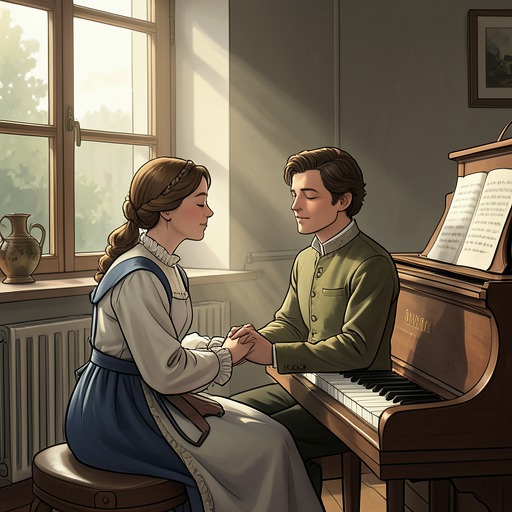
Thomas and Gerda Buddenbrook’s marriage
BuddenbrooksThomas and Gerda Buddenbrook’s marriage joins a decisive love match to a quiet, unusually respectful partnership, while unfolding within a family whose identity is measured through marriage, inheritance, and recorded succession. The town can see its outward signs—Thomas’s swift resolve, Gerda’s fortune, and their growing difference in age—but the marriage’s defining feature is a mutual trust that remains largely private and difficult for outsiders to interpret.
Courtship and Marriage
Thomas pursued Gerda with sudden certainty, declaring, "This woman or none," and the town understood that she had made an equally decisive choice. Until she was twenty-seven, Gerda had rejected every suitor in Amsterdam; then she accepted Thomas. People therefore judged theirs a marriage of love, even while recognizing the part played by Gerda’s three hundred thousand in wealth. The money mattered, but was regarded as secondary to the attachment.
The marriage’s public beginning belongs to the family’s social world of ceremony and display. At the wedding celebration, the dining room and corridor were dusted for dancing, guests from the Buddenbrook and Kröger circles gathered, and Thomas’s friends mingled with Tony’s. This elaborate occasion provides a contrast to the private character later attributed to the couple: the marriage was conspicuous as a social event, but its intimacy was not openly performed for others.
A Private Form of Intimacy
The town saw little of what it expected love to look like. From the beginning, observers noticed instead a correct courtesy between husband and wife, unusually formal for a married couple. The narration distinguishes this reserve from coldness: their manners seem to arise from a peculiar, silent, and profound mutual trust, from knowing one another and showing unfailing consideration and tolerance. The relationship is intimate precisely in a register that offers few public signs of intimacy.
This private bond takes shape within the household and its established domestic order. The Buddenbrooks’ landscape room, in the spacious old house on Meng Strasse, combines carefully arranged furniture, a harmonium, and a flute case with decorative pastoral scenes. The home is also a place where family life and family memory meet: the family records preserve births, childhood illnesses, journeys, and business history, treating even ordinary events as part of a continuing inheritance.
Marriage, Family Memory, and Inheritance
The Buddenbrook chronicle makes marriage one of the links through which family history is organized. Thomas’s mother reads the record of her own birth, illnesses, schooling, and confirmation as evidence that even modest personal events belong to a larger family story. The genealogy traces the line through successive marriages and records the wedding of Consul Johann Buddenbrook and Elisabeth Kröger in 1825, followed by their four children. In this framework, a marriage is both a personal relationship and a point in a documented sequence of generations.
That tension between family continuity and individual attachment recurs in the couple’s later circumstances. Thomas’s mother’s estate is substantial, yet the family’s capital has been divided by dowries, payments to relatives, business losses, and other demands. Thomas responds to the scale of the inheritance not simply as private wealth but from the standpoint of the firm, lamenting how family distributions have reduced the capital available to it. The marriage’s social and economic setting therefore includes obligations extending well beyond the couple themselves.
Time, Public Appearance, and Ending
As the years pass, the most visible change is the widening contrast in the spouses’ ages and appearance. Thomas grows stout and appears to be aging quickly, while Gerda remains tall, slender, and little changed in the eyes of the town. Her reserve and devotion to music feed speculation among people who know little about her; some assume she is unfaithful, but the account presents that suspicion as a product of gossip and limited understanding, not as a fact about the marriage.
Thomas’s public composure also becomes labor. On the day of the firm’s centenary, he prepares to receive visitors, answer a hundred congratulations with tact, and attend a long banquet, while privately feeling the return of his old gloom. The anniversary is a reminder of the family enterprise’s long history, but it does not resolve his inward strain. Later, his will directs that the firm be liquidated and dissolved within a year. Tony grieves that the venerable business will end despite Thomas and Gerda’s son, Hanno, being its legitimate heir; she consoles herself that the end of the firm need not mean the end of the family. The marriage thus remains part of a lineage whose continuity the records promise, even as the institution most closely associated with that lineage is brought to a close.