1848 Lübeck Assembly riots
BuddenbrooksThe 1848 Lübeck Assembly riots bring the political upheaval of the year into the private and civic world of the Buddenbrooks. A dispute over who may vote becomes a tense confrontation between the city council and a crowd of workers and townspeople, but the standoff ends not in an assault or a decisive political settlement: Consul Johann Buddenbrook speaks with the demonstrators, whose confused demand for a republic gives way to laughter and dispersal. The episode makes political order feel at once fragile and oddly recoverable, dependent on the same social hierarchies and personal authority that the unrest puts under pressure.
Political Background
The confrontation grows from an unresolved argument about Lübeck’s constitution and franchise. A new constitution had been drafted and adopted by decree of the Senate despite objections from Lebrecht Kröger and other older citizens. Elections followed, and a representative assembly met, but the political settlement did not quiet the city. Disagreement persisted over how voting qualifications should change and who should count as a citizen, including whether citizenship requirements should be eased for non-Christians.
The division cuts across the city’s governing and commercial circles. Johann Buddenbrook supports retaining restricted voting rights; Hinrich Hagenström is associated with the opposing demand for universal franchise. Others advocate a form of restricted universal suffrage. The competing formulas make the dispute institutional, but the scene also registers a wider fear that inherited distinctions between citizens and inhabitants, and the social privileges attached to them, are being unsettled. In the Buddenbrook household, the cook Trina’s prediction that she will one day sit on the sofa in a silk dress while her employers serve her gives the political language an immediate domestic echo: arguments about rights reach into the ordering of everyday service and status.
The Council Under Threat
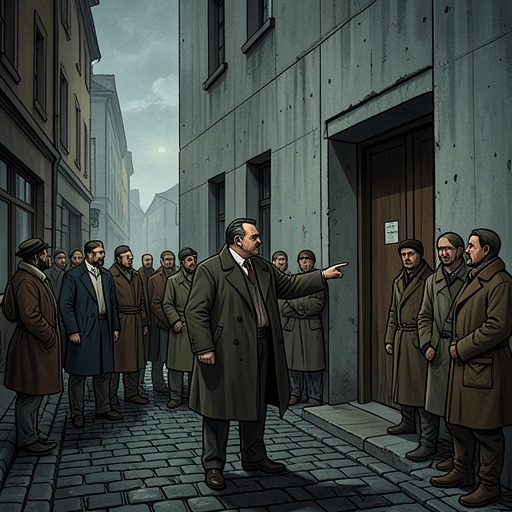
On an early October day in 1848, unrest already visible in the streets draws closer to the Buddenbrook home. Shouts, whistles, and the sound of many feet approach; Elisabeth Buddenbrook recognizes the disturbance as a revolution and orders the front door bolted. The alarm at home gives way to a more public crisis when Johann attends a council meeting. The assembly is held in a bare room belonging to a beer-and-dance hall, reached through a narrow, low door. Of the council’s 120 members, about a hundred have gathered, while some rural representatives stay away because of the circumstances.
Before the meeting has formally opened, the council hears that a crowd is coming to threaten it. Wenzel, a barber and council member, reports that the mob is not heading for the town hall or market square, but for the assembly; he identifies newspaper editor Rübsam as its instigator. The council’s members had gathered to decide between restricted voting rights and universal franchise, but now they hesitate to proceed. The Senate has proposed universal franchise, yet the men fear that any decision could provoke the crowd. A chairman reminds them that minutes must be presented to the mayor within three days and that the public expects them in print, but even a vote on whether to open the meeting finds no support. The clock of St. Mary’s strikes half past four as the council chooses to wait rather than risk antagonizing the demonstrators.
The threat turns the meeting into an uneasy vigil. Outside, the noise swells and fades; inside, the councillors gradually settle on the benches and resume business conversations, even striking deals, as if waiting out a thunderstorm. Their composure is imperfect: the narrow door raises fears of being crushed in a retreat, and the crowd’s cries of The vote! and Our rights! keep the political dispute present. The contrast between the assembly’s ordinary commercial habits and the demonstration outside reveals how readily civic procedure can be suspended when the established order feels exposed.
Confrontation and Reversal
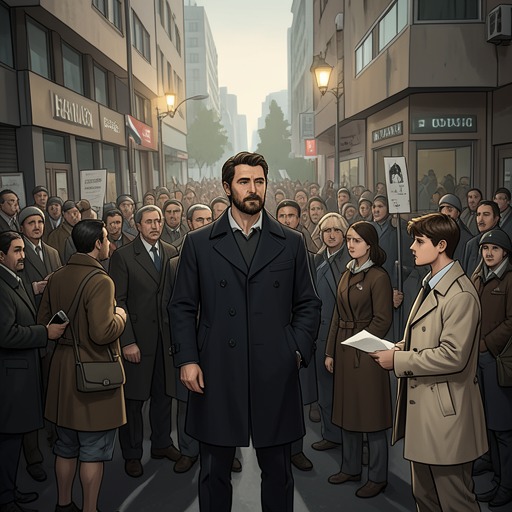
When Johann finally leaves the hall, broker Siegismund Gosch declares that he will accompany him, despite the danger. At the entrance, the scene is less like a military assault than a makeshift street gathering. The crowd consists of young dock and warehouse workers, porters, schoolchildren, and sailors, along with a few women. Some of the demonstrators have sat on the curb with their feet in the gutter to eat sandwiches. The lamps above the street remain unlit shortly before six, an unprecedented breach of public order that at last makes Johann lose his temper.
Rather than remain inside or address the crowd from a distance, Johann speaks to Corl Smolt, a young warehouse worker standing below the steps with his hat in his hand and bread still in his mouth. Smolt says that events have come to a pass and that they are making a revolution. Pressed to explain what he wants, he answers that the crowd wants a republic. Johann points out that Lübeck already has one; Smolt replies that they want another besides. The contradiction punctures the tense political performance. People who understand the joke begin to laugh, and their laughter spreads through the crowd until the demonstrators are in a broadly amiable mood. From the assembly windows, some councillors watch with beer mugs in hand.
The reversal is not a resolution of the franchise dispute. Johann simply urges the crowd to go home, and Smolt accepts that the moment can rest, expressing relief that the consul has not taken offense. The demonstrators begin to disperse in good spirits. Even as the encounter dissolves, Johann turns to a practical matter, asking whether the Krögers’ carriage has arrived through Burg Gate; Smolt confirms that it has and that it is somewhere nearby. The return of an ordinary concern at the scene’s close helps make the episode’s ending deliberately anticlimactic: a political confrontation ebbs into everyday conversation rather than culminating in force.
Political and Social Significance
The episode sets the vocabulary of reform against the material and personal structures of civic life. The council debates voting rights in a room lent by a widow who owns a beer-and-dance hall; a barber who serves the leading families has become his patrons’ equal in the council through local knowledge, affability, and self-confidence. His presence shows that civic participation can cross social boundaries, even as the larger argument over who is entitled to political voice remains unresolved. The demonstrators, meanwhile, are not an abstract mass but workers and youths drawn from the less prosperous streets, including employees of Johann’s own business.
Johann’s intervention both acknowledges and contains the challenge. His authority as consul allows him to question a worker directly, and the worker’s halting, contradictory explanation makes the crowd’s political demand appear less coherent than its cries of rights had suggested. Yet the humor does not erase the causes of the unrest: the constitution and the franchise remain contested, and the council has postponed rather than settled its decision. The event therefore offers no clear triumph for either side. Its fragile calm depends on a personal exchange that briefly turns hierarchy into familiarity, while leaving the political conflict intact.
The novel later returns to the day as part of the family’s recollection of revolutionary unrest. In that retrospective place in the story, the confrontation stands as a compact image of a city and family trying to preserve continuity amid changing political expectations: the crowd disperses, the council survives the immediate threat, but the demands that brought people into the street have not disappeared.