Hanno Buddenbrook’s Travemünde holiday
BuddenbrooksHanno Buddenbrook’s Travemünde holiday is a four-week season of ease whose central consequence is not physical renewal but a lasting inward refuge. Away from school, the Hagenström boys, and the scrutiny of adult expectations, he discovers a life paced by the beach, music, and the sea; when he returns to town no stronger, he carries the remembered sound of the waves as comfort against the demands awaiting him.
The Holiday’s Unhurried World
The first days seem to Hanno almost limitless, though the narration calls them a mere twenty-eight days. Ordinary routines are transformed by small unfamiliar pleasures: breakfast on a balcony or beneath a chestnut tree near the children’s playground, a waiter spreading a hastily laundered tablecloth, tissue-paper napkins, unfamiliar bread, eggs served in metal cups, and everyday teaspoons unlike those used at home. Such details give the holiday its texture. Delight lies less in grand events than in the freedom to notice what daily life ordinarily passes over.
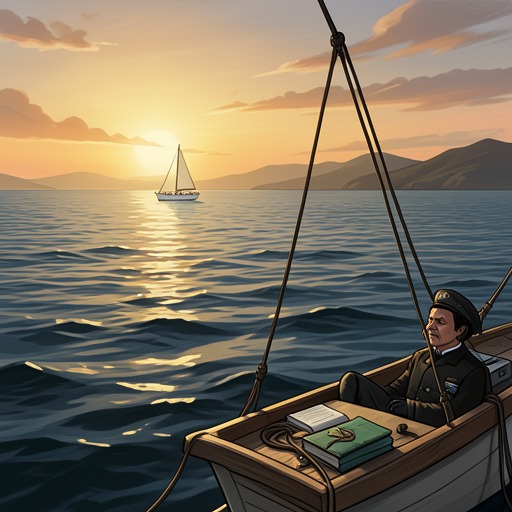
The day has no strict schedule. Mornings are spent resting beside wicker beach chairs while the band plays, drifting into quiet games in soft sand, looking across the green-blue sea, and swimming in clear water with sand underfoot. A walk toward Seagull Rock or the Temple of the Sea, a snack in the chair, and a nap complete a rhythm organized around ease rather than obligation. The setting is not simply a change of scenery: it suspends the pressures that define Hanno’s life at home and makes time itself seem generous.
That ease has limits. On Sundays, when his father joins the family, the resort fills with visitors from town. Hanno resents the day-trippers and would rather wait in his room until they leave. He also feels his father’s critical attention, ordinarily absent during the working week, fixed on him throughout Sunday. Even in the holiday landscape, the adult world intrudes; the respite depends on distance from the people and judgments that make him self-conscious.
A Holiday Measured by Changing Weather
After fourteen days, Hanno insists there is still plenty of time, comparing the remaining vacation to the Michaelmas holidays. The reassurance cannot stop the change in his sense of time. The holiday has reached its peak, and each remaining hour seems to hurry toward its end. He wants to hold on to every breath of sea air, converting the passage of time into a source of anxiety even while he remains surrounded by beauty.
The weather makes that passage tangible. Northeast winds drive a dark green flood tide onto the beach, scattering seaweed, mussels, and jellyfish and threatening the pavilions; great waves gather and crash onto the sand. At other times a west wind pulls the sea back, exposing sandbanks, while rain blurs the boundaries of heaven, earth, and water and streams down the windows. Hanno spends such days at an upright piano in the hotel lobby. Its muted, gurgling tone differs from the richer sound of his grand piano at home, but it enables amusing effects and keeps music within reach even when the beach is inaccessible.
The calm days offer a different image: heat, blue sky, flies above the Leuchtenfeld flats, and a sea lying still as a mirror. But no condition holds. With three days left, Hanno again pretends there is ample time, now comparing it to the Pentecost holidays; even he no longer believes the calculation. The recurring attempts to deny the approaching end make the four weeks feel both abundant and painfully brief.
Departure and the Failed Promise of Renewal
When the holiday ends, a carriage waits outside the hotel, packed high with luggage. Hanno has already said goodbye to the sea and beach; now he takes leave of the waiters, the band shell, and the rose beds as the staff bow and the carriage pulls away. On the ride, he looks back toward the lighthouse. Ida Jungmann tells him they will return the next year, and the promise is enough to bring tears to his eyes.
The journey back makes the separation from the shore concrete. The carriage passes the village, the Trave, and the people who will remain there. Hanno leans into a corner and avoids looking at Ida; later, after the last houses, he takes one final look at the lighthouse and closes his eyes. His farewell is not a clean break: the promise of another visit offers consolation, while his tears register how much the present one has come to mean.
The intended bodily result does not follow. Although his face and hands are browned by the sea air, the four weeks have not made him stronger, fresher, more energetic, or more robust. Hanno understands that he has instead become softer, dreamier, more spoiled, and more sensitive. Schoolwork that already frightens him—Herr Tietge’s ratios, historical dates, and grammatical rules—seems even harder to face. The vacation’s gift and its cost are therefore inseparable: it has deepened a private imaginative life without preparing him to meet the demands of the public one.
Return to Town and the Sea as Refuge
On the journey home, Hanno begins to recover some spirit by thinking of Kai, Herr Pfühl, his music lessons, his grand piano, and his harmonium. He remembers that the first day of school will be Sunday and therefore harmless. A little sand remains in his high-buttoned shoes, and he wants Grobleben to leave it there forever. The detail makes the return feel less like an erasure than an attempt to carry a physical trace of the beach into town.
The carriage passes through the Burg Gate, by the prison where Uncle Weinschenk is held, and down Fischer Grube. At home, the senator comes out from his office to greet the family, his pen still in hand. Hanno’s private holiday world has ended; the route delivers him directly back into the household, school, and family pressures from which he had briefly escaped.
In the days after his return, he learns again to miss the sea, to fear school, and to endure boredom. He keeps watch for the Hagenström boys and finds solace in Kai, Herr Pfühl, and music. The adult women ask how he feels about school with teasing winks that treat his concerns as a joke, sharpening the distance between the seriousness of childhood anxieties and adult amusement. The holiday has not resolved that mismatch; its memory instead gives Hanno somewhere inward to retreat.
His most durable consolation is the remembered sound of little waves splashing against the rampart from a remote, mysterious distance. When life’s hardships bear down, the thought of the sea and hotel gardens can put him beyond their reach. The holiday thus matters less as a successful cure than as an experience Hanno can preserve: a brief, sensory world of freedom that remains available to him when ordinary time resumes.