Gotthold Buddenbrook inheritance dispute
BuddenbrooksGotthold Buddenbrook inheritance dispute is a contest over whether Gotthold, the eldest son estranged from his father, Johann Buddenbrook, should receive compensation for a share in the family’s house on Meng Strasse. Its immediate claim is financial, but its stakes reach beyond the house: the argument tests who belongs to the family’s inherited wealth and who will control the capital supporting its business. The dispute’s eventual settlement is not a restored relationship but Gotthold’s withdrawal of his claim, leaving the division of inheritance to proceed on other terms.
The claim and its background
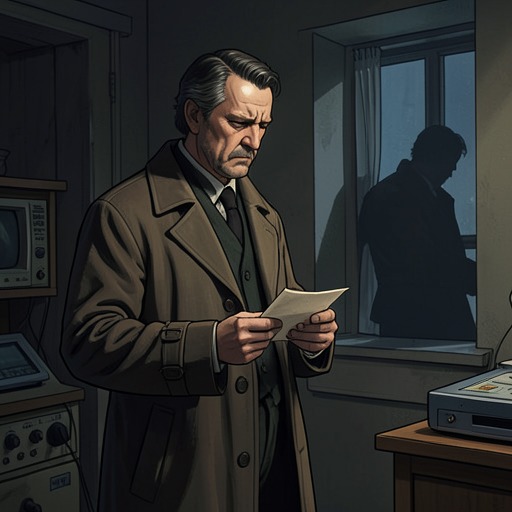
At a family gathering, Jean Buddenbrook discovers a third letter from Gotthold, arriving that afternoon. Its arrival abruptly changes Jean’s hospitable manner: he draws his mother aside and worries that bringing the letter to his father will spoil the day. The family’s ordinary gathering thus becomes the setting for a conflict that has already been developing through unanswered correspondence.
In his letter, Gotthold connects his demand to the estrangement that followed his marriage and decision to take charge of a retail business, choices he says offended his father’s pride. He points out that Johann had paid him 100,000 marks courant to establish his business and promised another 100,000 as his inheritance share, but argues that he did not then understand the scale of his father’s wealth. Now, in response to the purchase of the Meng Street house for about 100,000 marks, he claims 33,335 marks courant as compensation for one-third of its price. The letter frames the demand both as a claim of justice and as a judgment on their damaged father-son relationship.
The dispute occurs against a longer history of family accounting. The family notebook traces generations of Buddenbrooks, recording marriages, births, illnesses, and business succession in the same measured chronicle. Its account of Johann’s children includes Gotthold’s place in the family alongside that of Jean and the other siblings. The formal record asserts continuity, while the dispute reveals that membership in the family does not guarantee equal participation in its property.
Johann’s refusal and Jean’s calculation
After Johann reads the letter, Jean weighs the competing payments in terms of the family business. Paying Gotthold’s requested 33,335 marks as well as 15,000 to the Frankfurt branch would cost more immediately than paying Frankfurt 25,000 alone. More consequentially, Jean argues that granting Gotthold compensation could open the way for a later inheritance claim on the same basis as his siblings, withdrawing capital that Jean expects to control as the firm’s sole owner. He advises his father not to give in. The dispute is therefore not simply a question of the house’s price: Jean treats the precedent as a threat to the business’s future capital.
The numbers later discussed within the family show the broader pressures behind such calculations. In an account of the estate, Jean lists the 80,000-mark dowry sent to Frankfurt, the 100,000 spent to establish Gotthold in business, the cost of the Meng Street house and its improvements, and further compensation paid to Frankfurt. His figures present family transfers as deductions from resources that might otherwise remain at the firm’s disposal. After Johann’s death, the estate is estimated at roughly 750,000 marks courant apart from real estate, despite earlier business losses and withdrawals for family members. The figures do not settle Gotthold’s moral claim, but make clear why Jean understands inheritance as a business problem as well as a family obligation.
Renewal and renunciation
After Johann’s death, Gotthold meets Jean and asks whether anything has changed. Jean answers that it has not: their father’s decision stands. Gotthold then asks whether he can expect justice from Jean, transferring the unresolved claim from father to half-brother. Their exchange shows that the death of the person who made the refusal does not itself repair the rift or end the dispute.
At Johann’s funeral, however, Gotthold reappears with his wife and three grown daughters. Riding back from the family burial plot with Jean, he adopts a conciliatory tone and says he has come to understand that Jean had to proceed as he did. He does not want to retain hateful memories of his father and renounces his claim. He adds that he intends to retire from his linen business, which no longer gives him pleasure and is not profitable enough to justify further investment, and to live quietly on his inheritance and the proceeds from selling the business. The dispute ends through relinquishment, not through an award of the requested house compensation.
The family record and the later settlement
The inheritance question echoes through the family’s record-keeping. Tony reads that notebook as a sacred account in which even ordinary events—her birth, childhood illnesses, schooling, and confirmation—deserve to be entered. The entries make each person part of a chain of descendants expected to continue the family history. Yet Gotthold’s dispute exposes the material limit of that ideal: a place in the genealogy and a claim upon the family’s past do not ensure an equivalent share in its present wealth.
Later, when Thomas’s will directs that the firm be liquidated and dissolved within a year, Tony is distressed that Hanno, the sole heir, will not inherit a continuing business. She takes comfort in imagining that he can establish a new enterprise and renew the family name. The firm is nevertheless sold off under time pressure, with contracts, warehouse goods, and stored grain disposed of on disadvantageous terms. This later dissolution does not resolve Gotthold’s earlier dispute, but it sharpens its significance: across generations, the family treats inheritance as a means of preserving both capital and continuity, while its actual decisions repeatedly divide, withdraw, or dissipate the resources on which that continuity depends.